Most Canadian homeowners with solar panels assume they are protected during a blackout. They are not unless they also have a battery.
This is the single most misunderstood fact in residential solar. Your solar panels generate electricity in full sunlight. But the moment the grid goes down, your system shuts off automatically. No battery means no power even on the brightest day of the year.
This guide explains exactly why that happens, how a solar battery backup system fixes it, what it can realistically power during an outage, how long it lasts, and what it costs Canadian homeowners in 2026.
Why Solar Panels Shut Off During a Power Outage
This is the question that surprises nearly every solar homeowner the first time they experience a blackout.
Your solar panels are physically generating electricity. The sun is out. Your inverter is working. And yet, your home is completely dark.
The reason is a safety protocol called anti-islanding protection. When the utility grid goes down, repair crews go out to work on damaged power lines. If your solar panels kept pushing electricity into those lines while crews were on them, the result could be fatal electrocution.
The Canadian electrical code and the law in every province require grid-tied solar inverters to detect a grid failure and shut down within milliseconds. Your system is not broken. It is doing exactly what it is designed to do.
The problem is the outcome: a house with a functioning solar array sitting dark during a daytime outage, wasting every kilowatt the sun is producing.
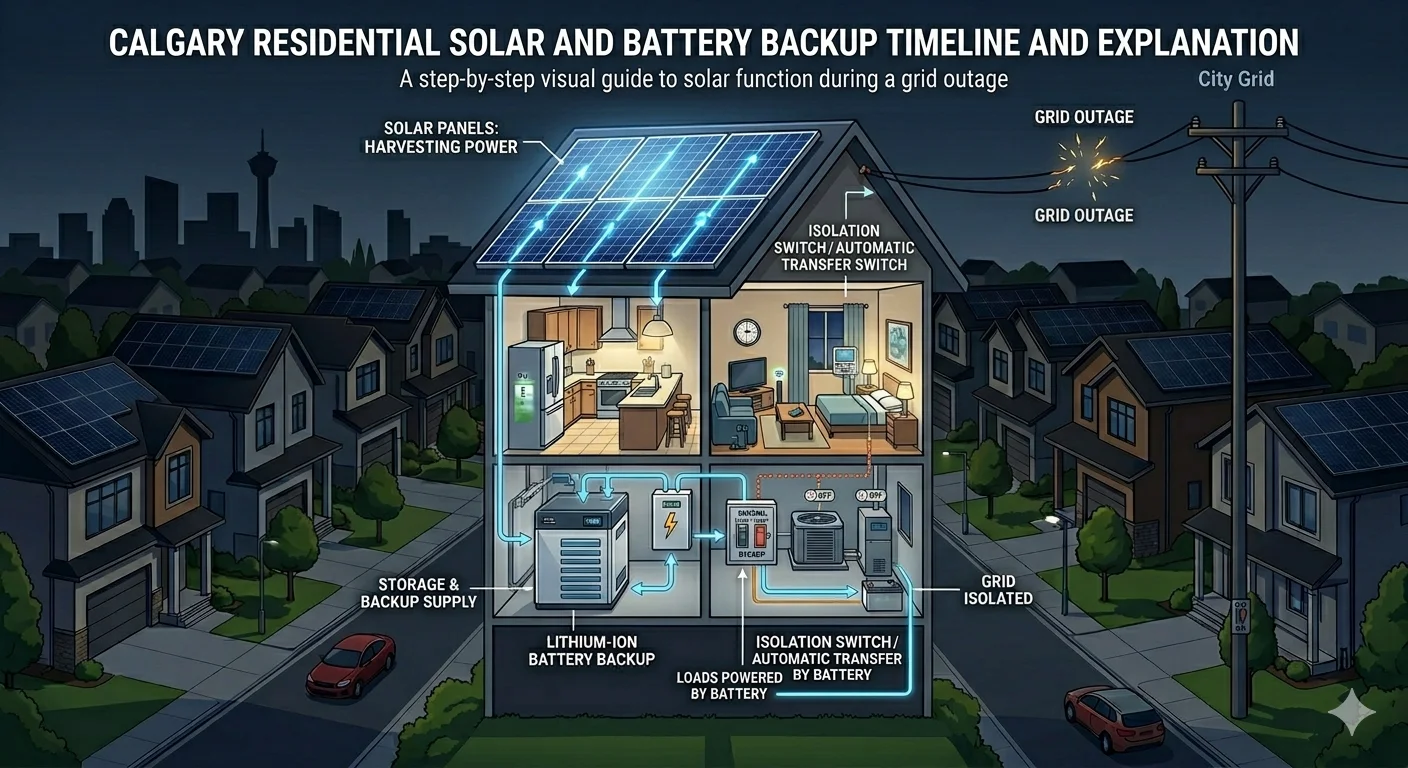
A solar battery backup system with a hybrid inverter solves this completely. The hybrid inverter detects the grid failure, immediately disconnects your home from the utility lines, and switches your solar system into island mode, a safe, self-contained power loop that only serves your property. Your solar panels keep generating. Your battery keeps storing and dispatching power. Your home stays on.
How Solar Battery Backup Works During a Power Outage Step by Step
The mechanics differ depending on whether the outage hits during the day or at night. Here is exactly what happens in both scenarios.
Daytime Outage: How Solar Panels and Battery Work Together
When the grid fails during daylight hours, your hybrid inverter detects the loss of the grid signal and triggers island mode in under 20 milliseconds, fast enough that most homeowners never notice the lights flicker.
From that point, your solar panels continue generating electricity exactly as they normally would. On a clear Canadian day, a well-sized rooftop system often covers your home's real-time energy demand without the battery needing to contribute at all.
But solar output fluctuates. A cloud passes over. An appliance cycles on with a startup surge. In those moments, the battery steps in automatically, dispatching stored energy to bridge the gap without any interruption.
Any excess solar generation that your home does not consume in real time flows into the battery, keeping it topped up throughout the day.
Nighttime Outage: Why Your Home Battery Backup System Carries the Load
After sunset, your solar panels produce nothing. A nighttime outage means you are running entirely on whatever energy is stored in your battery.
The transition is automatic and immediate. Your home battery backup system detects the grid failure, switches to battery power in milliseconds, and begins supplying electricity to your essential circuits.
This continues through the night. By morning, your solar panels begin generating again, recharging the battery and powering your home simultaneously. If the grid is still down, this cycle repeats, giving your household a genuine off-grid solar backup capability for as long as the sun continues to rise.
What Happens to Solar Panels During a Power Outage Without a Battery?
Without battery storage for solar panels, here is the exact sequence of events during a grid failure:
1. The grid goes down. Your hybrid inverter, or more accurately, your standard string inverter detects the loss of the grid signal.
2. The inverter shuts down to comply with anti-islanding requirements. Your home loses power.
3. Your solar panels continue generating DC electricity on the roof. But with the inverter offline, that electricity has no safe path into your home.
4. Every kilowatt your panels produce is wasted. The energy is simply lost until the grid returns and your system restarts.
5. You are now in the same position as every other neighbor on the street: no power, no timeline, and waiting for the utility to restore service.
A solar battery system for the home changes this entirely. The battery and hybrid inverter together allow your system to legally and safely operate in island mode, keeping your solar panels active and your home powered throughout the outage.
Solar Battery During Power Outage: What Can It Actually Power?
The most common question. And the most important one to answer honestly.
Most residential solar battery during power outage setups are configured around essential loads not whole-home backup. The goal is to keep the things that matter running for as long as possible, not to replicate your normal energy consumption.
Here is a realistic picture of what a home battery backup system can support, and how much power each load uses:
Appliance | Average Draw | Daily kWh Used |
Refrigerator + freezer | ~150–200W | ~1.5 kWh/day |
LED lighting (10 bulbs) | ~100W | ~0.8 kWh/day |
Wi-Fi router + modem | ~20W | ~0.5 kWh/day |
Phone + laptop charging | ~60W | ~0.5 kWh/day |
CPAP machine | ~30–60W | ~0.3 kWh/day |
Gas furnace fan | ~400–800W | ~0.5 kWh/day (cycling) |
Sump pump | ~400–800W | ~0.3 kWh/day (cycling) |
Essential load total | ~750–1,000W | ~4.4–4.9 kWh/day |
Central air conditioner | ~3,000–5,000W | ~12–15 kWh/day |
Electric stove / oven | ~2,000–5,000W | Varies |
Electric dryer | ~4,000–6,000W | Varies |
What this tells you: A 10 kWh battery running essential loads only uses roughly 4–5 kWh per day. That means one battery can realistically power your critical circuits for 24 hours or longer before solar recharge is even needed. Air conditioning and high-draw appliances are possible, but they require a larger system and careful load planning.
Medical devices, food preservation, lighting, communication, and your gas furnace fan are all well within the reach of a properly sized home battery backup system.
How Long Does a Home Battery Backup System Last During an Outage?
There is no single answer, but here are realistic benchmarks for Canadian homes based on current battery sizes:
System Size | Essential Loads Only | With Daytime Solar Recharge |
10–13.5 kWh (1 battery) | 12–24 hours | Indefinite for essential loads |
20–27 kWh (2 batteries) | 24–48+ hours | Indefinite for essential loads |
30–40 kWh (3 batteries) | 3–5 days | Indefinite; whole-home backup possible |
The Canadian winter variable: These numbers assume a summer or mild-weather scenario. In January in Ontario, Alberta, or Atlantic Canada, two things happen simultaneously: solar recharge windows shrink to 6–7 hours of useful generation, and heating loads increase dramatically. A system sized for a summer outage may deliver significantly less backup time in mid-winter. Always ask your installer to run a January scenario, not just a July one.
The 80% rule: Most LFP batteries operate at 80–90% depth of discharge to protect cycle life. A 13.5 kWh battery has approximately 10.8–12 kWh of usable capacity. Factor this into runtime calculations the label capacity and the usable capacity are not the same number.
How to Choose the Right Battery Storage for Solar Panels in Canada
Sizing battery storage for solar panels correctly is where most installations either succeed or fall short. Here is a practical framework:
Step 1: Define your critical load in watts. Write down every appliance you cannot live without during a blackout. Add their wattages. Multiply by the hours you want backup. That is your minimum usable kWh requirement.
Step 2: Add a winter recharge buffer. Canadian winter solar production is typically 40–60% of summer output. If you want your system to recharge meaningfully in January, account for this in your panel array size, not just your battery size.
Step 3: Confirm your inverter is compatible. Not all battery-inverter combinations support solar charging in backup (island) mode. Some budget systems can only discharge stored power during an outage; they cannot accept new solar input while islanded. Confirm explicitly: "Does this system support solar recharge while in island mode?"
Step 4: Choose LFP chemistry. Lithium Iron Phosphate (LFP) is the standard for Canadian residential installations in 2026. It handles cold temperatures better than older NMC chemistries, delivers 6,000–10,000 charge cycles over its lifetime, and carries a significantly lower fire risk. Popular models in the Canadian market include the Tesla Powerwall 3 (13.5 kWh), Growatt ARK-LV, and Enphase IQ 5P.
Step 5: Plan your critical load panel. A proper home battery backup system installation includes a dedicated backup subpanel that isolates your essential circuits. During a grid outage, only these circuits receive power from the battery. This is what makes the battery last and it is what separates a professional installation from a rushed one.
Visit our How It Works page to see exactly how Canada Solar Pro designs and sizes systems for real Canadian homes.
Backup Power with Solar Panels vs. a Traditional Backup Generator
Let us put the comparison in concrete terms. These are real 2026 Canadian market figures.
Factor | Solar Battery Backup | Traditional Backup Generator |
Upfront cost (installed) | $8,500–$20,700 (before rebates) | $6,000–$16,000 (standby) |
Available Canadian rebates | Up to $10,000 (ON HRSP) | None |
Net cost after rebates (Ontario) | $6,650–$11,200 | $6,000–$16,000 |
Annual fuel/maintenance cost | ~$0 | $850–$3,200/year |
Annual electricity savings | $600–$1,800/year (TOU arbitrage) | $0 |
Outage switchover time | Under 20 milliseconds | 15–60 seconds (manual) |
Noise level | Silent | 65–75 decibels |
Emissions | Zero | Carbon monoxide + exhaust |
Works every day (not just outages) | Yes | No |
10-year total cost of ownership | Lower in most scenarios | Higher due to ongoing fuel costs |
The number that matters most: $0 vs. $600–$1,800 per year.
Backup power with solar panels and battery storage reduces your electricity bill every single day through time-of-use optimization. In Ontario, a battery charged overnight at 3.9¢/kWh on the Ultra-Low Overnight (ULO) rate plan and discharged during on-peak hours at 39.1¢/kWh generates approximately $650–$950 per year in electricity savings from rate arbitrage alone before counting a single minute of outage protection.
A traditional backup generator earns exactly $0 on the 360+ days per year when the grid never goes down. It is purely a cost centre. The battery is a daily financial asset.
One additional note that rarely appears in these comparisons: carbon monoxide from generators causes an estimated 300 deaths per year across Canada. Generators must be installed at least 6 meters from any door, window, or vent. A home battery backup system produces zero emissions and can be installed indoors.
For a complete breakdown of current incentives that reduce the cost of backup power with solar panels in your province, visit our Solar Incentives page.
Off-Grid Solar Backup vs. Grid-Tied Solar Battery System: Which Is Right for Canada?
Off-grid solar backup means cutting the utility connection entirely. Your home runs only on solar generation and battery storage no grid access at all.
It sounds appealing. In practice, it is the wrong choice for the vast majority of Canadian homeowners.
The core problem: Canadian winters.
A typical Ontario, Alberta, or Atlantic Canada home uses 30–60 kWh per day for heating during cold snaps precisely when solar generation is at its annual lowest due to short days and snow accumulation on panels. To cover this demand entirely with off-grid solar backup through a Canadian winter, most homes would need 100+ kWh of battery storage and 15–20 kW of solar panels. The cost runs into six figures. The risk of running out of power during a January cold snap is real and serious.
Why grid-tied with battery wins for most Canadians:
A grid-tied solar battery system for the home gives you genuine backup protection while keeping the utility as a safety net. You use solar energy first. You store excess in the battery. During peak-rate hours, the battery reduces your bill. During an outage, the system isolates and keeps your home running. The grid is available on your terms, not as a dependency, but as insurance.
This hybrid approach is what the vast majority of Canada's solar market installs. It is the most practical, most cost-effective, and most resilient choice for Canadian conditions.
For homeowners in Alberta, our Alberta Solar Rebates guide explains the current incentive structure that makes grid-tied solar and battery installations particularly accessible. If you are in Manitoba, our guide to how solar panels work in Manitoba covers how net billing and provincial incentives affect the solar and battery economics specific to that market.
Why a Solar Battery System for the Home Is a Daily Financial Asset, Not Just Emergency Backup
This is the shift in how Canadian homeowners should think about batteries in 2026.
A solar battery system for the home is not an insurance policy that sits idle until disaster strikes. In provinces with Time-of-Use electricity pricing, it works for you every single day.
Ontario example: Ontario's Ultra-Low Overnight (ULO) rate plan charges just 3.9¢/kWh overnight and 39.1¢/kWh during weekday peak hours (4–9 PM). A battery charged overnight and discharged during the peak window generates a 35.2¢/kWh spread on every stored kilowatt. On a 13.5 kWh battery, fully cycled daily, that translates to approximately $800–$1,800 per year in electricity cost reduction from rate arbitrage alone.
Stack solar generation on top of your panels to cover daytime consumption at zero cost while the battery handles evening peak hours, and total annual savings for a solar-plus-battery household in Ontario reach $2,800–$3,400 per year on monitored installations.
For provinces with lower rate differentials, the daily financial case is less dramatic, but battery economics still improve every time electricity rates increase. Every province has seen rate increases in the past three years, and approved increases are already scheduled in most provinces through 2028.
Smart battery features make this automatic: Modern batteries like the Tesla Powerwall 3 include Storm Watch, a feature that monitors local weather forecasts and automatically pre-charges the battery to 100% before a storm is predicted. You do not manage this manually. The system manages it for you.
Home Energy Backup Solution: What Does a Solar Battery System Cost in Canada in 2026?
Real installed costs for Canadian homeowners in 2026, before incentives:
Battery Model | Capacity | Installed Cost (Ontario) |
Growatt ARK-LV | 10 kWh | $8,000–$14,000 |
Enphase IQ 5P | 5 kWh per module | $8,500–$11,200 per module |
Tesla Powerwall 3 | 13.5 kWh | $16,500–$20,700 |
After Ontario's HRSP rebate ($300/kWh of battery storage, up to $5,000), net costs on a Powerwall 3 installation drop to approximately $11,500–$15,700. When paired with a solar installation, the HRSP solar rebate (up to $5,000 additional) can reduce the combined project cost by up to $10,000.
Important: Ontario's HRSP requires pre-approval before installation begins. If you install first and apply after, the rebate is denied. Canada Solar Pro handles all HRSP applications on behalf of our customers before any work starts.
For current rebate programs in your province, including Alberta, Manitoba, British Columbia, and Atlantic Canada, visit our Solar Incentives page. Programs change frequently, and budgets run out.
For a full breakdown of what solar panels cost in Alberta specifically, including current provincial incentives, see our Alberta solar panels cost guide.
How Canada Solar Pro Designs the Right Solar Battery Backup System for Your Home
At Canada Solar Pro, we build systems around your actual Canadian conditions not North American averages.
That means your winter solar production profile, not just your summer one. Your province's utility rate structure, not a generic figure. Your specific essential loads, not a template. And the rebate programs you are actually eligible for before we design anything.
Our free assessment starts with your real electricity bill, identifies your critical loads, and produces a system design that performs in January, the month most installations are not actually designed for.
We connect you with licensed, province-registered installers who understand Canadian electrical code, your utility's interconnection requirements, and how to submit a successful rebate application on your behalf.