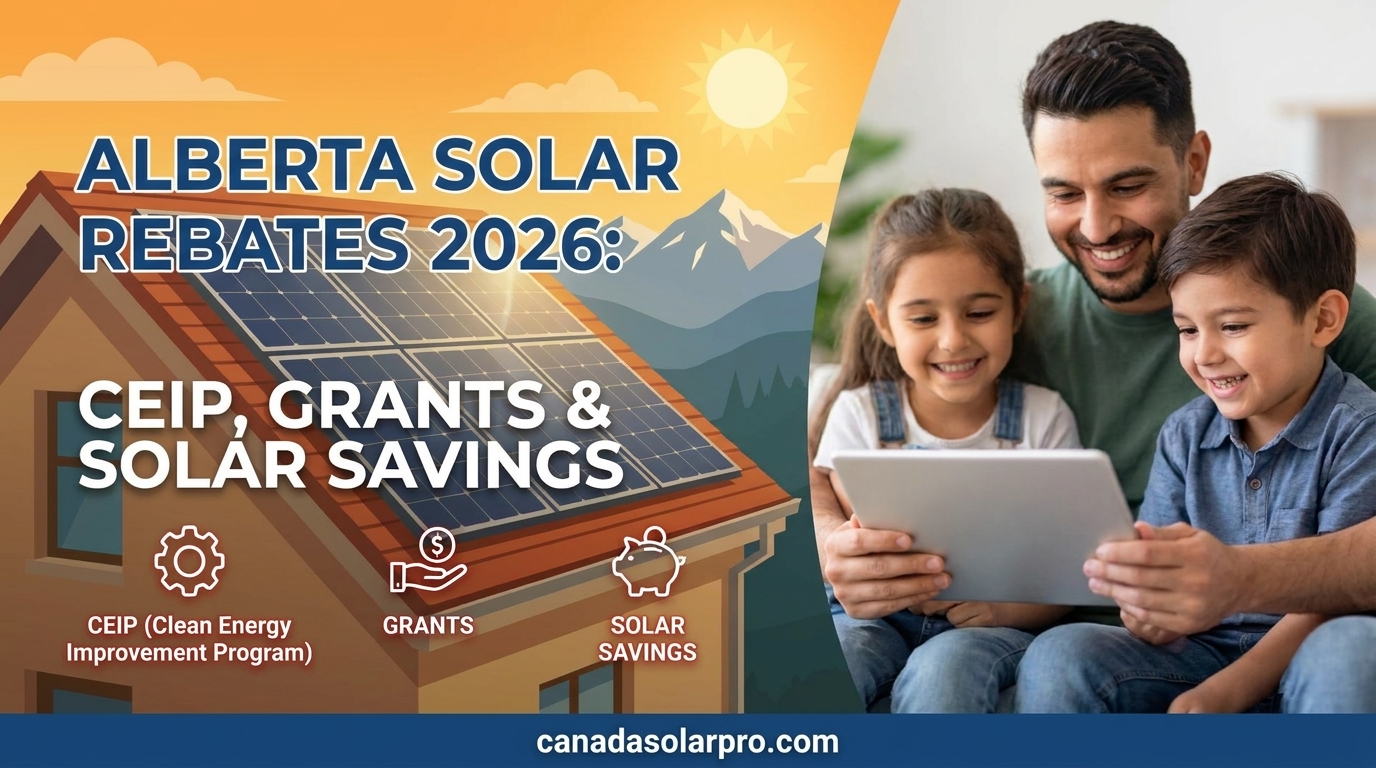
Alberta homeowners often search for Alberta solar rebates 2026 because solar panels can be a big investment. The confusing part is that not every program is a direct rebate. Some options help reduce upfront cost, some offer financing, and some improve long-term savings through solar credits or better electricity rates.
In 2026, homeowners should understand the difference between Alberta solar incentives, CEIP solar financing Alberta, local municipal programs, and Solar Club Alberta before installing panels. Each option works differently, and the right choice depends on your city, property type, system size, and solar goals.
This guide explains the main solar rebates, financing options, export credits, and local programs available for Alberta homeowners. It will also help you understand what to check before applying, what mistakes to avoid, and how these incentives can affect your solar payback.
Are there Solar Rebates in Alberta in 2026?
Yes, there are still solar support options in Alberta in 2026, but homeowners should understand one important point: not every program is a direct rebate. Some options are financing programs, some are local municipal supports, and some are electricity credit programs that help improve long-term savings.
At the province-wide level, Alberta does not have one simple residential solar rebate that applies to every homeowner. Instead, many homeowners look at CEIP solar financing Alberta, local programs, and export credit options like Solar Club Alberta.
Federal support has also changed. The Canada Greener Homes Grant is closed, and the Canada Greener Homes Loan portal is closed to new applications. Homeowners who already applied should check official program updates, but new applicants should not depend on these federal programs for 2026 solar planning. Natural Resources Canada says the Greener Homes Grant is closed, and CMHC says the Greener Homes Loan portal closed to new applications as of October 2, 2025.
For many Alberta homeowners, the main options to check are local CEIP availability, municipal solar programs, and solar export credits. Calgary’s CEIP, for example, can finance up to 100% of eligible project costs to a maximum of $50,000, but the city clearly states that CEIP is not a rebate and must be repaid.
CEIP Solar Financing Alberta: The Program Homeowners Should Understand First
CEIP solar financing Alberta helps homeowners cover the upfront cost of solar panels and other energy upgrades. CEIP stands for Clean Energy Improvement Program, and it is available through participating municipalities.
The most important thing to understand is this: CEIP is not a rebate. It is a financing option. That means it can help you install solar panels without paying the full project cost upfront, but the borrowed amount must be repaid over time.
CEIP usually works through the property tax bill. Instead of taking a regular personal loan, the homeowner repays the approved project cost through municipal property tax payments. Alberta Municipalities says CEIP can cover up to 100% of project costs and offers repayment through the property owner’s regular property tax bill.
For Calgary homeowners, the city says CEIP can finance up to 100% of eligible project costs, up to a maximum of $50,000. Calgary also clearly states that CEIP is not a rebate and must be repaid. This option can be useful for homeowners who want to go solar but do not want to pay the full installation cost at once.
Before applying, homeowners should check if their municipality participates, what the current interest rate is, which upgrades qualify, and whether approval is needed before installation starts.
If you want to compare installation prices before applying for financing, read the Alberta solar panel cost guide.
Calgary CEIP Solar Financing 2026: Up to $50,000 in Property-Tax Financing
Calgary CEIP solar financing can help eligible homeowners install solar panels without paying the full cost upfront. The City of Calgary says the Residential Clean Energy Improvement Program can finance up to 100% of eligible project costs, up to a maximum of $50,000. The city also says CEIP is not a rebate program, and homeowners must repay the borrowed funding.
The repayment is added to the property tax bill instead of being handled like a regular personal loan. This can make solar easier to plan for because the project cost is spread over time. The City of Calgary also lists an estimated interest rate range of 5.66% to 5.75%, but homeowners should confirm the latest rate before applying because program terms can change.
For Calgary homeowners, CEIP can be useful if the solar system cost is high and they want to avoid a large upfront payment. Still, it is important to compare the financing cost with expected solar savings, export credits, and long-term payback.
Before applying, check the current intake status, eligible upgrades, contractor requirements, repayment terms, and approval steps. You can also review Calgary and Edmonton solar pricing to understand typical local installation costs before using CEIP.
Edmonton CEIP Solar Financing 2026: What Homeowners Should Check
Edmonton CEIP solar financing can help eligible homeowners manage the upfront cost of solar panels and other energy upgrades. Like Calgary, this program is not a direct rebate. It is a financing option that lets homeowners repay approved project costs over time through their property tax bill.
For Edmonton homeowners, CEIP can be useful if they want to install solar but do not want to pay the full installation cost at once. It may make the project easier to plan, especially when combined with long-term solar savings and export credits.
Before applying, homeowners should check the current program status, eligibility rules, approved upgrade list, contractor requirements, repayment terms, and whether approval is needed before the work starts. Program details can change, so it is always better to confirm the latest information through the official Edmonton CEIP page before making a decision.
If you are comparing Edmonton solar incentives, also check the full installation cost and expected payback. You can review Solar Panels Alberta 2026 to understand how Alberta solar quotes, CEIP financing, and local savings options fit together.
Local Solar Rebates in Alberta: City-by-City Support Can Change
Local solar rebates in Alberta can vary by city or municipality. This is why homeowners should not only search for one province-wide rebate. Some Alberta communities offer direct solar rebates, while others offer CEIP financing or other local support programs.
For example, Calgary and Edmonton homeowners may check CEIP availability, while Banff has a local solar incentive program. The Town of Banff says residential property owners can receive $450 per kW of installed solar capacity, up to 20 kW, which means a maximum rebate of $9,000. Commercial properties may qualify for a higher amount under the same local program.
Medicine Hat also has solar support through its HAT Smart program. Some competitor guides mention Medicine Hat solar rebate support, but homeowners should always confirm current rules directly with the city before making plans.
Location | Program Type | What Homeowners Should Check |
Calgary | CEIP financing | Funding limit, interest rate, approval steps, contractor rules |
Edmonton | CEIP financing | Program status, eligibility, repayment terms, approved upgrades |
Banff | Local solar rebate | Rebate amount, system size limit, post-install rules |
Medicine Hat | HAT Smart solar rebate | Utility customer rules, system review, rebate amount |
Other Alberta municipalities | CEIP or local programs | Whether the municipality participates and funding is open |
These programs can change, pause, or run out of funding. Before installing panels, homeowners should confirm the latest details with their city or municipality. They should also check whether approval is needed before the work starts.
Solar Club Alberta and Export Credits: Savings, Not a Rebate
Solar Club Alberta is not a direct rebate. It is an electricity rate program that can help solar homeowners get better value from the extra power their panels send back to the grid.
When your solar panels produce more electricity than your home uses, the extra power goes to the grid. Your electricity retailer then adds a credit to your bill for that exported power. Alberta’s micro-generation rules explain that the credit rate is agreed between the customer and the electricity retailer, and the provincial government does not set that rate.
This is where Solar Club can become useful. During high-production months, the Solar Club high rate may increase the value of your exported electricity. During lower-production months, the Solar Club low rate may help manage the cost of electricity your home imports from the grid.
Solar Club should be seen as a savings tool, not a government grant. It does not reduce the upfront cost of installing panels like a rebate would. Instead, it may improve long-term savings by helping homeowners earn stronger solar credits when their system exports more electricity.
For a deeper explanation, read the Alberta microgeneration solar guide.
Alberta Solar Rebates vs Solar Financing vs Solar Credits
Many homeowners confuse rebates, financing, and solar credits, but they are not the same. Understanding the difference can help you avoid wrong expectations before installing solar panels.
A solar rebate usually means money back or a direct discount. This can reduce the actual cost of your solar project. Some local Alberta programs may offer this type of support, but availability depends on the city or municipality.
Solar financing helps you spread the cost over time. CEIP solar financing Alberta is a good example. It can help cover upfront project costs, but it must be repaid through the property tax bill. This means CEIP is helpful, but it is not free money.
Solar credits work differently. These credits are added to your electricity bill when your solar panels send extra power back to the grid. The value of those credits depends on your electricity retailer and rate plan.
Type | What It Means | Example |
Solar Rebate | Money back or direct discount | Local municipal rebate |
Solar Financing | Helps spread project cost over time | CEIP |
Solar Credit | Bill credit for exported solar power | Alberta micro-generation credits |
Rate Program | Better rate timing for solar owners | Solar Club Alberta |
So, when comparing Alberta solar incentives 2026, do not only ask, “Is there a rebate?” Also ask whether the program is a rebate, financing option, bill credit, or rate program. This will help you understand the real value before choosing a solar system.
Federal Solar Incentives for Alberta Homeowners in 2026
Federal solar incentives for Alberta homeowners are more limited in 2026 than they were in previous years. Many homeowners still search for the Canada Greener Homes Grant or Canada Greener Homes Loan, but both programs are no longer open for new solar applicants.
The Canada Greener Homes Grant is closed. Natural Resources Canada says the grant is closed, and December 31, 2025, was the final day for existing applicants to upload documents.
The Canada Greener Homes Loan is also closed to new applications. CMHC says the portal closed to new applications as of October 2, 2025, and NRCan says new loan applications cannot be approved because funding is fully committed.
This means Alberta homeowners should not plan a new 2026 solar project around federal grant or loan money. Instead, they should focus on current Alberta options such as CEIP solar financing Alberta, local municipal programs, and solar export credits.
If you already applied for a federal program before it closed, check your official account or program updates for next steps. If you are starting fresh in 2026, compare local incentives, financing terms, installation cost, and expected solar payback before moving ahead.
How Incentives Affect Solar Payback in Alberta
Solar incentives can affect solar payback Alberta by lowering the upfront cost, spreading payments over time, or improving yearly savings. The better your total savings, the faster your solar system may pay for itself.
A direct rebate can reduce the actual project cost. This means homeowners may recover their investment sooner because they paid less at the start. Local programs, when available, can make a noticeable difference in the final cost.
Financing works differently. Programs like CEIP solar financing Alberta do not reduce the full project cost like a rebate. Instead, they help spread payments over time through the property tax bill. This can make solar easier to start, but homeowners should still compare repayment costs with expected savings.
Solar export credits can also improve payback. When your panels send extra electricity back to the grid, those credits can reduce your bill. If you use a rate program like Solar Club Alberta, the high rate may improve credit value during sunny months.
Still, payback is different for every home. It depends on system size, installation cost, roof direction, electricity use, local weather, financing terms, and your installer quote. Before making a decision, compare rebate value with total system cost and long-term savings.
How to Check If You Qualify for Alberta Solar Incentives
Before applying for Alberta solar incentives, homeowners should first check whether their city or municipality offers an active program. Some programs are only available in specific locations, and funding can change or close without much notice.
The next step is to check your property type. Some programs may apply to residential homes, while others may include commercial or multi-unit buildings. Eligibility can also depend on whether you own the property, pay property taxes, or meet local program rules.
You should also confirm whether solar panels are included as an eligible upgrade. Most solar incentive or financing programs have approved project lists, contractor requirements, quote requirements, and application steps.
In many cases, homeowners should apply before the work starts. Installing solar panels before approval may make the project ineligible for certain programs. This is why it is important to check the rules before signing a final installation agreement.
What to Check | Why It Matters |
City or municipality | Programs vary by location |
Property type | Not every property qualifies |
Program status | Funding may be open, paused, or closed |
Eligible upgrades | Solar must be listed as an approved project |
Contractor rules | Some programs require approved contractors |
Application timing | Some require approval before installation |
Required documents | Quotes, permits, tax details, and project forms may be needed |
Repayment terms | Financing programs like CEIP must be repaid |
If you are also planning the technical side of your solar project, this grid-tie solar system guide for Alberta can help you understand the installation process.
Mistakes to Avoid Before Applying for Alberta Solar Rebates
Many homeowners make mistakes because they treat all Alberta solar rebates 2026 as the same. In reality, rebates, financing, export credits, and rate programs all work differently. Understanding the difference can help you avoid delays, wrong expectations, or missed savings.
One common mistake is calling CEIP solar financing Alberta a rebate. CEIP can help with upfront project cost, but it must be repaid through the property tax bill. It is not free money.
Another mistake is assuming federal solar grants are still open. The Canada Greener Homes Grant is closed, and new loan applications are no longer being approved. Homeowners should check current local options instead of planning around closed federal programs.
Some homeowners also start installation before checking approval rules. This can be risky because certain programs may require approval before the work begins. If you install first and apply later, you may lose eligibility.
It is also important to check your municipality. A program available in Calgary may not be available in another Alberta city. Contractor rules, funding limits, application windows, and repayment terms can also vary.
Finally, do not look only at the rebate amount. Compare the full solar installation cost, financing cost, expected export credits, and long-term payback before making a decision. A good incentive only helps when it fits your home, budget, and solar goals.
Homeowners should also check insurance questions before installation. This solar panels and home insurance guide explains what to ask before adding panels to your home.
How Canada Solar Pro Helps Alberta Homeowners Compare Solar Quotes
Canada Solar Pro does not control government rebates, CEIP financing, municipal programs, or Solar Club rates. These programs are managed by government bodies, municipalities, electricity retailers, or program providers.
What Canada Solar Pro does is help Alberta homeowners compare local solar quotes before they choose an installer. This can make the decision easier because solar cost, system size, roof layout, expected production, and payback can vary from one home to another.
Before installing solar panels, homeowners should understand both sides of the decision: available incentives and real installation cost. A rebate or financing option may help, but the final value still depends on the quote, system design, electricity use, and long-term savings.
Canada Solar Pro helps homeowners review solar options more clearly so they can compare pricing, ask better questions, and choose a system that fits their home and budget. The site also explains how the quote process works in simple steps for Canadian homeowners.
Final Thoughts
Alberta solar rebates and incentives 2026 are not one simple program. Some options may reduce upfront cost, some may help with financing, and others may improve long-term savings through export credits or better electricity rates.
Homeowners should understand the difference before installing solar panels. CEIP solar financing Alberta is not a rebate. Solar Club Alberta is not a grant. Local solar programs can also change by city, funding, and application rules.
The best step is to check current program status, compare installation costs, review expected savings, and understand payback before choosing an installer.