Quick Stats at a Glance
Calgary: 2,396 sunshine hours/year sunniest major city in Canada
Average monthly savings: $90–$150/month on a 6–8 kW system
Typical payback period: 6–10 years (one of the fastest in Canada)
CEIP financing: $0 upfront repaid through your property tax bill
Home value increase: 3–4% higher resale with solar
Net metering credits: up to $0.35/kWh for energy you export to the grid
If you've been thinking about installing solar panels on your Alberta home, 2026 may be the most compelling year yet to make that move. Electricity bills are climbing. The technology is better than ever. Financing options have evolved so you can go solar with little to no money down. And Alberta believes it or not is one of the best places in the entire country to harness solar energy.
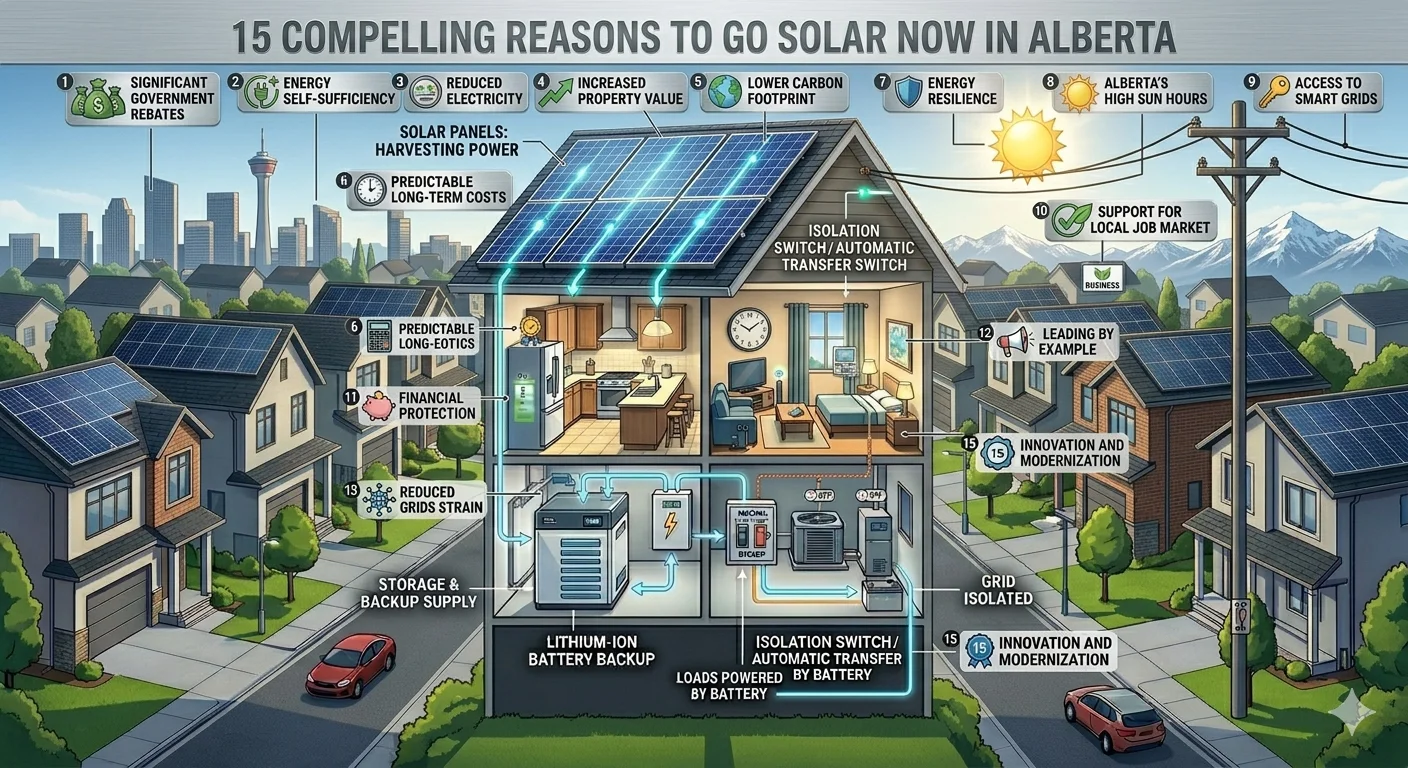
Yet many homeowners still hold back. They worry about cold winters, upfront costs, or whether solar is really "worth it" in Canada. This guide cuts through the noise with 15 real, data-backed reasons why going solar in Alberta right now is one of the smartest financial and lifestyle decisions you can make.
Whether you're in Calgary, Edmonton, Red Deer, Lethbridge, or anywhere across this province, here's everything you need to know before you decide.
Reason 1: Alberta Is the Sunniest Province in Canada By a Wide Margin
Most people associate solar power with warm, coastal climates. But here's what the data actually says: Alberta is Canada's sunniest province, and its cities top every national sunshine ranking.
Calgary averages 2,396 hours of bright sunshine per year, making it the sunniest major city in Canada. Edmonton isn't far behind at 2,345 hours annually. Medicine Hat, in southeastern Alberta, is Canada's single sunniest city at 2,544 sunshine hours per year. To put that in perspective, Vancouver, often imagined as a sunny coastal city receives only 1,200 to 1,400 annual sunshine hours.
Why is Alberta so sunny? It comes down to geography and climate. The province sits at elevation on the prairies, with a dry continental climate free of the persistent cloud cover that plagues coastal regions. The famous Chinook winds that sweep down from the Rockies regularly push away cloud cover in Calgary, delivering warm, clear winter days that are ideal for solar production.
This extraordinary sunshine resource is exactly why solar panels in Alberta don't just work, they thrive.
Reason 2: Electricity Rates Are Rising, and Your Bill Has Nowhere to Go But Up
One of the strongest arguments for solar isn't what electricity costs today, it's what it's going to cost you over the next 25 years.
Alberta's electricity market has been one of the most volatile in the country. In December 2022, floating rates hit a historic high of 37.464¢/kWh. While rates stabilized in 2024–2025, Alberta still ranks among the most expensive provinces for electricity. The current Rate of Last Resort (RoLR) sits at approximately 12¢/kWh in Calgary and Edmonton but that doesn't tell the whole story. When you add delivery charges, transmission fees, distribution costs, and administrative fees, the total bill for a typical Alberta household using 1,000 kWh/month can exceed $150 per month depending on your service area.
Looking ahead, wholesale electricity rates are projected to rise to 18¢/kWh by 2042. This is the grid you're locked into unless you take control.
Solar panels are your fixed price on electricity for the next 25+ years. The moment your system is activated, a significant portion of your electricity becomes free. You've essentially prepaid for decades of clean power at today's costs, completely insulated from whatever the market does next. Not sure what that could mean for your specific home?
Reason 3: CEIP Financing Means You Can Go Solar With $0 Upfront
The single biggest barrier to solar, the upfront cost, has largely been removed in Alberta thanks to the Clean Energy Improvement Program (CEIP).
CEIP is Alberta's property-assessed clean energy financing tool. Instead of taking out a traditional loan, you finance your solar installation up to $50,000 and repay it through your property tax bill at below-market interest rates over terms of up to 25 years. The program is available in more than 20 Alberta municipalities, including Calgary, Edmonton, Airdrie, Canmore, and Lethbridge.
What makes CEIP uniquely powerful is one key feature: the financing is tied to the property, not the owner. If you sell your home before the balance is paid off, the remaining payments transfer to the new owner along with the energy savings. You're not stuck paying for solar that no longer benefits you.
In practice, many Alberta homeowners can install solar and see their monthly energy savings exceed their CEIP repayment amount immediately making solar cash-flow positive from day one.
Reason 4: Net Metering Turns Your Roof Into a Revenue Stream
During summer months, your solar panels often produce more electricity than your home uses. That surplus flows back into the grid, and your utility credits you for it at the full retail rate up to $0.35/kWh with certain providers. In winter, when production drops, you draw on those accumulated credits to offset your bill.
A properly designed system can bring your annual electricity bill close to $0. Credits roll forward across the full 12-month billing cycle; they don't expire month to month.
Net metering is available through all Alberta electricity retailers ENMAX in Calgary, EPCOR in Edmonton, FortisAlberta across rural areas, and competitive retailers province-wide. Your distribution company installs a bi-directional meter as part of your solar installation process.
Think about what this means: your roof is no longer just a cost center. It becomes a power plant that pays back into your life every single month.
Reason 5: Solar Panels Pay for Themselves in 6 to 10 Years
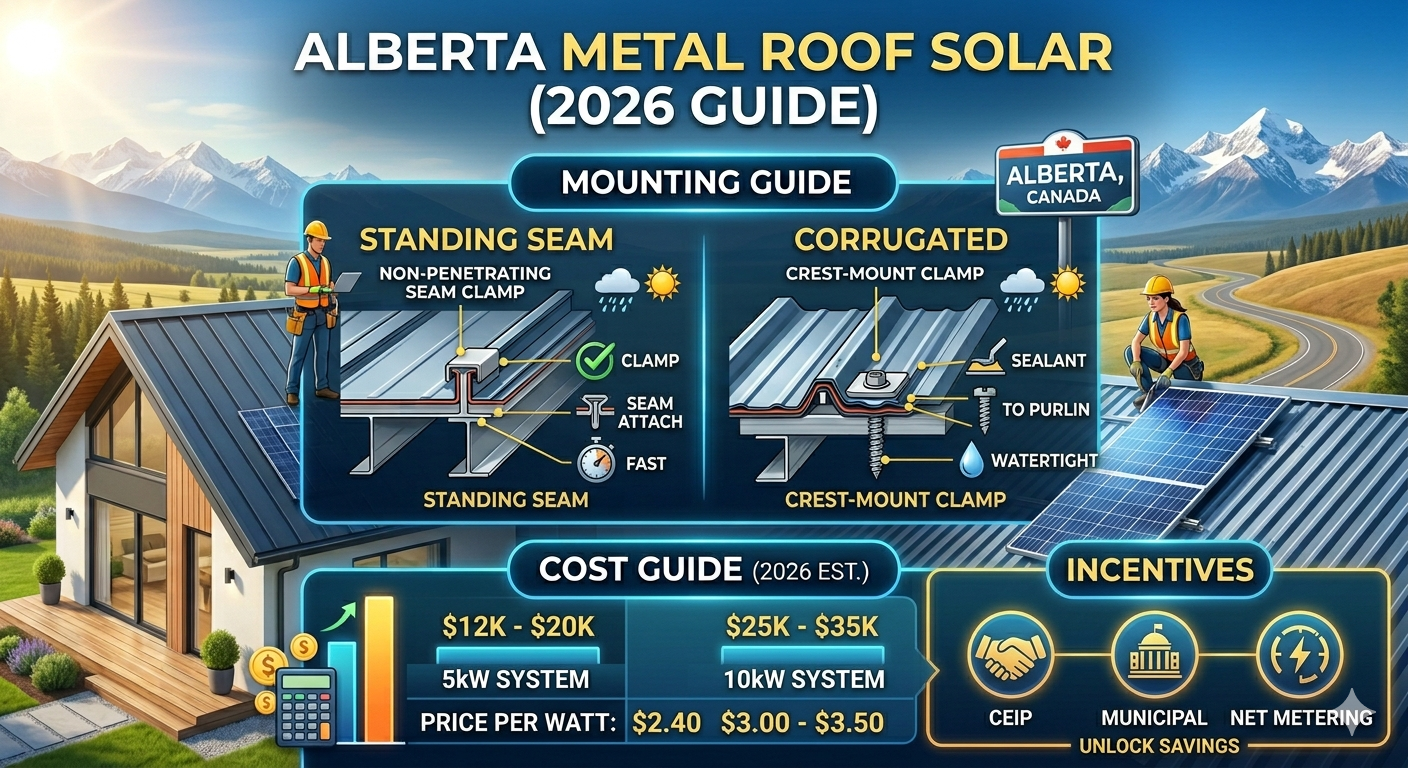
A typical residential solar installation in Alberta costs between $12,000 and $25,000 CAD installed, depending on system size, equipment quality, and your home's specific energy needs. A standard 6–8 kW system generates average monthly savings of $90–$150/month. For a detailed breakdown of what drives your solar panel installation costs in Alberta, including size, roof type, and available incentives, use our pricing guide.
At those savings rates, the typical payback period is 6 to 10 years, one of the fastest in all of Canada, largely because of Alberta's superior sunshine. After payback, you're generating free electricity for the remaining 15–20+ years of the system's life.
Over a full 25-year lifespan, a $25,000 Alberta system is estimated to deliver $75,000 to $90,000 in total electricity value, roughly three times the upfront investment. No GIC, no stock market, and no rental property delivers that kind of guaranteed, predictable return tied directly to your home.
Solar also improves your daily quality of life immediately lower bills start the month your system goes live.
Reason 6: Municipal Rebates and Incentives Are Still Available in 2026
Yes, the federal Canada Greener Homes Grant and the $40,000 interest-free loan have both closed. But there are still meaningful incentives available across Alberta in 2026 that can reduce your installation cost significantly. See our complete Alberta solar rebates and incentives guide for a current, municipality-by-municipality breakdown.
Active Programs in 2026:
Banff: $450/kW for residential installations (up to $15,000 max), $750/kW for commercial (up to $20,000). Application window: February 2 – March 31, 2026.
Canmore: 20 rebates of $1,250 available for rooftop systems of at least 3 kW. Selected by lottery apply early.
Medicine Hat: HAT Smart Existing Homes Incentive Program offers up to $5,000 for combined energy retrofits.
Wetaskiwin: $5,000 grants for businesses and non-profits installing a minimum 5 kWh solar system.
CEIP: Available in 20+ municipalities including Calgary and Edmonton finance up to 100% through your property taxes.
CMHC Eco Improvement: If you have a CMHC-insured mortgage, you may be eligible for a 25% refund on your mortgage insurance premium for qualifying solar upgrades, a national program many Alberta homeowners overlook.
Additionally, Alberta homeowners with solar panels generate carbon offset credits that can be aggregated and sold through the Alberta Emission Offset System, typically adding $200–$400/year in additional revenue for a standard residential system.
For commercial property owners, the 30% federal Clean Technology Investment Tax Credit (ITC), available until 2034, combined with Class 43.2 CCA write-offs, creates one of the most compelling commercial solar ROI profiles in the country.
Work with an installer who stays current on every available program and builds the optimal incentive stack into your quote.
Reason 7: Alberta Has No PST That's Thousands in Hidden Savings
This is one of the most overlooked advantages of going solar in Alberta specifically.
Alberta is one of the only provinces in Canada with no provincial sales tax (PST). You only pay the federal 5% GST on your solar installation. Compare that to provinces with HST, where homeowners pay 13–15% tax on the full installation cost.
On a $20,000 solar system, that difference means Alberta homeowners save $1,600 to $2,000 in tax alone compared to their counterparts in Ontario or Nova Scotia. That money directly reduces your net installation cost and shortens your payback period, with no application process required.
Reason 8: Solar Panels Work in Alberta Winters The Cold Myth, Debunked
"But what about all that snow and cold?" It's the most common objection heard from Alberta homeowners and it's based on a fundamental misunderstanding of how solar panels work.
Solar panels generate electricity from light, not heat. In fact, cold temperatures can actually improve panel efficiency. Most solar modules are rated at 25°C, and on a cold, sunny Alberta day, panels often outperform their rated efficiency. The same Chinook winds that make Calgary famous for its blue winter skies are also sweeping snow off rooftops and delivering clear solar exposure.
Modern solar panels are engineered and tested to withstand extreme temperature cycles, heavy snow loads, and hail. They carry 25-year product and performance warranties and have no moving parts to fail. The same technology that works in northern Europe and Scandinavia where winters are longer and darker than Alberta's performs just as well or better here.
Alberta winters do mean shorter daylight hours from November to January. A well-designed system accounts for this seasonality, oversizing slightly to maximize summer production and banking net metering credits that offset winter bills.
Reason 9: Your Home Value Goes Up the Moment Your System Is Activated
Installing solar panels is not just an energy decision, it's a real estate decision.
Studies consistently show that solar-equipped homes sell 3–4% faster and for higher prices than comparable homes without solar. In Alberta's competitive real estate market, where buyers increasingly weigh operating costs alongside purchase price, a home with a documented solar system and production history is a tangible, verifiable financial asset.
A solar home signals lower utility bills for the next owner. In a market where buyers are scrutinizing monthly carrying costs, that's a powerful differentiator. Solar homes sell faster because they stand out. And homes with fully owned or clearly financed systems (like CEIP, where financing and savings both transfer with the property) create smooth transactions that benefit both buyer and seller.
If you're a Calgary or Edmonton homeowner considering your long-term equity position, solar is one of the few upgrades that pays you back both during ownership and at the point of sale.
Reason 10: Carbon Credits Give You an Extra Passive Revenue Stream
Alberta runs one of the most sophisticated carbon markets in Canada. Homeowners with solar systems generate carbon offset credits under the province's emissions framework, and those credits have real monetary value.
These credits can be aggregated through platforms connected to the Alberta Emission Offset System and sold on the carbon market. For a standard residential solar system, this typically represents $200–$400/year in additional income completely passive, requiring no extra effort once you're enrolled.
Some solar installers handle this aggregation and credit sale automatically, passing the value directly back to homeowners. It's not a fortune, but it's real money that reduces your effective payback period further and it rewards you for choosing clean energy.
Reason 11: Solar Is Your Personal Hedge Against Market Volatility
Alberta's electricity market is deregulated meaning prices are set by market forces, natural gas supply, weather, and policy decisions, not a stable government rate. The history speaks for itself: rates soared to 37¢/kWh in 2022, stabilized, and are now on an upward long-term trajectory, projected to reach 18¢/kWh at the wholesale level by 2042.
When you own a solar system, you remove a significant portion of your home's electricity consumption from that market entirely. You've locked in your generation cost at $0/kWh for 25+ years. The grid becomes your backup, something you use when the sun isn't shining rather than your primary power source.
This is true energy price certainty. No surprise bills. No rate of anxiety. No carbon levy uncertainty. You control your energy costs in a way that no electricity retailer can offer you.
Reason 12: Solar Technology Has Never Been Better or More Affordable
The solar industry has experienced extraordinary progress over the past decade. The cost of solar panels has dropped by over 70%, while panel efficiency, durability, and warranty terms have all improved dramatically.
Today's Tier 1 solar panels the standard used in every quality solar panel installation in Alberta, come with 25-year performance warranties guaranteeing production at 80–85% of rated output for a full quarter century. Modern inverters (string inverters with optimizers, or microinverters) maximize output even under partial shading. Battery storage systems integrate seamlessly with residential solar, giving homeowners the option to store excess energy for use during outages or peak demand periods.
The industry has matured significantly in Alberta. Qualified installers have built thousands of systems across the province, establishing the skilled local workforce and installation standards that protect your investment.
This is no longer early-adopter territory. Solar in Alberta is proven, mainstream technology backed by decades of real-world performance data.
Reason 13: Battery Storage = True Energy Independence and Grid Backup
Solar panels alone give you lower bills. Solar panels plus battery storage give you something more: energy independence.
Adding a home battery storage system to your solar installation allows you to store surplus daytime generation and use it at night, during outages, or during peak-rate periods. In a province where Alberta has experienced grid stress during both summer heat waves and winter cold snaps, having backup power isn't just convenient, it's increasingly practical.
For Alberta homeowners in rural areas served by FortisAlberta, where outages can last longer due to distribution infrastructure distances, battery storage is particularly valuable. And for households with electric vehicles, combining solar with a home EV charger turns your transportation electricity costs to near-zero.
The synergy between solar, storage, and EVs is creating a new kind of home energy ecosystem, one where your house genuinely runs on sunshine.
Reason 14: Going Solar Directly Supports Alberta's Energy Transformation
Alberta's electricity grid is undergoing a historic shift. Coal-fired generation has been fully phased out ahead of schedule, completing in June 2024. Renewable energy capacity has grown from 3,028 MW in 2019 to over 8,433 MW by 2026, according to Alberta's 2026 Budget electricity data. Alberta's legislated Renewable Electricity Act set a target of 30% of electricity from renewables by 2030, a goal the province's own government confirmed it remains on track to meet.
Every residential solar system in Calgary or Edmonton that exports clean energy through net metering is displacing natural gas generation at the margin. The Alberta Emission Offset System quantifies that contribution and compensates homeowners for it, turning your environmental choice into a financial one as well.
When individual Albertans generate their own electricity, they reduce peak demand pressure on the grid, contribute to a more distributed and resilient energy system, and strengthen the case for continued investment in clean energy infrastructure across the province.
Going solar isn't just good for your wallet. It puts you on the right side of where Alberta's energy future is going.
Reason 15: Right Now Is the Best Time Before the Next Rate Reset
This is the reason that makes 2026 uniquely urgent.
Alberta's Rate of Last Resort (RoLR) is fixed at approximately 12¢/kWh through December 31, 2026. After that, it will be reset based on current market conditions and given the structural upward pressure on Alberta electricity prices (grid infrastructure investment, growing demand, and market-driven rate-setting), that reset is expected to push rates higher for most consumers.
The homeowners who install solar before that reset lock in their CEIP financing terms at current interest rates, build up net metering credits during the remaining high-production months of 2026, and begin their payback period earlier compounding savings from day one.
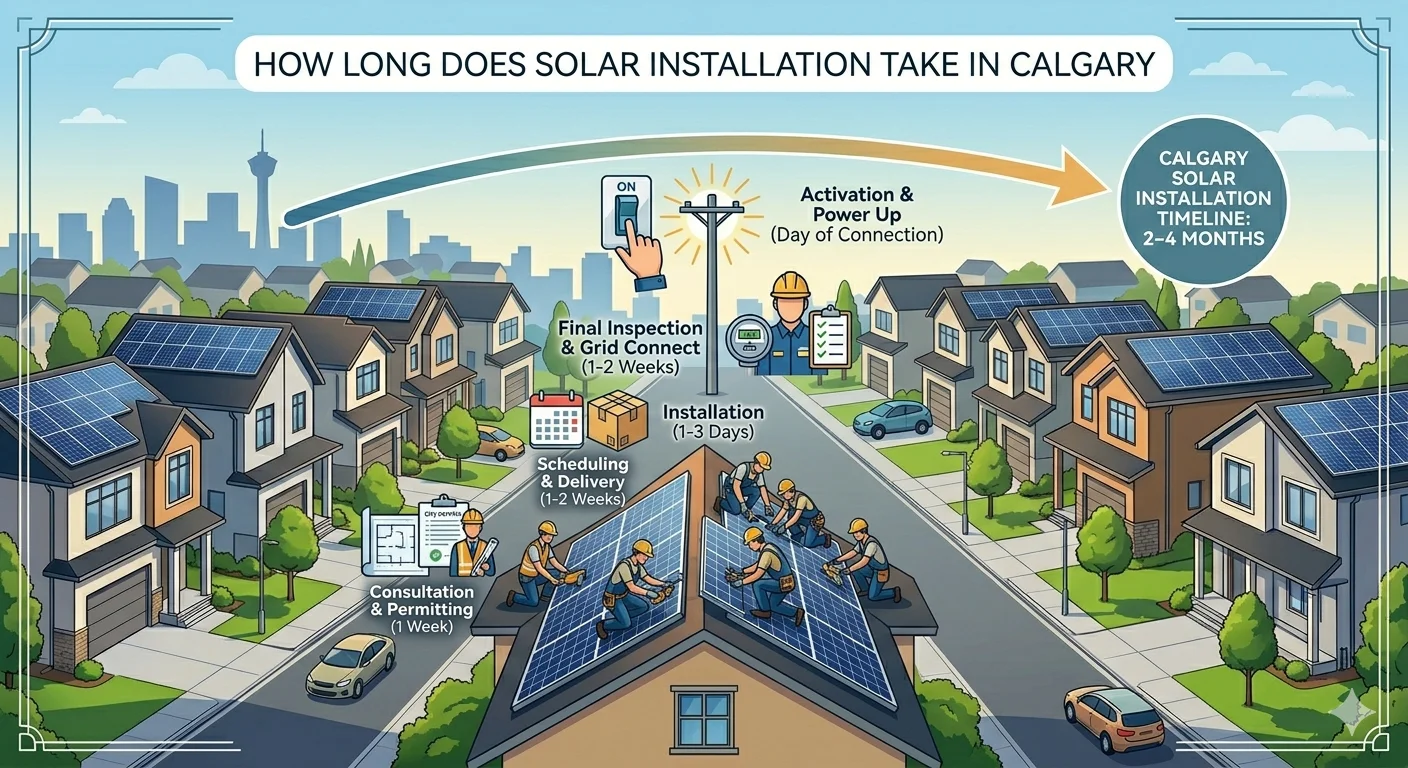
Spring and early summer are the ideal installation seasons in Alberta maximum daylight, no snow complication for installers, and panels that begin generating credits immediately on long summer days.
There is no better time to get your system assessed, quoted, and installed. Every month you wait is another month of full-rate electricity bills you didn't have to pay.
Ready to Go Solar in Alberta? Start With a Free Assessment
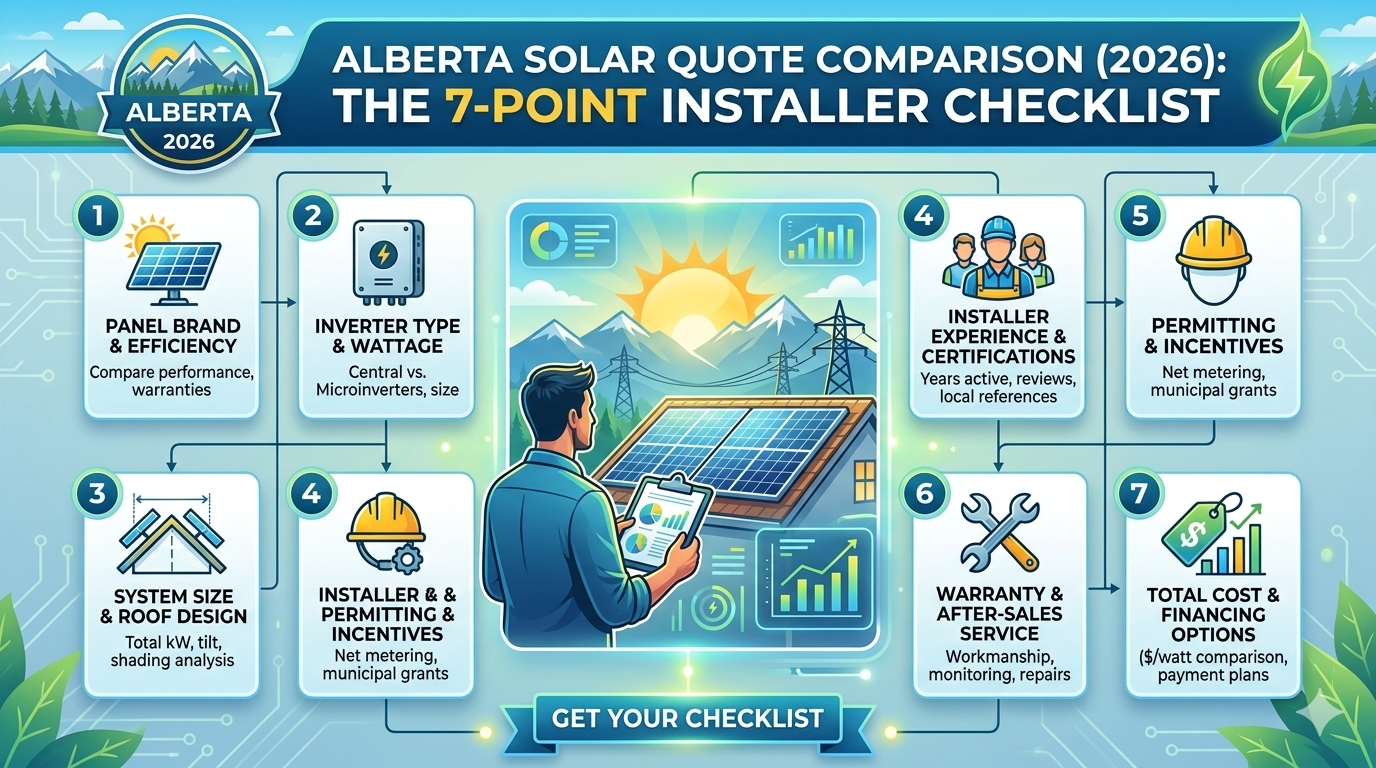
If you're in Calgary, Edmonton, or anywhere across Alberta and you're serious about going solar, the next step is simple: get a proper, no-obligation assessment of your roof, your usage, and your specific savings potential.
Canada Solar Pro provides transparent, no-pressure solar assessments for Alberta homeowners. Their team knows the local incentive landscape inside and out, understands the unique demands of Alberta's climate, and designs systems that maximize your real-world ROI, not just a number on a quote sheet.
A proper solar assessment answers three specific questions:
How much will your system produce annually, based on your actual roof and location?
What will your real payback period be, after all available 2026 incentives?
What will your electricity bill look like in Year 1, Year 5, and Year 25?
Get Your Free Solar Assessment →