TL;DR
A solar quote in Alberta should give you more than a price tag. The right quote shows your actual energy usage, system sizing based on real bills, production estimates for your specific roof, transparent costs, full scope of work, and accountable warranties.
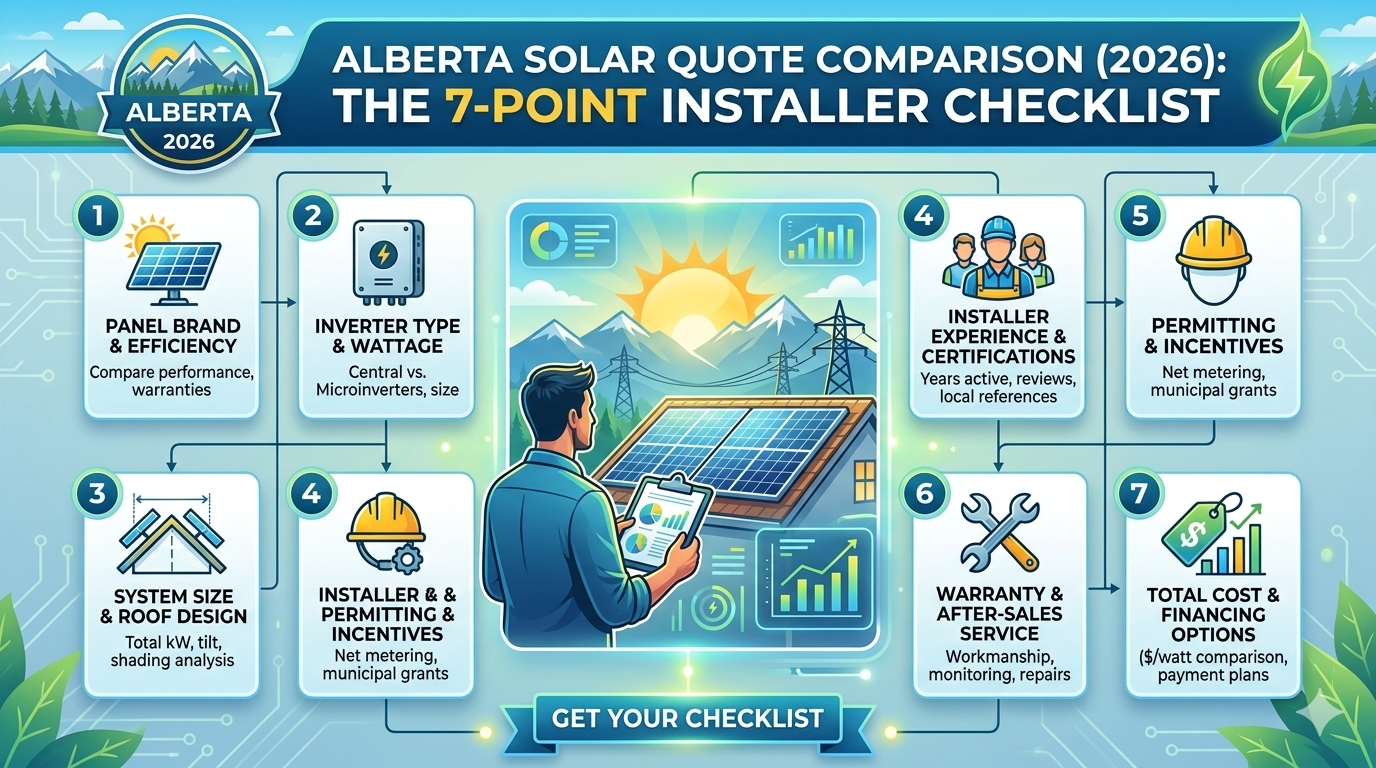
If any of these are missing, the quote is incomplete. This guide gives you a seven-point checklist to compare any solar quote in Alberta in 2026.
What Is a Solar Quote and Why It Matters for Alberta Homeowners
A solar quote is a written proposal that specifies the system size, equipment, production estimate, total cost, and warranty terms for a residential solar installation. Alberta homeowners use it to decide which installer earns their project.
A solar quote is not a sales receipt. It is the foundation of a 25-year energy decision. The quote sets the assumptions that determine your monthly savings, your payback period, and your long-term return.
Alberta’s deregulated electricity market makes this even more important. Rates change. Retailers offer different export credit structures. The wrong assumptions inside a quote can cost you thousands over the system’s lifetime.
What Information a Solar Quote Contains
A complete solar quote contains nine specific data points:
• System size in kilowatts
• Number and model of solar panels
• Inverter type and brand
• Annual production estimate in kilowatt-hours
• Total system cost (cash and financed)
• Financing breakdown with all fees
• Warranty terms for panels, inverter, and workmanship
• Scope of work with line-item tasks
• Estimated payback period
If any of these data points are missing, the quote is incomplete.
How a Solar Quote Differs from a Solar Proposal
A solar proposal often refers to a marketing document with general numbers and savings claims. A solar quote is a binding offer with line-item pricing, equipment models, and signed terms. Always confirm which one you are receiving before making any decision.
Why Solar Quote Accuracy Matters More in Alberta’s Climate
Alberta receives over 2,300 hours of sunshine per year and around 312 days of sun on average. That is more solar potential than most provinces in Canada.
But Alberta also gets long winters with snow cover, low solar angles, and seasonal usage spikes. A quote that ignores these realities will overpromise on production and underdeliver on savings.
What Are the Core Components of a Solar Quote
Every complete solar quote contains six structural components. Each one decides whether the system will perform as promised over 25 years. Skip the marketing language and look for these directly.
System Size and Panel Count
The system size is measured in kilowatts. The panel count tells you how many panels make up that system. For example, 16 panels of 400 watts each create a 6.4 kilowatt system. The size should match your annual energy usage. For a deeper look at sizing, read our guide on how many solar panels you need for your home.
Annual Production Estimate in Kilowatt-Hours
The production estimate predicts how much electricity your system will generate per year. For an Alberta home with a south-facing roof, a 6.4 kilowatt system typically produces around 8,000 to 9,000 kilowatt-hours annually. The exact number depends on your location, tilt, and shading.
Equipment List with Manufacturer and Model Details
The equipment list names every component. Solar panels. Inverters. Mounting hardware. Wiring type. The quote should specify brands and model numbers where possible. If models are listed as "to be confirmed," ask the installer what the substitution policy is.
Scope of Work and Installation Specifications
The scope of work defines every physical task the installer commits to. This includes mounting the panels, wiring the system, installing the inverter, connecting to your electrical panel, pulling permits, and arranging utility interconnection.
Total Cost, Financing Terms, and Payment Schedule
The cost section breaks down the full price. Cash purchase. Loan-based purchase. Property-tax-based financing through programs like CEIP. The payment schedule shows when each amount is due and to whom.
Warranty Coverage and Performance Guarantees
The warranty section covers three types of protection. Panel performance warranty. Equipment product warranty. Workmanship warranty. Each one has a different term and a different party responsible for honouring it.
How to Compare Solar Quotes in Alberta Step by Step
Comparing solar quotes in Alberta requires evaluating seven specific criteria. Each criterion isolates one factor that affects long-term value. Working through all seven removes the guesswork from your decision.
The seven criteria are:
20. Pricing transparency
21. System sizing accuracy
22. Production modeling
23. Financing structure
24. Scope of work
25. Equipment and warranty coverage
26. Installer credentials and track record
What Criteria Define a Reliable Solar Quote Comparison
A reliable comparison treats every quote against the same checklist. Not the cheapest. Not the friendliest sales rep. The quote that answers all seven criteria with written specifics wins. Anything vague costs you later.
How Many Solar Quotes an Alberta Homeowner Should Request
Most Alberta homeowners request at least three solar quotes before signing. Three quotes give you enough comparison points without overwhelming the decision. See how Canada Solar Pro matches you with local installers to get verified quotes from independent installers in your area.
1. How Solar Pricing Works in Alberta and Why Price Per Watt Alone Misleads
Price per watt is a useful starting point but it ignores the variables that decide the true cost of solar in Alberta. Two systems with the same price per watt can deliver very different long-term value.
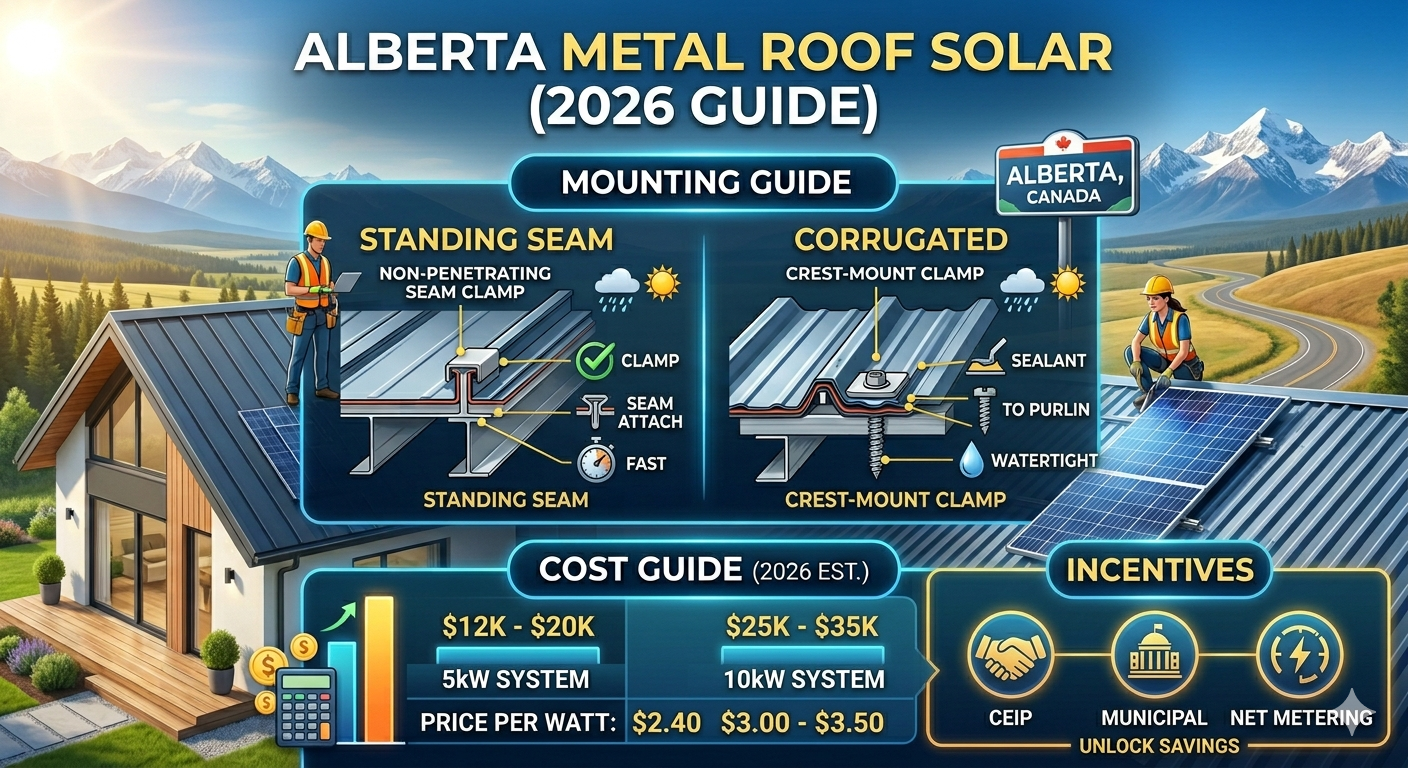
Price per watt divides the total system cost by the system size in watts. A 6.4 kilowatt system priced at $19,200 works out to $3.00 per watt. The number is easy to compare but it does not tell you what you are actually buying.
What a Realistic Price Per Watt Looks Like in Alberta in 2026
Pricing varies by installer, equipment quality, and roof complexity. Forum-based "rules" like "anything over $3.00 per watt is overpriced" miss the point.
A higher price per watt may reflect Tier 1 panels, microinverters, or premium workmanship warranties. A lower price may reflect cut corners that cost you later.
[CONFIRM: insert your typical 2026 Alberta $/W range here if you want a specific number on the page]
What Cost Variables Affect a Solar Quote in Alberta
Several factors push pricing up or down:
• Roof complexity, pitch, and number of planes
• Shading and shading mitigation hardware
• Main electrical panel upgrade requirements
• Conduit routing distance from array to inverter
• Equipment selection such as panel tier and inverter type
• Permit and inspection fees in your municipality
How Cash Pricing Differs from Financed Pricing
Cash pricing reflects what the installer earns directly. Financed pricing usually includes lender fees built into the rate. The same system can cost more under a low-interest loan once the dealer fee is factored in. Always ask for both numbers in writing before you decide.
2. How System Sizing Determines Whether a Solar Quote Is Accurate
System sizing decides every other number in a solar quote. Production, savings, and payback all derive from the size. If the sizing is wrong, everything downstream is wrong.
A properly sized system matches your annual electricity usage. Too small means you keep paying the utility for power you could have generated. Too large wastes money on panels that produce surplus you cannot fully monetize under Alberta’s current micro-generation rules.
Why Twelve Months of Electricity Usage Data Is Required
Your sizing should be based on a trailing 12 months of electricity bills. This captures summer and winter swings. It accounts for heating, cooling, and lifestyle patterns. Anything shorter risks a system designed around the wrong baseline.
How Seasonal Usage Patterns Influence System Size
Alberta homes use more power in winter. Solar production peaks in summer. The Solar Club rate strategy through Park Power lets eligible homeowners shift between seasonal high and low rates. Your installer should factor this into sizing if the strategy applies to you.
Why Square Footage Estimates Produce Wrong-Sized Systems
Some installers size based on roof square footage or average household assumptions. This is a clear red flag. A 2,500 square foot home with gas heating uses far less electricity than the same home with electric heating. Sizing by floor area ignores the actual energy load.
3. How Production Modeling Determines Solar Quote Reliability
Production modeling translates panel count into kilowatt-hours. Only location-specific modeling delivers reliable numbers for Alberta roofs. Generic estimates fail because Alberta’s solar conditions vary by region, season, and roof setup.
A reliable production model uses irradiance data from your specific area, your roof orientation and tilt, and a realistic shading analysis. It should include conservative assumptions for snow loss and soiling.
What Data Sources Accurate Production Models Use
Quality production estimates draw from the Photovoltaic Potential and Solar Resource Maps of Canada published by Natural Resources Canada. They use modeling software such as Aurora, PVsyst, or Helioscope. The output is specific to your address, not a national average.
How Roof Orientation and Tilt Affect Production Output
South-facing roofs in Alberta produce the most power. East and west orientations work but with lower annual output. North-facing slopes are rarely viable. Roof tilt between 30 and 45 degrees is optimal for Alberta latitudes.
Why Snow Loss and Shading Belong in Every Alberta Estimate
Alberta gets snow. Snow on panels reduces output. A serious production estimate accounts for snow loss as a percentage of annual production. The same applies to tree shading, chimney shading, and any neighbouring structures.
4. How Solar Financing Options Work in Alberta in 2026
Solar financing in Alberta falls into three main structures. Each one carries a different total cost of ownership beyond the monthly payment.
The three options are cash purchase, bank loan, and property-tax-based financing through programs like the Clean Energy Improvement Program. Choosing the right structure depends on your cash position, your interest rate options, and what your municipality offers.
How Cash Purchase, Bank Loan, and CEIP Compare
Cash purchase carries the lowest total cost. You pay once and own the system outright. A bank loan spreads the cost but adds interest. Property-tax-based financing through CEIP can cover up to 100 percent of project cost, repaid through your property taxes over up to 20 years.
CEIP is renewing in 2026 for cities like Calgary. Other Alberta municipalities have separate eligibility windows. Check our Alberta solar incentives page for the current list.
How Dealer Fees Are Built Into Low-Interest Loans
Many low-interest solar loans include a dealer fee. The fee is added to the system price to offset the lender’s lower advertised rate. The cash price and the financed price can differ by thousands of dollars on the exact same system. Always ask the installer to disclose any dealer fee in writing.
How CEIP Repayment Through Property Tax Functions
CEIP loans are repaid through an annual addition to your property tax bill. The repayment is tied to the property, not the homeowner. If you sell the home, the remaining balance transfers to the new owner. This makes CEIP attractive for homeowners planning to stay in the property long term.
5. What the Scope of Work Section Should Specify in a Solar Quote
The scope of work defines every physical task the installer commits to. Missing items in this section are the leading cause of surprise costs after signing.
A complete scope of work locks in pricing for everything required to bring your system online. Anything left out becomes a change order. Change orders are billed separately at the installer’s discretion.
When a Main Electrical Panel Upgrade Is Required
Some homes need a main electrical panel upgrade before solar can be installed. The trigger is panel capacity. If your existing panel cannot handle the added solar load, an upgrade is required. The cost typically ranges from $1,500 to $4,000. The quote must state whether the upgrade is included or excluded.
What Permits and Inspections the Installer Must Handle
Solar installations in Alberta require electrical permits and a final inspection. The installer should pull the permit, schedule the inspection, and pass it. The quote should list these costs as included. If the wording says "permits if required by municipality," ask for written clarity.
How Vague Scope Language Causes Budget Overruns
Watch for these red flag phrases in the scope section:
• "If required"
• "To be determined"
• "Subject to site conditions"
• "Standard installation only"
Each phrase shifts cost risk from the installer to you. Ask for specifics before signing anything.
6. How Equipment Quality and Warranty Coverage Define Long-Term Value
Equipment quality and warranty terms determine whether a solar system delivers value for 25 years or fails inside ten. The model numbers matter less than the warranty structure behind them.
A strong equipment package combines proven panels, a reliable inverter, and warranties that cover real failure scenarios. The installer’s accountability matters as much as the manufacturer’s.
What Tier 1 Solar Panels Mean in Practical Terms
Tier 1 is a financial classification, not a quality grade. It identifies panel manufacturers with the financial strength to honour long-term warranties. Most reputable installers in Alberta use Tier 1 panels by default.
How Microinverters Differ from String Inverters
Microinverters convert DC to AC at each individual panel. String inverters convert DC to AC for an entire string of panels at once. Microinverters perform better with partial shading and allow panel-level monitoring. String inverters cost less upfront. Your installer should explain the tradeoff for your specific roof.
What Performance, Product, and Workmanship Warranties Each Cover
Three warranties protect a solar system:
• Performance warranty: guarantees the panels produce a minimum percentage of rated output, typically 80 to 90 percent at year 25
• Product warranty: covers manufacturing defects, typically 12 to 25 years depending on brand
• Workmanship warranty: covers installation errors, typically 5 to 25 years depending on installer
Read all three. A 25-year panel warranty means little if the workmanship warranty is only one year.
Who Owns the Monitoring Data After Installation
Most solar systems include a monitoring app. The app shows production in real time. Confirm who owns the monitoring data. You should have direct access to your own system’s output. The installer should not control whether you can see your own production data.
7. How to Vet the Solar Installer Behind the Quote
An installer’s credentials, insurance, and track record decide whether the warranties on paper will hold up in practice. The right equipment with the wrong installer leads to long-term problems.
A qualified Alberta solar installer can show proof of every credential without hesitation. Vague answers here are a warning sign.
What Credentials a Qualified Alberta Solar Installer Holds
Look for installers with these credentials:
• Certified electrician on staff or as the supervising contractor
• Active registration to work with your local utility for micro-generation interconnection
• Membership with Solar Alberta or another recognised industry body
• Valid provincial business licence
Why Alberta Micro-Generation Registration Status Matters
Solar systems in Alberta are connected through the provincial micro-generation regulation. Your installer must coordinate with your local utility. That means EPCOR in Edmonton, ENMAX in Calgary, or FortisAlberta in most rural areas. Without correct registration, your system cannot legally export to the grid.
How to Verify Workers’ Compensation and Liability Insurance
Ask for a Workers’ Compensation Board clearance letter. Ask for proof of general liability insurance with a minimum of $2 million coverage. A reputable installer provides both documents on request. If they hesitate, walk away.
What Subcontracting Disclosure a Reputable Installer Provides
Some solar companies subcontract the installation to third-party crews. This is not automatically a problem. But the contract should disclose it. You should know who is actually installing your system and who carries the workmanship warranty.
What Questions to Ask Every Solar Installer Before Signing a Contract
The right questions force every installer to put their assumptions in writing. Verbal answers do not bind anyone. Written answers do.
Use these 15 questions across all the installers you are comparing:
27. What is the cash price and the financed price for the same system?
28. Is the dealer fee disclosed separately if I choose financing?
29. What is the production estimate for my specific roof, and what software was used to model it?
30. What is the assumed annual snow loss in the production estimate?
31. Is a main electrical panel upgrade required, and is it included in the price?
32. Are all permits and inspections included in the quoted price?
33. What is the workmanship warranty term and what does it cover?
34. Which panel and inverter models are quoted, and what is the substitution policy?
35. Who owns the monitoring data and how do I access it?
36. Is the installation done by your in-house crew or a subcontractor?
37. Can you provide a WCB clearance letter and proof of liability insurance?
38. How many systems have you installed in my municipality?
39. What is the timeline from contract signing to system activation?
40. What happens if my actual production falls below the estimate?
41. Is there a cooling-off period in the contract, and how many days is it?
For more detailed answers to common questions, browse all solar FAQs.
How to Score Solar Quotes Using a Side-by-Side Comparison Matrix
A comparison matrix turns the seven criteria into a scorable framework. Each installer is evaluated against the same checklist. The strongest quote on paper wins the project.
Build the matrix with the seven criteria as rows. Add columns for each installer you are comparing. Score each criterion as strong, average, or weak. The strongest installer is the one with the most strong scores, not the lowest price.
Criterion | Installer A | Installer B | Installer C |
1. Pricing transparency |
|
|
|
2. System sizing accuracy |
|
|
|
3. Production modeling quality |
|
|
|
4. Financing structure clarity |
|
|
|
5. Scope of work completeness |
|
|
|
6. Equipment and warranty strength |
|
|
|
7. Installer credentials and track record |
|
|
|
Total cash price |
|
|
|
Total financed price |
|
|
|
Years in business |
|
|
|
What Criteria to Include in a Solar Quote Comparison Table
Your comparison table should include all seven points plus three additional rows for total cash price, total financed price, and years in business. Add customer reviews as a separate fact-check before signing.
How to Weight Upfront Price Against Long-Term Value
The cheapest quote often misses scope items or uses lower-tier equipment. A quote that is $2,000 more upfront may save $8,000 over 25 years through better warranties and higher production. Score for value over time, not lowest sticker price.
What Red Flags to Watch for in a Solar Quote or Sales Process
Certain sales tactics and quote omissions reliably predict a bad outcome. Recognising them early protects your investment.
Why High-Pressure Closing Tactics Signal Installer Risk
"Sign today or the price goes up." "This rebate ends Friday." These tactics push you to decide before you can compare. A reputable installer gives you time. If the offer is real, it should still be available next week.
How to Identify Misleading Government Affiliation Claims
Some installers claim partnership with government programs. Verify every claim directly with the program. Most government rebates and financing programs work with any qualified installer. No installer is the "official" provider for a public program.
Why Deposits Above Ten Percent Deserve Scrutiny
A normal deposit on a solar contract in Alberta is 10 percent or less. Some installers ask for 50 percent or full payment upfront. This is a warning sign. It signals cash flow problems or fraud risk. Pay deposits only to companies with strong reviews and long business history.
What Door-to-Door Solar Sales Usually Hide
Door-to-door solar sales often involve high-pressure tactics, inflated pricing, and aggressive financing terms. Legitimate Alberta installers rarely rely on door-to-door sales as their primary channel. If a salesperson knocks on your door with a "limited time" solar offer, take their card and verify the company independently before committing to anything.
What Solar Incentives and Programs Apply to Alberta Homeowners in 2026
Incentives and rate programs change the real return on a solar investment. A complete quote factors them into the savings projection.
Alberta has several programs active in 2026. Each one applies under specific conditions.
How Micro-Generation Credits Work in Alberta
Under Alberta’s micro-generation regulation, homeowners receive bill credits for electricity exported to the grid. The credit rate depends on your retailer and rate plan. Some retailers offer one-for-one credits. Others offer wholesale rates. Always confirm the credit structure with your installer and your retailer.
What the Solar Club Rate Strategy Offers Solar Homeowners
The Solar Club, operated through Park Power, lets eligible solar homeowners switch between seasonal high and low rates. The Hi Rate reached 33 cents per kilowatt-hour as of 2025. Micro-generators who own an electric vehicle receive 5 percent cashback on energy imported from the grid. The strategy aligns export pricing with summer production and import pricing with winter demand.
Which Alberta Municipalities Offer CEIP Financing in 2026
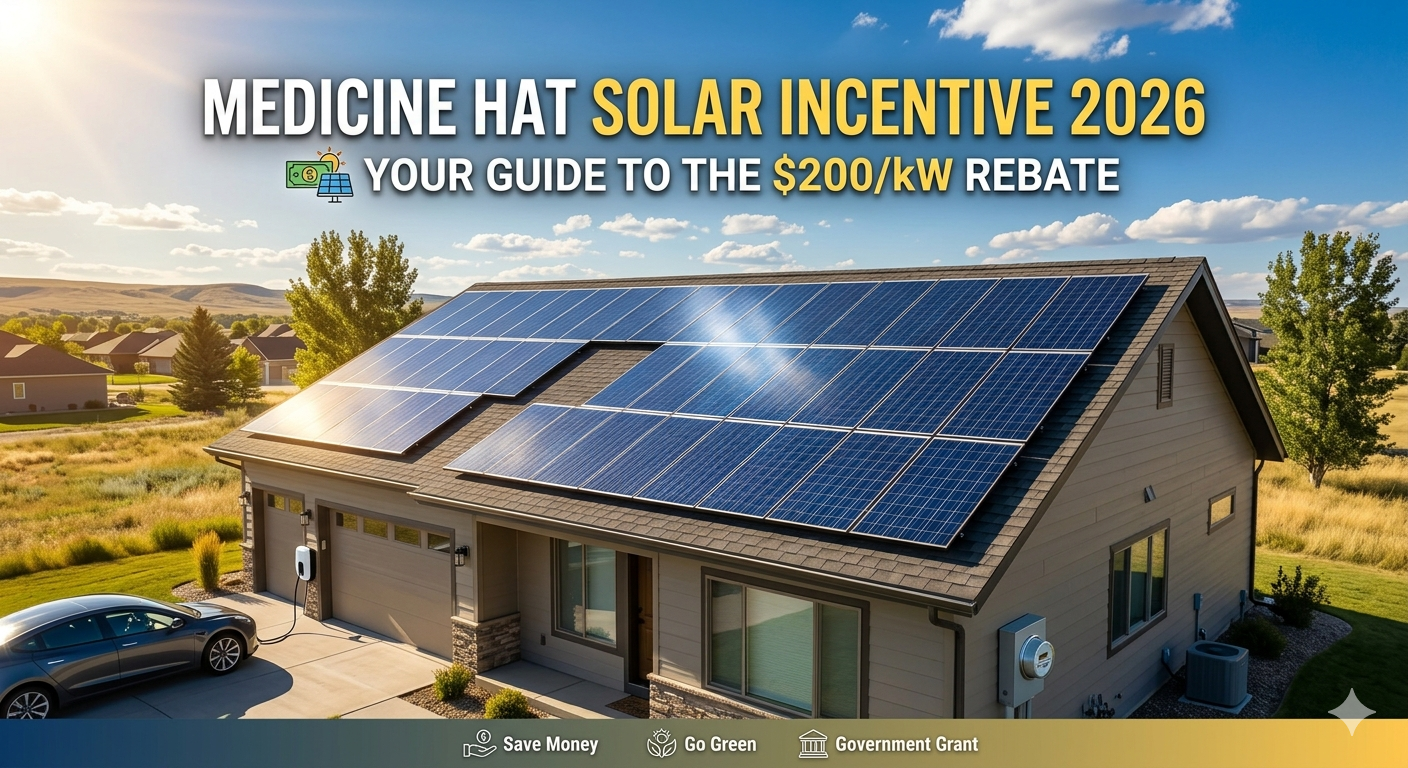
The Clean Energy Improvement Program allows property owners to finance up to 100 percent of solar costs through their property tax bill. CEIP availability varies by municipality. Calgary is renewing the program in 2026. Other municipalities have separate intake windows. Banff and Medicine Hat run their own direct rebate programs alongside CEIP. The Banff Solar Incentive Program pays $450 per kilowatt up to $9,000 in 2026. The Medicine Hat HAT Smart Solar Electric rebate pays $200 per kilowatt.
Status of the Federal Greener Homes Program in 2026
The Canada Greener Homes Grant closed to new applications in February 2024. Homeowners who applied before the closure may still be processing claims. As of 2026, there is no federal grant that directly replaces it. Check our current Alberta solar incentives page for the latest federal and provincial options.
What Happens Between Signing a Solar Quote and System Activation
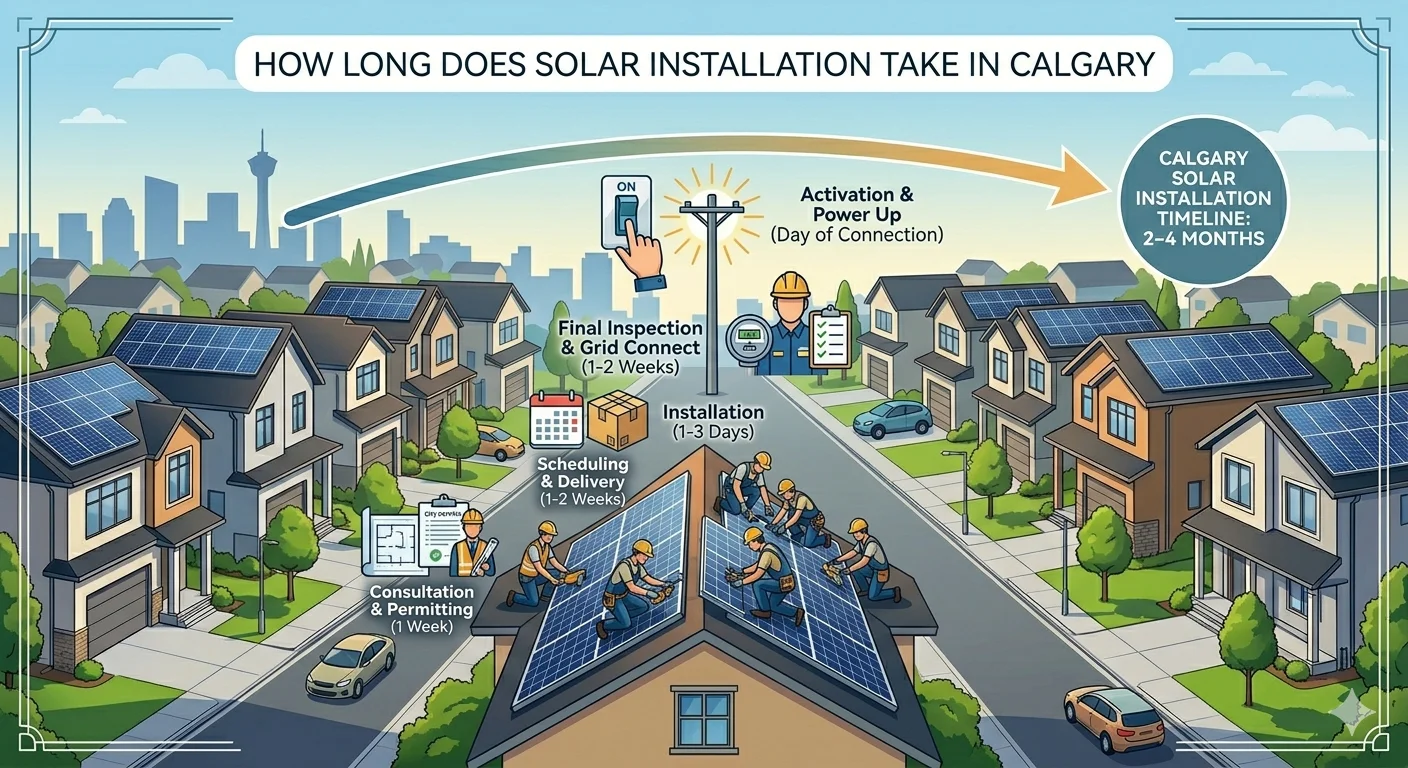
After signing a solar quote, the installation moves through four stages. The full process typically takes 6 to 12 weeks in Alberta.
The stages are permit application, equipment ordering and installation, electrical inspection, and grid interconnection. Each stage has dependencies on the previous one.
How Permit and Inspection Timelines Work in Alberta
The installer pulls the electrical permit through your municipality. Permit approval takes 1 to 3 weeks depending on workload. Installation usually takes 1 to 3 days. Final electrical inspection happens within 1 week of installation completion.
How Grid Interconnection Works with EPCOR, ENMAX, and FortisAlberta
After inspection, the system is connected to the grid through your utility. EPCOR handles connections in Edmonton. ENMAX serves Calgary. FortisAlberta covers most rural areas of the province. Each utility has its own micro-generation application process. Interconnection approval can take 2 to 6 weeks.
What System Commissioning and Handover Involve
Commissioning is the final step. The installer activates the system, confirms safe operation, and walks you through the monitoring app. Handover includes warranty documents, the system manual, and contact information for service calls. Keep all paperwork in one folder for future reference.
How to Manage a Solar System After Installation
Ongoing system management protects production output and warranty coverage across the 25-year lifespan of the panels.
Most maintenance is passive. Solar panels have no moving parts. But active monitoring and warranty awareness keep your investment safe.
How to Monitor Annual Production Against the Quote Estimate
Check your monitoring app monthly. Compare actual production against the quote estimate at the end of each year. Small variations are normal. A drop of more than 10 percent below estimate usually signals a problem. Contact your installer if you see one.
What to Do if the Solar Installer Goes Out of Business
Solar installer closures have happened across Canada. If your installer closes, your panel and inverter warranties remain valid with the manufacturer. Workmanship warranties may be harder to enforce. Keep manufacturer contact information for direct support. Some industry groups provide orphan system support for affected homeowners.
How to Maintain Warranty Coverage Over 25 Years
Register your panels and inverter with the manufacturers right after installation. Keep all warranty documents accessible. Avoid third-party repairs that could void coverage. Schedule a professional system check every 5 years to confirm everything is performing within spec.
The Complete Solar Quote Comparison Checklist for Alberta Homeowners
Use this checklist before signing any solar quote in Alberta:
• Is the price per watt explained with what drives it up or down?
• Is the system size based on 12 months of my actual electricity bills?
• Is the production estimate location-specific and conservative?
• Are cash and financed prices both disclosed in writing?
• Are all permits, inspections, and panel upgrades included in the scope?
• Are the workmanship, product, and performance warranties all listed?
• Does the installer hold valid registration, insurance, and WCB clearance?
• Have I read the cooling-off clause and deposit terms?
• Are Alberta-specific incentives like CEIP and micro-generation credits factored into savings?
• Does the quote include a 25-year savings projection based on realistic assumptions?
If you can answer yes to all ten, the quote is ready to sign. If any answer is no or unclear, ask for clarification before committing.
How to Request a Solar Quote You Can Confidently Compare
A transparent solar quote answers every question in the seven-point checklist before you have to ask. That is the standard you deserve as an Alberta homeowner making a 25-year investment.
Canada Solar Pro matches you with independent local installers who compete for your project. Each installer is familiar with Alberta’s solar programs, micro-generation regulations, and utility requirements. You see real offers, not call-centre estimates.
Request your free solar quote today and compare quotes against the seven-point checklist. No obligation, no pressure, and no missing assumptions.