Solar energy adoption continues to grow across Alberta as homeowners look for ways to reduce electricity costs and gain more control over their long-term energy expenses. At the same time, metal roofing has become increasingly popular because of its durability, low maintenance requirements, and ability to withstand Alberta's challenging weather conditions.
This combination often leads property owners to ask an important question: Can solar panels be installed safely and effectively on a metal roof?
In most cases, the answer is yes. In fact, many solar professionals consider metal roofs among the most solar-friendly roofing materials available. Certain metal roof designs can even allow solar panels to be installed with minimal roof penetrations, helping preserve the roof's integrity while supporting long-term system performance.
However, not every metal roof is the same. Installation methods, mounting hardware, costs, snow-load considerations, and expected energy production can vary depending on the roof profile and the property's location within Alberta.
This guide explains everything Alberta homeowners need to know about installing solar panels on metal roofs in 2026. You'll learn how different mounting systems work, what installation costs to expect, how Alberta's climate affects performance, and what factors influence long-term return on investment.
If you're still evaluating whether solar makes sense for your property, you may also find our guide on residential solar installations in Alberta helpful, as it covers system sizing, energy production expectations, and key planning considerations before installation.
Are Metal Roofs Good for Solar Panels?
Yes, metal roofs are generally considered one of the best roofing materials for solar panel installations. From an installation perspective, they offer a combination of durability, structural strength, and longevity that aligns well with the lifespan of modern solar energy systems.
One of the biggest advantages is lifespan compatibility. Most quality solar panels are designed to produce electricity for 25 years or longer, while many metal roofing systems can last 40 to 70 years when properly installed and maintained. This reduces the likelihood of needing a roof replacement during the solar system's service life, helping homeowners avoid the additional expense of removing and reinstalling panels in the future.
Metal roofs also perform exceptionally well in Alberta's climate. Property owners must contend with heavy snowfall, freeze-thaw cycles, strong winds, hail events, and significant seasonal temperature swings. A properly installed metal roof is built to withstand these conditions, making it a reliable foundation for a long-term solar investment.
Another important benefit is mounting flexibility. Certain roofing profiles, particularly standing seam metal roofs, allow solar mounting clamps to attach directly to the roof seams. Because these systems often require few or no penetrations through the roofing surface, they can reduce potential leak risks compared to some traditional roofing materials.
From practical field experience, solar installers often find that metal roofs provide cleaner installation pathways for wiring and mounting hardware. The smooth roof surface can also simplify maintenance and inspection work over the life of the system.
That said, homeowners should not assume that every metal roof is automatically ideal for solar. Factors such as roof age, structural condition, roof pitch, orientation, shading, and the specific metal roof profile all influence system design. An older roof with visible corrosion or structural issues may require repairs before solar installation begins.
It's also important to understand that energy production depends on more than the roofing material itself. Solar panel placement, system size, inverter selection, and available sunlight have a much greater impact on performance than the roof material alone. Metal roofs provide an excellent platform for solar, but proper system design remains essential for achieving the best results.
For Alberta homeowners planning a long-term energy upgrade, the combination of a durable metal roof and a professionally designed solar system can be a practical and cost-effective solution when both components are evaluated together.
Types of Metal Roofs Used in Alberta
Before choosing a solar mounting system, it's important to identify the type of metal roof on your property. Not all metal roofs are built the same, and the roof profile often determines how solar panels can be attached, what hardware is required, and how much the installation may cost.
In Alberta, several metal roofing styles are commonly used on residential, agricultural, and commercial buildings. Each comes with its own advantages and installation considerations.
Standing Seam Metal Roofs
Standing seam roofs are widely regarded as the most solar-friendly metal roofing option available.
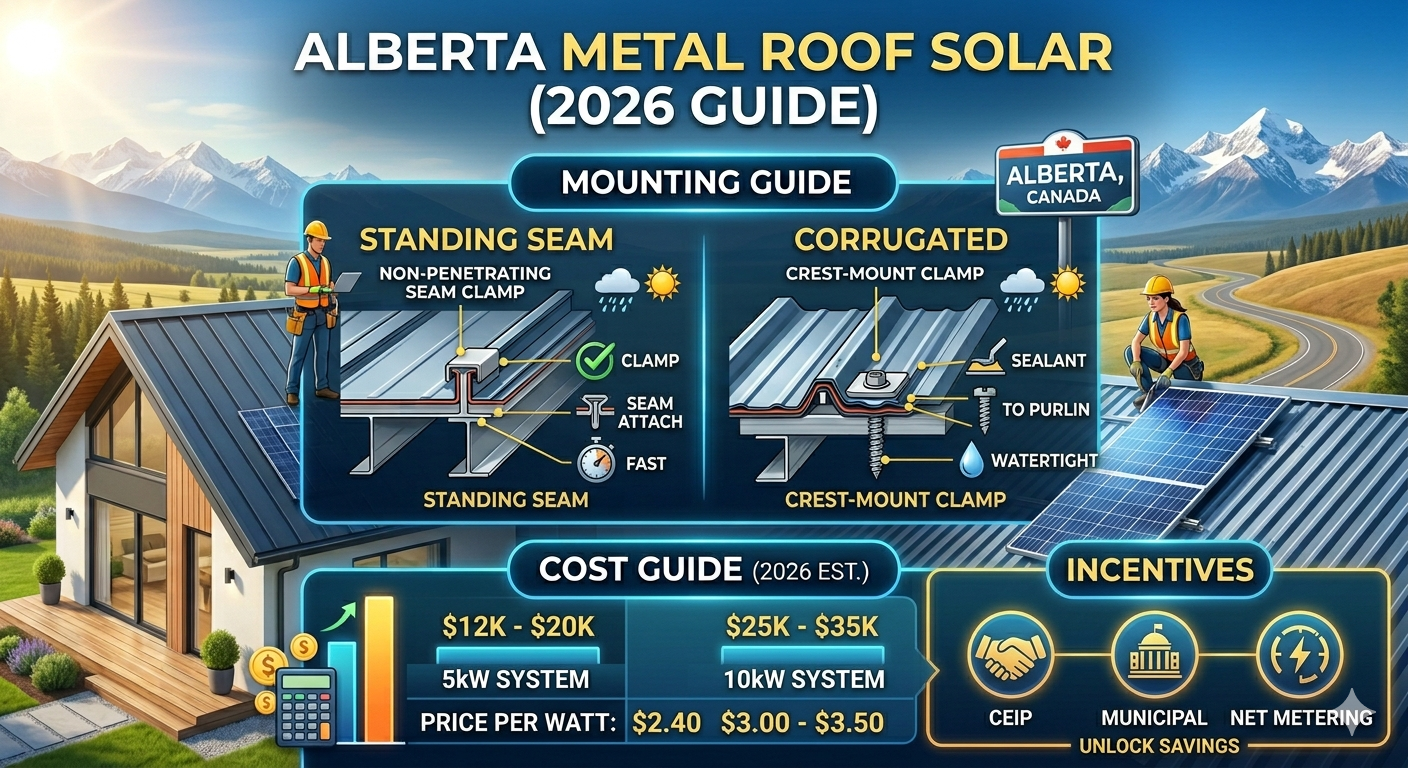
These roofs feature raised vertical seams that run from the ridge to the eaves. Specialized solar mounting clamps can attach directly to these seams without drilling through the roofing surface. This approach minimizes roof penetrations and helps preserve the roof's weather-resistant design.
Because of their durability and installation flexibility, standing seam roofs are often preferred for long-term solar projects. They are especially common on newer homes, commercial properties, and high-performance building designs.
Corrugated Metal Roofs
Corrugated metal roofs use a repeating wave-like pattern and are commonly found on rural properties, workshops, garages, and agricultural buildings throughout Alberta.
Solar panels can be installed on corrugated roofs, but the mounting system usually requires attachments that pass through the roofing material and connect to the structural supports beneath. Proper flashing and waterproofing are essential to prevent moisture issues over time.
While installation may require more labor compared to standing seam roofs, corrugated roofing remains a practical option for solar energy systems when installed correctly.
Exposed-Fastener Metal Roofs
Exposed-fastener systems are another common roofing type found on residential and commercial structures.
As the name suggests, the screws used to secure the roof panels remain visible on the surface. Solar mounting systems for these roofs typically require carefully engineered attachment points designed to maintain weather resistance while supporting the additional load of the solar array.
Because these roofs already contain penetrations from existing fasteners, experienced installers pay close attention to waterproofing details during the design process.
Metal Tile and Specialty Metal Roofs
Some Alberta homes use metal roofing products designed to resemble traditional shingles, slate, or tile.
Although solar installation is usually possible, these roof systems often require custom mounting solutions. Installation complexity can vary depending on the manufacturer and roof design, which may increase labor costs compared to more straightforward standing seam systems.
Commercial Metal Roofing Systems
Many commercial buildings across Alberta use large-span metal roofing systems that provide excellent space for solar panel installations.
The large roof area can accommodate higher-capacity systems capable of offsetting a significant portion of a building's electricity consumption. Commercial projects may also involve additional engineering considerations related to snow loads, wind uplift requirements, and structural assessments.
For business owners evaluating larger systems, it can be helpful to review commercial solar installation options before moving forward with project planning.
Ultimately, the best solar mounting solution depends on the specific roof profile rather than simply whether the roof is made of metal. Identifying the roof type early helps ensure the system is designed for long-term safety, performance, and weather resistance.
How Solar Panels Are Mounted on Metal Roofs
The mounting system is one of the most important components of any solar installation. While solar panels often receive the most attention, the mounting hardware is what secures the system to the roof and helps it withstand decades of exposure to Alberta's weather conditions.
The right mounting approach depends largely on the type of metal roof. Factors such as roof profile, structural design, snow loads, wind exposure, and manufacturer requirements all influence the installation method.
Clamp-On Mounting Systems for Standing Seam Roofs
Standing seam metal roofs are often considered the easiest and most efficient metal roofs for solar installations.
Instead of drilling through the roofing material, specialized clamps attach directly to the raised seams. Solar rails or mounting brackets are then secured to these clamps, creating a stable platform for the solar panels.
This approach offers several advantages:
Fewer roof penetrations
Reduced leak risk
Faster installation
Easier future maintenance
Preservation of roof warranties in many cases
For homeowners planning long-term solar ownership, clamp-based systems are often viewed as the preferred solution when compatible roofing is available.
Rail-Based Mounting Systems
Rail-mounted systems remain one of the most common installation methods across Alberta.
In this setup, aluminum rails are attached to roof mounting points, creating a framework that supports the solar panels. The panels are then secured to the rails using specialized clamps.
Rail-based systems provide excellent flexibility because installers can adjust panel placement to optimize spacing, alignment, and performance.
They are commonly used on:
Corrugated metal roofs
Exposed-fastener roofs
Commercial metal buildings
Large residential installations
Because Alberta experiences significant snow accumulation in some regions, rail systems are often engineered to handle local snow load requirements.
Rail-Less Mounting Systems
Some modern installations use rail-less mounting systems.
Rather than relying on long continuous rails, these systems use mounting hardware that attaches directly beneath individual solar panels. This can reduce material requirements and lower overall system weight.
Potential benefits include:
Fewer components
Faster installation times
Reduced material costs
Cleaner roof appearance
However, not every roof type is suitable for rail-less designs, and system compatibility should always be verified during the engineering stage.
Penetrating vs. Non-Penetrating Mounts
One of the most common questions homeowners ask is whether solar panels require holes in the roof.
The answer depends on the roofing system.
Non-penetrating mounts are commonly used on standing seam roofs where clamps attach directly to the seams.
Penetrating mounts are often necessary on corrugated and exposed-fastener roofs. These systems use specialized flashing, sealants, and waterproof attachment methods designed to prevent moisture intrusion.
When installed according to manufacturer specifications, both approaches can provide reliable long-term performance.
Waterproofing and Leak Prevention
Concerns about roof leaks are understandable, especially in regions that experience heavy snow, ice buildup, and freeze-thaw cycles.
Professional solar installers address this through:
Engineered attachment systems
Manufacturer-approved flashing products
Waterproof sealing methods
Structural load calculations
Post-installation inspections
In practice, most roof-related issues stem from improper installation rather than the solar panels themselves. Choosing an experienced installer who understands both roofing and solar system design is critical.
For homeowners comparing installation options, it is also helpful to understand how roof design affects overall system performance and long-term energy production. This becomes especially important when evaluating expected savings and return on investment.
Ultimately, the mounting system serves as the foundation of the entire solar array. Selecting the right hardware for the specific roof profile helps ensure the system remains secure, weather-resistant, and productive throughout its lifespan.
Solar Panel Installation Cost on Metal Roofs in Alberta (2026)
One of the first questions homeowners ask is whether installing solar panels on a metal roof costs more than installing them on other roofing materials. The answer depends on the roof type, mounting system, system size, and site-specific conditions.
In many cases, metal roofs can actually simplify installation. Certain roof profiles, particularly standing seam roofs, may require less labor and fewer roof penetrations than asphalt shingle roofs. However, specialized mounting hardware and engineering requirements can still influence the final project cost.
Rather than focusing only on the upfront price, homeowners should evaluate the total value of the system, including energy savings, equipment lifespan, maintenance requirements, and expected return on investment.
Average Residential Solar System Costs in Alberta
While pricing varies by installer, equipment selection, and property conditions, most residential solar systems in Alberta fall within the following ranges:
System Size | Typical Home Type | Estimated Cost Range |
5 kW | Small home | $12,000–$18,000 |
8 kW | Average family home | $18,000–$25,000 |
10 kW | Larger home | $22,000–$32,000 |
15 kW | High-consumption property | $32,000–$45,000+ |
These estimates generally include solar panels, inverters, mounting hardware, electrical components, permits, and professional installation.
Actual pricing should always be confirmed through a site-specific assessment, as roof conditions and energy requirements can significantly affect project costs.
How Metal Roof Type Affects Installation Costs
Not all metal roofs require the same amount of labor or hardware.
For example, standing seam roofs often use clamp-based mounting systems that attach directly to the seams. Because fewer roof penetrations are needed, installation may be faster and less complex.
Corrugated and exposed-fastener roofs typically require additional mounting attachments, flashing components, and waterproofing measures. These factors can increase labor requirements and material costs.
The difference is not usually dramatic, but it can influence the final project budget.
Cost of Solar Mounting Hardware
Mounting equipment represents a relatively small portion of the overall solar project cost, but it remains a critical component.
Typical mounting costs may include:
Roof attachment hardware
Standing seam clamps
Aluminum rails
Rail-less mounting components
Flashing and waterproofing materials
Grounding and bonding equipment
Higher-quality mounting systems often carry a higher initial cost but can provide better long-term durability in Alberta's challenging weather conditions.
Labour and Installation Costs
Labour is one of the largest factors affecting project pricing.
Installation costs depend on:
Roof accessibility
Roof height
Roof pitch
System size
Electrical upgrades
Installation complexity
Properties with steep roofs, multiple roof sections, or limited access may require additional labor and safety equipment.
Engineering, Permits, and Inspection Costs
Most Alberta solar projects require permit approvals and electrical inspections before the system can be connected to the grid.
Additional costs may include:
Structural engineering reviews
Electrical permit fees
Municipal permit requirements
Utility interconnection applications
Final inspections
These costs vary by municipality and utility provider but should be included in a professional solar proposal.
Factors That Can Increase Project Costs
Several property-specific factors may increase installation expenses:
Aging roofs requiring repairs
Complex roof layouts
Significant shading issues
Electrical panel upgrades
Snow-load engineering requirements
Long wiring distances
Premium solar equipment selections
A detailed site assessment helps identify these factors before installation begins, reducing the likelihood of unexpected costs later in the project.
Is a Metal Roof Worth the Additional Investment?
When evaluating solar costs, it's important to consider the roof and solar system as a long-term combination.
Because metal roofs often last significantly longer than traditional roofing materials, homeowners are less likely to face the expense of removing and reinstalling solar panels for a roof replacement. Over the lifespan of the system, this can contribute to lower ownership costs and fewer disruptions.
For many Alberta property owners, the focus should not be on achieving the lowest installation price. Instead, the goal is to balance system quality, energy production, durability, and long-term savings to maximize overall value.
Understanding cost is only one part of the decision-making process. Alberta's climate also plays a major role in how solar systems are designed, especially when considering snow accumulation, wind exposure, hail events, and winter energy production.
Alberta Weather Considerations for Solar Panels on Metal Roofs
Alberta's climate is one of the most important factors to consider when designing a solar energy system. While the province offers excellent solar potential, it also experiences weather conditions that can influence system design, mounting requirements, and long-term performance.
Fortunately, modern solar equipment is engineered to operate in a wide range of environmental conditions. When properly installed, solar panels on metal roofs can perform reliably throughout Alberta's hot summers, cold winters, and rapidly changing weather patterns.
Snow Loads and Structural Requirements
Snow accumulation is a major design consideration for solar installations in Alberta.
Different regions experience varying snow loads, which means mounting systems and roof attachments must be engineered to meet local building code requirements. Professional installers use structural calculations to ensure the roof and mounting hardware can safely support both the solar array and expected snow accumulation.
While snow can temporarily cover panels, it rarely shuts down production for extended periods. The dark surface of solar panels absorbs sunlight, helping snow slide off more quickly than many homeowners expect.
Metal roofs can provide an additional advantage because their smooth surface often allows snow to shed more efficiently than some traditional roofing materials.
Winter Solar Production
A common misconception is that solar panels stop working during Alberta winters.
Solar panels generate electricity from sunlight, not heat. In fact, cooler temperatures can improve solar panel efficiency under certain conditions.
Although shorter daylight hours reduce overall winter production, solar systems continue generating electricity throughout the colder months whenever sunlight reaches the panels.
Many homeowners are surprised to learn that Alberta's bright winter days can still contribute meaningful energy production despite lower temperatures.
Chinook Winds and Rapid Temperature Changes
Southern Alberta is known for Chinook weather events, which can bring dramatic temperature changes within a short period.
These rapid shifts create expansion and contraction cycles for roofing materials and mounting systems. High-quality solar mounting hardware is specifically designed to accommodate these movements while maintaining structural stability.
Proper engineering and manufacturer-approved mounting systems help ensure reliable long-term performance despite Alberta's temperature extremes.
High Wind Exposure
Certain regions of Alberta experience strong wind events throughout the year.
Solar mounting systems are engineered to withstand uplift forces created by high winds. During the design process, installers evaluate:
Roof height
Building location
Wind exposure
Roof geometry
Local code requirements
This information helps determine the attachment spacing and mounting configuration needed to secure the system safely.
Hail Resistance
Hail is another concern frequently raised by Alberta homeowners.
Modern solar panels undergo impact testing designed to evaluate their ability to withstand hail and other environmental stresses. While no roofing or solar product can be considered completely damage-proof, quality solar panels are built to tolerate conditions that would concern many property owners.
Interestingly, solar panels can sometimes provide an additional protective layer over portions of the roof by shielding the surface beneath them from direct exposure.
Ice Formation and Water Management
Winter weather can also create ice buildup along roof surfaces.
Proper panel spacing and drainage design help maintain natural water flow across the roof. Experienced installers pay close attention to roof drainage pathways to avoid creating areas where water or ice could become trapped.
This is particularly important for metal roofing systems because maintaining proper water movement helps protect both the roof and mounting components over time.
Why Climate-Specific Design Matters
The most successful solar installations are designed specifically for local conditions rather than relying on generic system layouts.
A solar array that performs well in a mild climate may require different engineering considerations in Alberta due to snow loads, wind exposure, temperature fluctuations, and seasonal production patterns.
This is why site-specific engineering, structural reviews, and local installation experience play such an important role in project success.
When properly designed, solar panels on metal roofs can provide reliable energy production for decades while withstanding Alberta's unique environmental conditions. The next question many homeowners ask is whether the installation itself could damage the roof or increase the risk of leaks over time.
Do Solar Panels Damage Metal Roofs?
One of the most common concerns among Alberta homeowners is whether installing solar panels could damage their metal roof or create leaks in the future. This is an understandable question, especially for property owners who have invested in a premium roofing system designed to last for decades.
In most cases, a professionally installed solar system should not damage a properly maintained metal roof. In fact, many metal roofs are considered ideal candidates for solar because of their durability and compatibility with modern mounting systems.
The key factor is not the solar panels themselves—it's the quality of the installation and the mounting method used.
Can Solar Panels Cause Roof Leaks?
When installed correctly, solar panels should not cause roof leaks.
Leak concerns typically arise when homeowners hear that solar mounting hardware may require roof penetrations. However, professional installers use engineered attachment systems, flashing components, and waterproof sealing methods specifically designed to protect the roofing system.
For standing seam metal roofs, many installations can be completed using clamp-based mounting systems that attach directly to the roof seams without drilling through the roofing surface. This significantly reduces concerns about future water intrusion.
Even when penetrations are necessary on corrugated or exposed-fastener roofs, properly installed mounting systems are designed to maintain weather resistance and long-term durability.
Does Solar Installation Void a Metal Roof Warranty?
Warranty implications vary depending on the roofing manufacturer and installation method.
Before installation begins, homeowners should review their roofing warranty documentation and discuss requirements with both the roofing manufacturer and solar installer.
Many roofing manufacturers provide approved mounting methods for solar installations. Following these guidelines helps preserve warranty coverage and ensures compatibility between the roof and solar system.
Experienced installers are typically familiar with manufacturer requirements and can recommend mounting solutions that align with warranty conditions.
Can Solar Panels Add Too Much Weight?
Solar panels do add weight to the roof structure, but modern systems are generally included in engineering calculations before installation.
A structural assessment may evaluate:
Roof framing
Building age
Roof condition
Existing loads
Local snow-load requirements
In most cases, modern residential and commercial buildings can support a properly designed solar system without issue. However, older structures may require additional review before installation proceeds.
Can Solar Panels Damage the Metal Roofing Surface?
When installed using manufacturer-approved mounting systems, solar panels should not damage the roofing material.
Potential problems typically occur when:
Improper mounting hardware is used
Roofing guidelines are ignored
Attachments are installed incorrectly
Unqualified contractors perform the work
This is why choosing an installer with experience working on metal roofing systems is so important.
Can Solar Panels Protect Parts of the Roof?
An often-overlooked benefit is that solar panels can shield portions of the roof from direct exposure to sunlight, rain, snow, and hail.
While this should not be viewed as a primary reason to install solar, some roofing professionals note that the covered areas beneath panels often experience less environmental exposure over time.
The overall lifespan of the roof will still depend on factors such as installation quality, maintenance, weather conditions, and material selection.
Ongoing Roof Maintenance After Installation
Installing solar panels does not eliminate the need for periodic roof inspections.
Homeowners should continue to:
Inspect for debris accumulation
Monitor drainage pathways
Check for visible roof damage after severe storms
Schedule professional inspections when recommended
Routine maintenance helps ensure both the roof and solar system continue operating as intended.
The Real Risk: Poor Installation
In practice, most roof-related issues associated with solar installations are linked to poor workmanship rather than the technology itself.
A qualified installer should evaluate the roof condition, select appropriate mounting hardware, follow manufacturer guidelines, and complete all waterproofing measures according to industry standards.
For Alberta homeowners, the safest approach is to view the roof and solar array as a single integrated system. When both are properly designed and installed, solar panels can operate for decades without compromising the performance or integrity of the metal roof.
Once homeowners understand the risks and installation requirements, the next question is usually financial: how much electricity can a solar system actually produce on a metal roof in Alberta, and how does that production affect long-term savings?
How Much Electricity Can Solar Panels Produce in Alberta?
The amount of electricity a solar system produces depends on several factors, including system size, roof orientation, panel efficiency, shading, and geographic location. While the type of roof affects how the system is mounted, it has very little impact on energy production when compared to sunlight exposure and overall system design.
Alberta is one of the strongest solar markets in Canada because of its abundant sunshine and favorable solar resource. Many areas of the province receive enough annual sunlight to make residential and commercial solar systems a practical long-term investment.
For homeowners considering solar on a metal roof, understanding realistic production expectations is essential for estimating energy savings and return on investment.
Average Solar Production by System Size
The following estimates represent typical annual energy production ranges for well-positioned solar systems in Alberta.
System Size | Estimated Annual Production |
5 kW | 5,500–7,000 kWh |
8 kW | 8,800–11,200 kWh |
10 kW | 11,000–14,000 kWh |
15 kW | 16,500–21,000 kWh |
Actual production will vary depending on site conditions and system design.
A professional solar assessment can provide more accurate estimates based on your property's location, roof orientation, and electricity usage patterns.
Does Roof Orientation Matter?
Roof orientation plays a major role in determining solar performance.
In Alberta, south-facing roof sections generally receive the highest annual sunlight exposure and often deliver the strongest production results.
However, east-facing and west-facing roof surfaces can still perform very well. Many homeowners achieve excellent results even when their roof is not perfectly south-facing.
The difference is often smaller than many people expect, especially when modern high-efficiency solar panels are used.
How Roof Pitch Affects Production
Roof pitch also influences solar output.
A roof angle that captures sunlight efficiently throughout the year can improve overall production. Fortunately, many residential metal roofs in Alberta already fall within a range that works well for solar energy generation.
In some situations, mounting systems can be adjusted to optimize panel positioning while still maintaining compliance with structural and wind-load requirements.
Southern Alberta vs. Northern Alberta Solar Output
Location within the province can affect annual energy production.
Generally, southern Alberta communities such as Calgary, Lethbridge, and Medicine Hat benefit from some of the strongest solar resources in Canada.
Northern regions still offer viable solar opportunities, but annual production may be somewhat lower due to differences in available sunlight and weather patterns.
This is why production estimates should always be based on site-specific data rather than provincial averages alone.
The Impact of Shading
Even a highly efficient solar system can experience reduced output if panels are regularly shaded.
Common shading sources include:
Trees
Neighboring buildings
Chimneys
Roof structures
Utility poles
During the design process, installers typically evaluate shading conditions to identify potential production losses and determine the best panel placement.
Reducing shading is often one of the most effective ways to improve system performance.
Seasonal Production Changes
Solar production naturally changes throughout the year.
Summer months typically generate the highest energy output because of longer daylight hours and increased sunlight availability.
Winter production is lower due to shorter days and occasional snow coverage, but solar systems continue generating electricity whenever sunlight reaches the panels.
Because Alberta experiences strong solar conditions throughout much of the year, annual production remains attractive despite seasonal fluctuations.
Why Accurate Production Estimates Matter
Energy production is the foundation of every solar investment decision.
A system that generates more electricity can potentially offset a larger portion of utility consumption, which may improve long-term savings. However, larger systems also require higher upfront investment.
The goal is to design a system that matches the property's energy needs rather than simply maximizing panel count.
For this reason, reputable installers typically review historical electricity usage before recommending a system size. This helps create realistic production expectations and supports better financial planning.
Once production estimates are established, homeowners can calculate one of the most important metrics in the solar decision-making process: the expected payback period and long-term return on investment.
Solar Payback Period for Metal Roof Homes in Alberta
For most homeowners, the decision to install solar panels ultimately comes down to one question: when will the system pay for itself?
The answer depends on several factors, including installation costs, electricity consumption, utility rates, system performance, and future energy prices. While every property is different, Alberta's strong solar resource and relatively high electricity costs often create favorable conditions for solar investments.
Rather than focusing solely on the initial installation cost, it's important to evaluate solar as a long-term energy asset that can generate savings for decades.
What Is a Solar Payback Period?
A solar payback period is the amount of time it takes for accumulated electricity savings to equal the total cost of the solar system.
For example, if a homeowner invests $25,000 in a solar system and saves approximately $2,500 per year on electricity costs, the simple payback period would be around 10 years.
Once the system reaches its payback point, future energy production effectively becomes ongoing financial value for the remainder of the system's lifespan.
Typical Solar Payback Periods in Alberta
While actual results vary by property, many Alberta homeowners see estimated payback periods ranging from:
Approximately 8–12 years for well-designed residential systems
Potentially shorter periods when electricity rates increase
Longer periods for properties with lower energy consumption
It's important to remember that payback calculations should be based on realistic assumptions rather than best-case scenarios.
A reputable installer should provide production estimates and financial projections that reflect actual site conditions.
How Electricity Rates Affect Solar Savings
Utility rates are one of the biggest variables influencing solar economics.
As electricity costs increase, the value of every kilowatt-hour generated by the solar system also increases. This means future utility price changes can significantly impact long-term savings.
While no one can predict future electricity prices with certainty, many homeowners view solar as a way to reduce exposure to rising utility costs over time.
Net Metering and Energy Credits
Alberta's net billing and utility credit programs can further improve the financial value of solar energy.
When a solar system produces more electricity than the property consumes, excess energy may be exported to the grid in exchange for credits. These credits can then help offset electricity costs during periods when solar production is lower.
Understanding how local utility programs work is an important part of evaluating expected savings.
Homeowners interested in maximizing financial performance should review available solar net-metering and energy credit options before selecting a system size.
Long-Term Return on Investment
Payback period is only one financial metric.
A complete solar evaluation should also consider:
Total lifetime energy production
Utility savings over 25+ years
Equipment warranties
Maintenance costs
Potential electricity rate increases
Property value considerations
Many modern solar systems continue generating electricity well beyond their initial payback period, which can significantly increase their overall lifetime value.
Does a Metal Roof Improve Solar ROI?
While a metal roof does not directly increase electricity production, it can contribute to better long-term economics.
Because metal roofs often last several decades, homeowners are less likely to face roof replacement costs during the life of the solar system. This can eliminate one of the most common hidden expenses associated with rooftop solar installations.
In contrast, installing solar on an aging roof may require future panel removal and reinstallation if roof replacement becomes necessary.
This is one reason many property owners choose to evaluate both roofing and solar investments together.
Beyond Financial Savings
While cost savings are often the primary motivation, many homeowners also value the predictability and energy independence that solar can provide.
Generating electricity on-site can help reduce reliance on utility providers while giving homeowners greater control over a portion of their long-term energy costs.
The exact financial outcome will vary from property to property, but a properly designed solar system on a durable metal roof can offer both economic and practical benefits over the long term.
Before moving forward with an installation, however, homeowners should also understand the permits, inspections, and regulatory requirements that apply to solar projects in Alberta.
Permits and Regulations for Solar Panels in Alberta
Before installing solar panels on a metal roof, homeowners must ensure the project meets local permitting and utility requirements. While the process may vary slightly between municipalities, most residential solar projects follow a similar approval pathway.
Do You Need a Permit for Solar Panels in Alberta?
Yes. Most solar installations require electrical permits and inspections before the system can be connected to the grid. Depending on the municipality, additional building permits may also be required.
Utility Approval and Grid Connection
Solar systems connected to the electrical grid must receive approval from the local utility provider. This process ensures the system complies with safety and interconnection requirements before it begins exporting electricity.
Electrical Inspections
A certified inspection is typically completed after installation to verify that all electrical work meets applicable codes and safety standards.
Alberta Building Code Considerations
Solar mounting systems must be designed to handle local snow loads, wind exposure, and structural requirements. This is especially important for rooftop installations where engineering calculations may be needed.
Understanding Net Billing Programs
Many Alberta homeowners can receive credits for excess electricity exported to the grid through approved net billing programs. The specific rules and credit structures depend on the utility provider and program selected.
Why Professional Installation Matters
Experienced solar installers typically manage permit applications, utility paperwork, engineering documentation, and inspection scheduling on behalf of the homeowner. This helps streamline the approval process and reduces the risk of delays.
With permits and approvals addressed, the final step is choosing the solar configuration and mounting system that best matches your specific metal roof and energy goals.
Choosing the Best Solar Setup for Your Metal Roof
The ideal solar setup depends on more than just the type of metal roof. Homeowners should consider their annual electricity consumption, available roof space, budget, long-term energy goals, and the condition of the existing roof before selecting a system.
A properly designed solar installation balances energy production, structural compatibility, and financial return rather than simply maximizing the number of panels installed.
Best Option for Standing Seam Roofs
Standing seam metal roofs are often the easiest and most cost-effective metal roofs for solar installations.
Clamp-based mounting systems can attach directly to the roof seams without penetrating the roofing material, reducing installation complexity while helping preserve the roof's weather-resistant design.
For many homeowners, this combination offers one of the most straightforward paths to rooftop solar.
Best Option for Corrugated and Exposed-Fastener Roofs
Corrugated and exposed-fastener roofs can also support solar panels successfully, but they typically require specialized roof attachments and waterproofing measures.
The most suitable solution depends on the roof structure, panel layout, and local engineering requirements. Working with installers experienced in metal roof solar projects is particularly important for these roof types.
Residential Solar Recommendations
Most residential properties benefit from a system sized around actual electricity consumption rather than available roof space alone.
A professional energy assessment can help determine:
Appropriate system size
Expected annual production
Estimated utility savings
Payback period
Future expansion opportunities
Matching system size to household energy needs often results in the strongest long-term value.
Commercial Solar Recommendations
Commercial properties frequently have larger roof areas and higher electricity demands, making them strong candidates for larger solar systems.
Businesses should evaluate factors such as operational energy usage, available roof space, utility rates, and long-term facility plans before selecting a system design.
Questions to Ask a Solar Installer
Before moving forward, homeowners should ask:
Does my roof require structural review?
What mounting system will be used?
Are permits and utility approvals included?
What production can I realistically expect?
What warranties are provided?
How will snow loads and wind exposure be addressed?
What is the estimated payback period?
Clear answers to these questions can help homeowners compare proposals more effectively and avoid unexpected costs later.
Finding Reliable Solar Guidance
Because solar is a long-term investment, choosing the right information source is just as important as choosing the right equipment. Many Canadian homeowners use Canada Solar Pro to compare trusted local installers, understand financing options, explore available incentives, and evaluate projected savings before making a decision. Rather than promoting a one-size-fits-all solution, the platform focuses on helping homeowners make informed choices based on their property, energy usage, and financial goals. Its experience with Alberta solar programs, financing options, and net-billing structures can be especially helpful for first-time solar buyers navigating the planning process.
The final step before making a decision is addressing a few common questions homeowners have about installing solar panels on metal roofs in Alberta.
Conclusion
Installing solar panels on a metal roof can be an excellent long-term investment for Alberta homeowners. Metal roofs offer durability, structural strength, and compatibility with modern mounting systems, making them one of the most practical roofing materials for solar energy projects.
Whether you have a standing seam, corrugated, or exposed-fastener roof, the key to long-term success is choosing the right mounting solution and ensuring the system is designed for Alberta's unique weather conditions, including snow loads, wind exposure, and seasonal temperature changes.
While installation costs, energy production, and payback periods vary from property to property, many homeowners find that solar provides meaningful utility savings while helping reduce dependence on rising electricity prices. A properly sized system, combined with a well-maintained metal roof, can continue generating value for decades.
Before making a decision, it's worth obtaining a professional assessment that evaluates your roof type, energy usage, available roof space, and long-term goals. Comparing multiple options can help ensure you choose a system that delivers the right balance of performance, durability, and financial return.
If you're exploring solar for your Alberta home, Canada Solar Pro can help simplify the process by connecting you with trusted local installers, explaining available financing and net-billing options, and providing the information needed to make a confident, well-informed decision.