Quick answer: Most Canadian homes need 15 to 25 solar panels to cover their full electricity use. The exact number depends on your yearly power use, your local sun levels, and each panel's wattage. A home using about 10,000 kWh per year needs roughly 20 panels rated at 420W. Your matched installer confirms the final count from your real hydro bills.
Going solar starts with one simple question. How many solar panels do you actually need? The answer is rarely a single number. It shifts with your home, your habits, and your location. This 2026 guide shows you how to find your number fast. Canada Solar Pro has helped over 10,000 homeowners compare quotes from 200+ independent installers. We built this guide from that real project data.
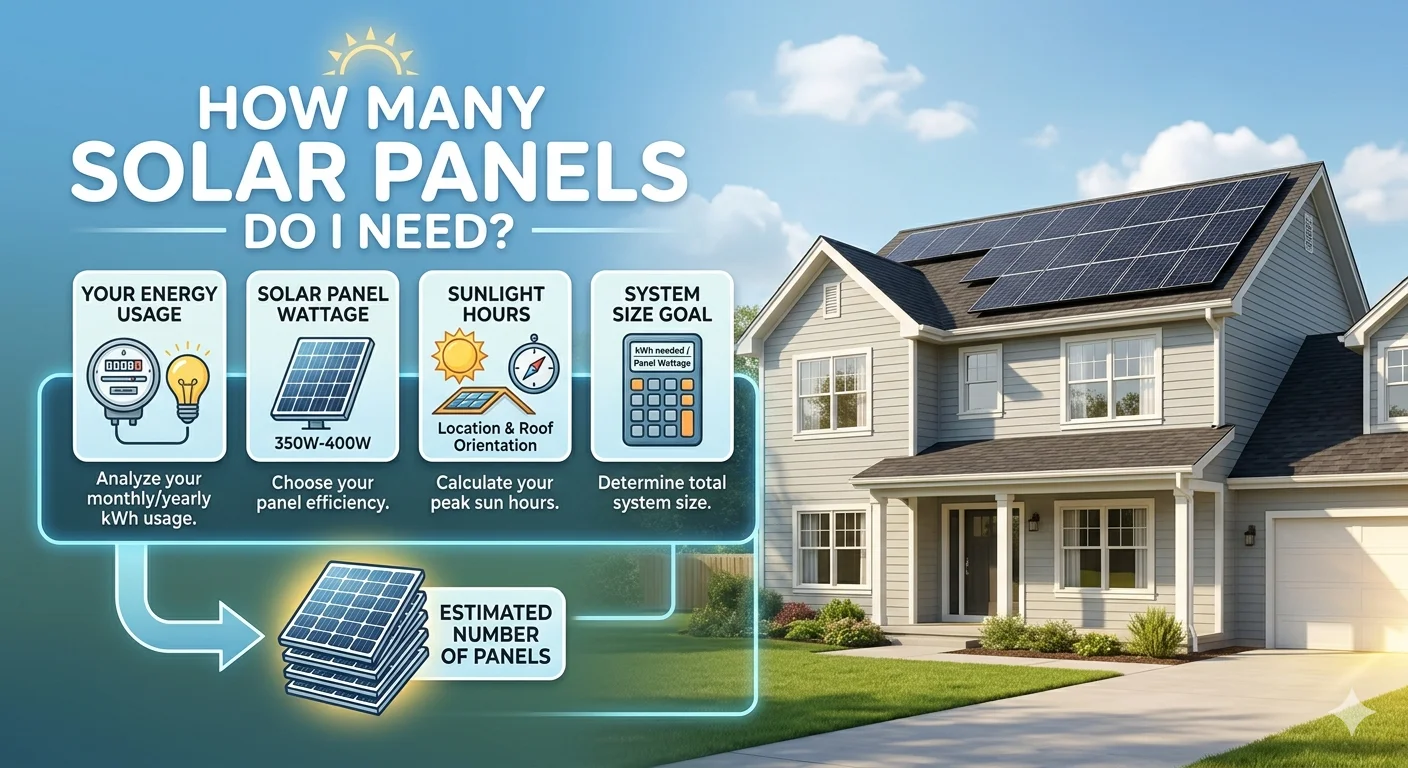
The 3 Things That Decide Your Number
Three factors control how many panels you need.
1. Your yearly electricity use, measured in kilowatt-hours (kWh).
2. Your local sun resource, called specific yield.
3. The wattage of each panel you install.
Get these three right and the math is simple. Skip them and you risk a system that is too small or too large. The average Canadian household uses around 10,000 to 11,000 kWh per year, per Statistics Canada. Your own bills always beat any average.
The Formula: How to Calculate Your Solar Panel Count
Use this formula to size your system.
Panels needed = (Annual kWh ÷ Specific yield) × 1,000 ÷ Panel wattage
Here is how to work through it step by step.
4. Add up 12 months of hydro bills to find your yearly kWh. Do not multiply one month by 12. Seasonal swings make that wrong.
5. Find your province's specific yield. This is the power each kilowatt of panels makes per year.
6. Divide your yearly use by the specific yield. This gives your system size in kilowatts.
7. Divide the system size in watts by your panel wattage. Most 2026 panels are 420W.
Worked Example: A Mississauga Home
Let us run a real example.
• Yearly use: 10,200 kWh from a 12-month statement.
• Specific yield in Mississauga: about 1,150 kWh per kW.
• System size: 10,200 ÷ 1,150 = 8.87 kW.
• Panel wattage: 420W.
• Panels needed: 8,870 ÷ 420 = 21 panels.
This home needs 21 panels on an 8.87 kW system. Costs and payback then depend on the chosen installer and incentives.
Solar Panels Needed by Province (2026)
Your province's sun resource is the biggest factor after your usage. Southern Ontario and Alberta get strong sun. They rival parts of Germany, a world leader in home solar. The table below shows typical ranges, drawn from Natural Resources Canada photovoltaic potential data.
Province | Avg Use (kWh/yr) | Specific Yield | System Size | Panels (420W) |
Ontario | 9,000-9,500 | 1,100-1,200 | 7.5-8.6 kW | 18-21 |
Alberta | 7,200 | 1,280-1,400 | 5.1-5.6 kW | 12-13 |
British Columbia | 10,800-15,600 | 1,000-1,150 | 9.4-13.6 kW | 22-32 |
Nova Scotia | 10,000 | 1,050-1,150 | 8.7-9.5 kW | 21-23 |
New Brunswick | 9,500-12,000 | 1,100-1,150 | 8.3-10.9 kW | 20-26 |
Saskatchewan | 7,500-9,000 | 1,340-1,385 | 5.4-6.7 kW | 13-16 |
Manitoba | 9,000-11,000 | 1,250-1,300 | 7.1-8.6 kW | 17-21 |
Sources: NRCan Photovoltaic Potential Maps, provincial energy boards, and Canada Solar Pro project data.
Panels by City and Utility
Sun levels and power prices change from city to city. Local rules and incentives also shift your payback. See current programs on our solar incentives page.
Ontario Cities
City | Local Utility | Specific Yield | Panels (420W) |
Toronto | Toronto Hydro | ~1,096 | 19-21 |
Mississauga | Alectra | ~1,150 | 18-20 |
Ottawa | Hydro Ottawa | ~1,200 | 17-19 |
Hamilton | Alectra | ~1,150 | 18-20 |
London | London Hydro | ~1,140 | 18-20 |
Alberta, Atlantic Canada and BC
City | Local Utility | Specific Yield | Panels (420W) |
Calgary | Enmax | ~1,290 | 12-14 |
Edmonton | EPCOR | ~1,245 | 13-14 |
Halifax | NS Power | ~1,100 | 21-23 |
Vancouver | BC Hydro | ~1,004 | 24-30 |
Panels by Home Size
Square footage gives a rough guide only. Your hydro bill is far more accurate. Use this table for early planning.
Home Size | Yearly Use | System Size | Panels (420W) | Roof Space |
Small / condo (under 1,200 sq ft) | 5,000-7,000 | 4.5-6 kW | 11-14 | 210-270 sq ft |
Mid-size (1,200-2,000 sq ft) | 7,000-10,000 | 6-8.5 kW | 14-20 | 270-380 sq ft |
Large (2,000-3,000 sq ft) | 10,000-14,000 | 8.5-12 kW | 20-29 | 380-550 sq ft |
Estate / rural (3,000+ sq ft) | 14,000-20,000+ | 12-15+ kW | 29-36+ | 550+ sq ft |
Each 420W panel covers about 19 sq ft of roof.
Factors That Change Your Panel Count
Four real-world factors push your number up or down.
1. Roof Direction and Tilt
A south-facing roof at a 30 to 45 degree tilt works best at Canadian latitudes. East-west arrays produce about 85 to 90% of a south array's output. North-facing sections are not suitable for solar.
2. Shading
One tree branch can cut a panel's output by 20 to 40% with string inverters. Microinverters fix this by running each panel on its own. Shaded roofs may need 2 to 4 extra panels.
3. Panel Efficiency and Wattage
In 2026, most Tier-1 residential panels rate 400 to 450W at 21 to 23% efficiency. Higher wattage panels mean fewer panels for the same system size.
4. Future Energy Needs
Planning an EV, a heat pump, or a switch off gas? Oversize now. Adding panels later costs more per watt because permits and racking must be redone.
How Many Extra Panels for an EV?
Electric vehicle adoption is rising fast in Canada. Add charging to your sizing from day one.
Driving | Extra kWh / yr | Extra Panels (420W) |
Light commuter (10,000 km) | ~1,800 | 4 |
Average driver (15,000 km) | ~2,700 | 6 |
Heavy driver (20,000 km) | ~3,600 | 7-8 |
Two-EV household (30,000 km) | ~5,400 | 11-12 |
How Many Extra Panels for a Heat Pump?
Heat pumps are replacing gas furnaces across Canada. They run on electricity. So they raise your power use and your panel count. A cold-climate heat pump can add 2,000 to 6,000 kWh per year.
Heating Load | Added kWh / yr | Extra Panels (420W) |
Mild climate / small home | 2,000-3,000 | 5-7 |
Average home, cold winters | 3,000-4,500 | 7-11 |
Large home / very cold region | 4,500-6,000 | 11-15 |
Size for the heat pump now if you plan to switch within five years.
Net Metering vs Load Displacement: How Grid Choice Affects Size
How you connect to the grid changes your ideal size.
Sizing Path | Recommended Size | Best For |
Net metering (full offset) | 100-110% of use | Simple setup, no battery |
Rebate + battery (load displacement) | 70-85% of use | Maximizing rebates |
Future-proofed (EV + heat pump) | 120-140% of use | Electrification-ready homes |
In Ontario, the Home Renovation Savings Program pays for solar but bans net metering. So your sizing path and your rebate choice are linked. Pick the path before you pick the panel count.
How 2026 Incentives Affect Your System Size
The incentive map changed in 2025. Both federal home programs closed, per Natural Resources Canada.
• The Canada Greener Homes Grant closed in early 2024.
• The Canada Greener Homes Loan closed on October 1, 2025.
• A new program, the Canada Greener Homes Affordability Program, now targets lower-income households.
• The 30% Clean Technology tax credit applies to businesses only, not homes.
Provincial programs now lead. Here are the headline ones for 2026.
• Ontario HRSP: $1,000 per kW solar (max $5,000) plus $300 per kWh battery (max $5,000).
• BC Hydro: up to $10,000 for solar and battery.
• Efficiency Manitoba: $0.50 per watt, up to $5,000.
• NB Power THESP: $200 per kW, up to $3,000.
• Nova Scotia: $0.30 per watt up to $3,000, plus strong net metering.
• Alberta: no provincial rebate, but cities like Banff and Medicine Hat help. Property-tax financing covers up to $50,000.
These rebates often reward a smaller, smarter system. So your panel count and your incentive choice work together.
Common Sizing Mistakes to Avoid
Sizing from square footage
Two identical 2,000 sq ft homes can use 6,000 or 18,000 kWh. Heating type, family size, and habits drive the gap. Always use your real bills.
Ignoring seasonal output
Panels make 60 to 70% of their yearly output between April and September. Annual offset is what counts, not any single month.
Forgetting future loads
An EV adds 2,500 to 4,000 kWh per year. A heat pump adds 2,000 to 6,000 kWh. Plan for both before you size.
Trusting generic US calculators
They use US data. They miss Canadian snow, your roof pitch, and your local net metering rules.
What It Costs: System Size and Price (2026)
Price scales with system size. The table shows ballpark ranges before and after incentives. Typical payback runs 7 to 15 years in Canada.
System | Panels | Cost Before | Ontario After HRSP |
5 kW | 12 | $12,100-$17,500 | $7,100-$12,500 |
8 kW | 19 | $19,400-$28,000 | $14,400-$23,000 |
10 kW | 24 | $24,200-$35,000 | $19,200-$30,000 |
12 kW | 29 | $29,000-$42,000 | $24,000-$37,000 |
Ontario figures assume $5,000 solar plus $5,000 battery rebate. Municipal financing can bring the upfront cost to $0 in some cities.
Quick Reference: Size From Your Monthly Bill
No math? Find your monthly hydro bill below for a fast estimate.
Monthly Bill | Yearly kWh | System Size | Panels (420W) |
$80-$120 | 5,500-7,500 | 5-6.5 kW | 12-15 |
$120-$170 | 7,500-10,000 | 6.5-8.5 kW | 15-20 |
$170-$230 | 10,000-13,500 | 8.5-12 kW | 20-29 |
$230-$350 | 13,500-20,000 | 12-15+ kW | 29-36+ |
Do Solar Panels Work in Canadian Winters?
Yes. Cold air actually helps. A panel at -20°C can make up to 18% more power than the same panel at 35°C. Snow slides off tilted panels fast. Your yearly sizing already covers the full 12-month cycle. For the full breakdown, read our winter solar guide.
How Canada Solar Pro Helps You Get the Right Count
We are not an installer. We are Canada's solar comparison platform. We match you with independent local pros who size your system properly. Here is how it works.
8. You share your postal code and a few details. It takes about two minutes.
9. We match you with vetted installers in your area within 24 hours.
10. Each installer reviews your real hydro bills and roof.
11. They use satellite imagery and shading analysis, not generic averages.
12. You compare clear, no-obligation quotes and choose.
See the full process on our How It Works.
How to Check an Installer's Panel Count Before You Sign
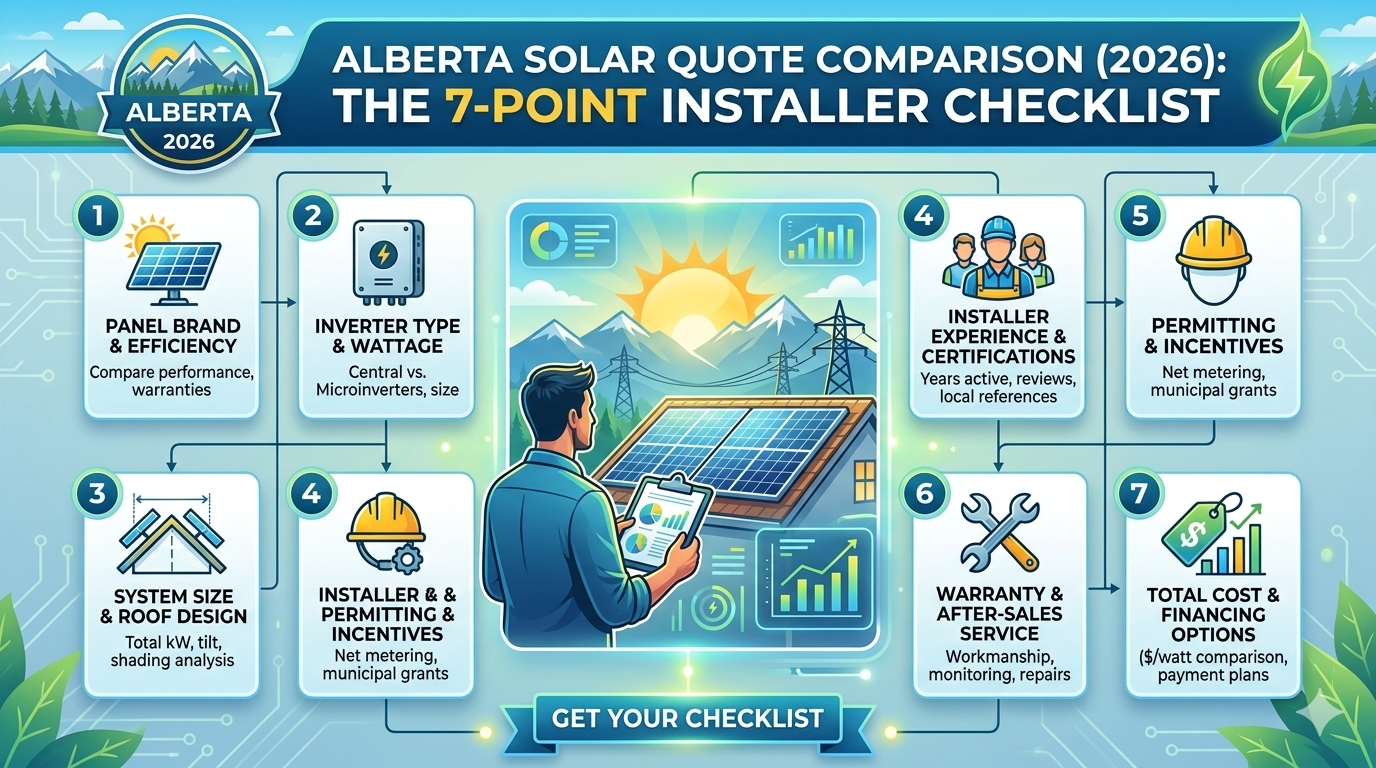
A good quote shows its math. Use this checklist before you commit.
• Does the quote list your annual kWh from your bills?
• Does it state the specific yield used for your area?
• Does it name the panel wattage and brand?
• Does it model both net metering and rebate paths?
• Does it account for shading and roof direction?
If a quote skips these, ask questions. Comparing several quotes makes weak math easy to spot. You can also vet installers using our Best Solar Companies in Ontario guide with trusted local installers in 24 hours. Compare quotes free, with no obligation.