Calgary is one of Canada's best cities for solar — but only if you go in informed. Here's the complete, no-fluff guide before you sign anything.
More Calgary homeowners are going solar every year. Rising ENMAX rates, a deregulated electricity market that creates price unpredictability, and improving panel technology have all shifted the math firmly in favour of installation. But solar is a 25-year decision, and getting it right requires more than a quick quote.
This guide covers everything you need to know before a single panel goes on your roof: how much sun Calgary actually gets, what your home needs to qualify, what a system really costs, how permits work, how panels perform in winter, and what incentives are available in 2026.
Why Calgary Is One of Canada's Best Cities for Solar
Let's start with the fundamentals — because Calgary's solar resource is genuinely exceptional and often undersold.
Calgary receives approximately 2,396 hours of bright sunshine annually, with around 333 sunny days per year. That's more annual sunshine than Miami, despite the cold winters. Calgary's irradiance of 1,350 kWh/m² per year means each kilowatt of installed solar capacity produces approximately 1,250–1,350 kWh of electricity annually — among the highest yields in the country.
Combined with Alberta's deregulated electricity market (where rates can spike unpredictably), rising baseline ENMAX rates, and a no-PST advantage that saves you $1,000–$3,000 on installation versus provinces with provincial sales tax, Calgary sits at a genuinely favourable intersection of solar resource and financial incentive.
Is Your Home a Good Candidate for Solar?
Not every home is equally suited to solar. Before getting quotes, do a quick self-assessment across these four areas:
1. Roof Orientation and Pitch
The ideal Calgary solar roof faces south at a pitch of 30–45 degrees. This orientation captures the most direct sunlight throughout the year and produces the highest annual output.
That said, south-facing isn't mandatory:
- Southeast or southwest orientations still produce 90–95% of peak south-facing output — a negligible difference in the context of a 25-year system
- East-west split arrays (panels on both sides of the roof) are a viable option when south-facing space is limited, sacrificing some peak efficiency to gain total capacity
What you want to avoid is a north-facing roof as your primary array area, which significantly reduces annual production.
2. Roof Condition and Age
This is one of the most overlooked factors. Solar panels are warranted for 25–30 years. If your roof is already 10–15 years old and due for replacement within the next 5 years, replace the roof first — or plan to do both together. Removing and reinstalling solar panels for a mid-life reroof adds $2,000–$4,000 to the project.
Ask your installer to assess your roof's remaining life as part of the site evaluation.
3. Shading
Shading is the enemy of solar production. Trees, neighbouring buildings, chimneys, dormers, and rooftop vents can all cast shadows that meaningfully reduce output — especially if you're using a standard string inverter where one shaded panel can drag down the entire string.
A good installer will conduct a shading analysis (often using tools like Aurora Solar) to model your specific roof at different times of day and year. If your roof has significant shading, microinverters — which optimize each panel individually so one shaded panel doesn't affect the others — are worth the additional cost.
4. Electrical Panel
Many Calgary homes, particularly those built before 2000, have 100-amp electrical service. Solar systems, especially when paired with an EV charger or heat pump, typically require 200-amp service. Upgrading your electrical panel costs $2,000–$4,000 and should be factored into your total project budget if needed. A licensed installer will assess this during your quote.
How Much Does a Calgary Solar System Cost in 2026?
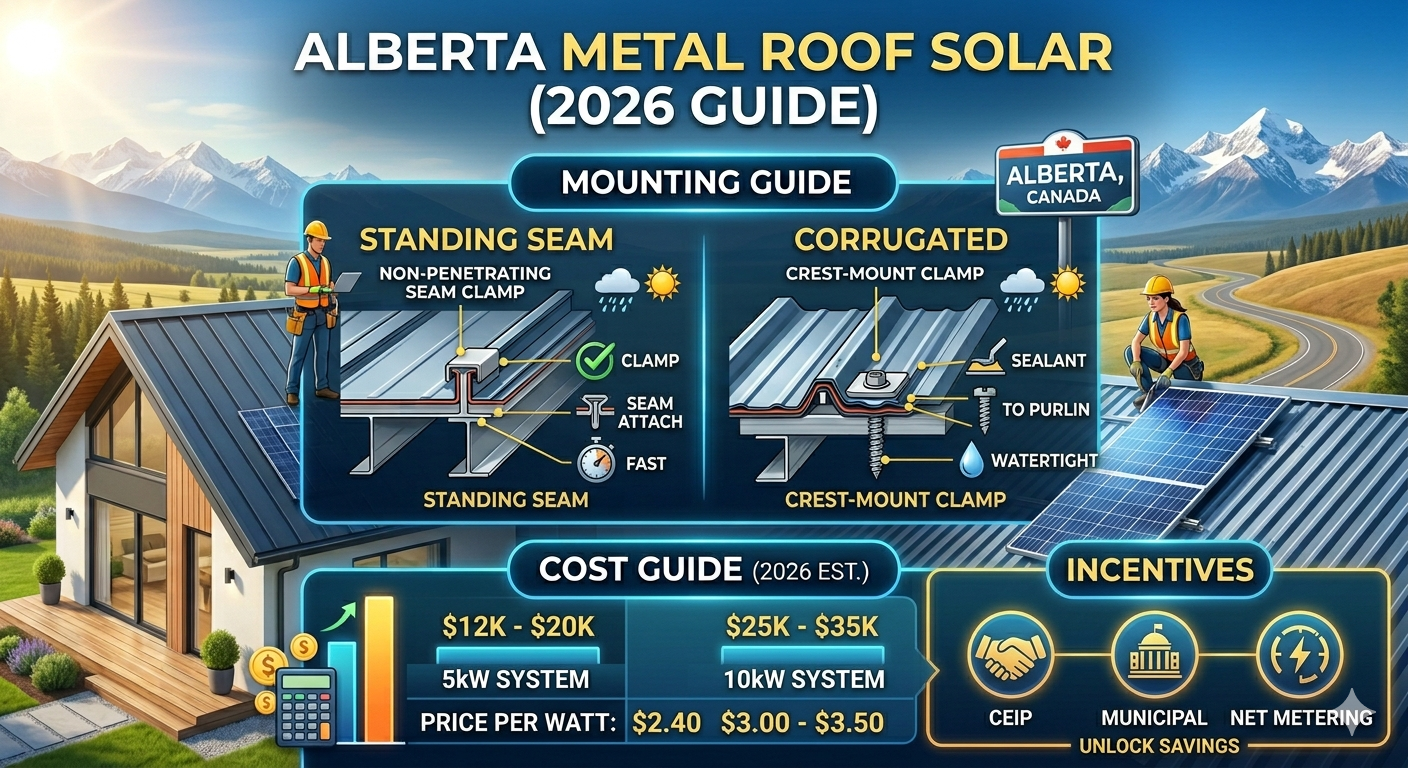
Solar panel installation in Calgary runs approximately $2.70–$3.20 per watt in 2026. For the systems most Calgary homes need:
| System Size | Typical Use Case | Installed Cost (Pre-Incentive) |
|---|---|---|
| 6 kW | Smaller home or condo, ~7,200 kWh/yr usage | $16,200–$19,200 |
| 8 kW | Average Calgary home, ~9,600 kWh/yr usage | $21,600–$25,600 |
| 10 kW | Larger home or EV charging, ~12,000 kWh/yr usage | $27,000–$32,000 |
What affects the final price:
- Panel efficiency: Higher-efficiency panels (21–23%) cost more per watt but produce more power per square foot — valuable on a space-limited roof
- Inverter type: String inverters ($1,500–$3,000) are the most affordable; microinverters ($3,000–$5,000) are better for roofs with shading
- Roof complexity: South-facing roofs at 30–45° pitch are the most straightforward; east-west splits, flat roofs, or ground-mounted systems add $1,000–$5,000
- Electrical panel upgrade: Add $2,000–$4,000 if required
Alberta's no-PST advantage: Unlike homeowners in Ontario, BC, or Saskatchewan, Calgary buyers pay only 5% GST on solar equipment and installation — saving $1,000–$3,000 versus PST provinces on a typical system. For a deeper cost breakdown, see our Calgary solar installation cost guide.
What Incentives Are Available in Calgary in 2026?
CEIP (Clean Energy Improvement Program)
Calgary's primary solar incentive in 2026 is not a grant — it's a zero-down, low-interest financing program that covers 100% of your installation cost (up to $50,000), repaid through your property tax bill. The 2026 fixed rate is 3.75% over up to 20 years, with a completion bonus of up to 10% of project costs. Applications opened in March 2026 — check calgary.ca/ceip for current round status. Read our full CEIP solar guide for Calgary.
No PST on Solar
Alberta charges only 5% GST on solar — no provincial sales tax. This is a passive but real saving on every installation.
ENMAX Net Metering
Under Alberta's Micro-Generation Regulation, your solar system can export surplus electricity to the ENMAX grid in exchange for bill credits. Credits roll over month to month and settle annually. This effectively uses the grid as free battery storage — the excess your panels produce in June offsets your higher usage in December. Learn more in our Alberta net metering guide.
Solar Club (High-Export Rates)
Some Alberta electricity retailers offer what's known as a "Solar Club" — an arrangement where you sell summer surplus to the grid at high export rates (approximately 30¢/kWh) and buy back power in winter at low rates (approximately 12¢/kWh). This buy-low, sell-high dynamic is how some Calgary homeowners reach near-zero annual electricity costs.
Do Solar Panels Work in Calgary Winters?
This is the question every Calgary homeowner asks — and the honest answer will probably surprise you.
Yes. Solar panels not only work in Calgary winters, they actually perform more efficiently in cold temperatures.
Here's the physics: solar panels are rated at 25°C. Every degree below that operating temperature improves electrical conductivity and boosts output by approximately 0.5%. On a crisp, clear Calgary winter day at -10°C, panels are running 35°C below their rated temperature — generating electricity more efficiently than they ever do on a hot summer afternoon.
The University of Calgary and NAIT have both studied winter solar performance in Alberta. NAIT's reference array in Edmonton found that panels lost only about 5% of annual production to snow — far less than most homeowners expect.
Why snow isn't the problem people think it is:
- Panels are installed at angles of 20–45° that help snow slide off naturally
- The dark panel surface absorbs heat even in weak winter light, warming the glass
- Alberta's dry, powdery snow (unlike wet Maritime snow) clears within a day or two
- Calgary's frequent Chinook events can clear panels entirely within hours
The bottom line on winter production: Calgary solar systems typically generate 25–35% of their peak output during the October–March period — and the massive summer surplus (up to 17 hours of daylight in June) more than compensates annually. Your installer's production estimate already accounts for typical winter losses.
Permits and Regulations in Calgary
Unlike some renovation projects, solar in Calgary always requires permits. Here's what's involved:
Electrical Permit
Mandatory for all solar PV installations. The work must be performed by a licensed and registered electrical contractor in Calgary. Solar installers are electricians who have completed additional training specific to PV system design and installation.
Building Permit
Required when a solar collector is roof-mounted. Per the City of Calgary's Land Use Bylaw:
- A solar collector on a roof with a pitch of 4:12 or greater may project a maximum of 1.3 m from the roof surface
- The system must not extend beyond the outermost edge of the roof
- Fire safety setbacks from roof edges must be observed to ensure firefighter access
Utility Interconnection
Your installer must also obtain approval from ENMAX (or your local utility) for grid connection. This is handled by the installer as part of the installation process and ensures your system's safe integration into the electricity grid, as required under the Alberta Electrical Utility Code.
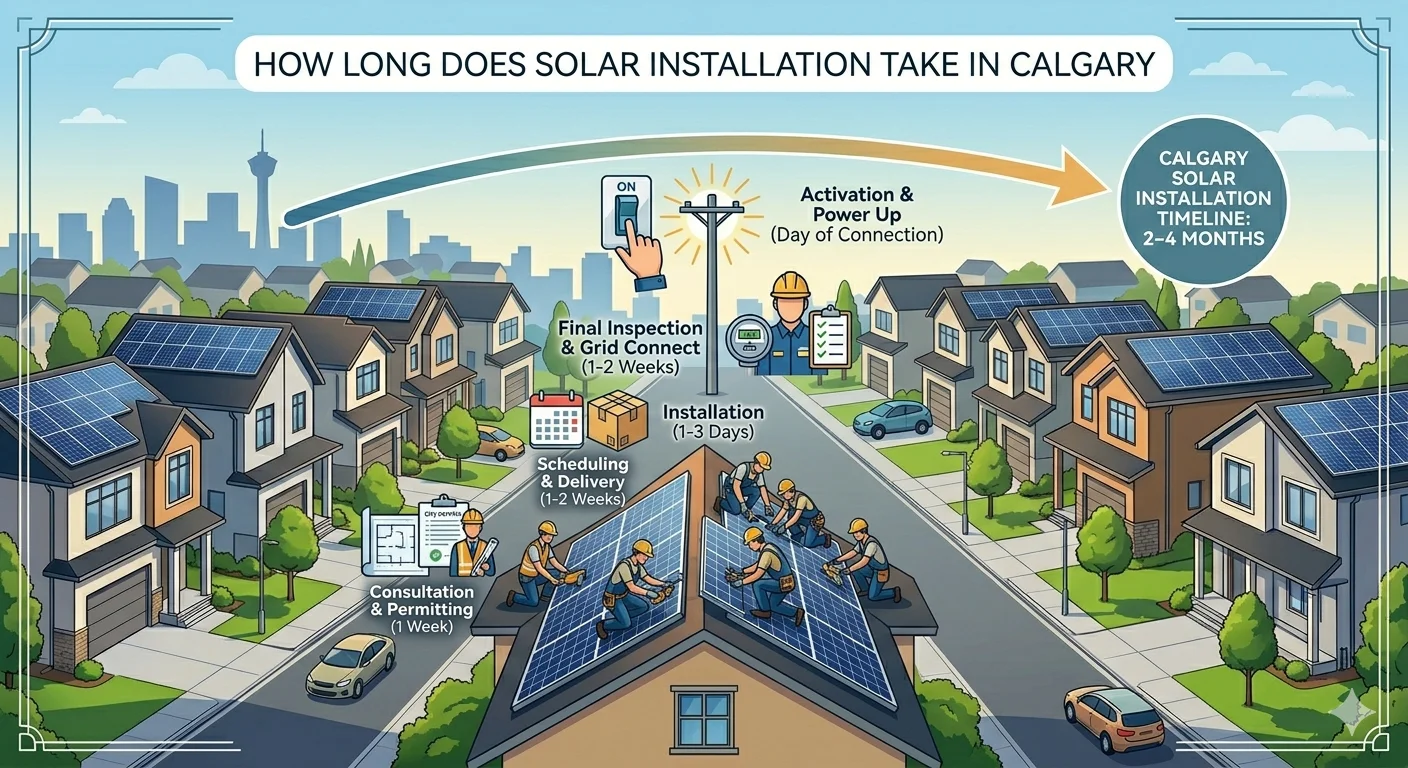
The practical reality: Reputable Calgary solar installers handle all permits and utility applications on your behalf. A quality installer will have never had a system rejected due to permit non-compliance — it's part of what you're paying for. See our Calgary solar installation timeline for a phase-by-phase breakdown.
How Much Will You Actually Save?
Real savings depend on your system size, your electricity consumption, your rate plan, and how much of your solar production you self-consume versus export.
A realistic model for a typical 8 kW Calgary system:
- Annual production: ~10,000–11,500 kWh
- Annual electricity savings (at 18¢/kWh all-in, including delivery charges): $1,800–$2,100/year
- System cost after no-PST advantage and CEIP completion bonus: ~$22,000–$24,000
- Payback period: 8–12 years
- Remaining years of near-free electricity after payback: 15–20+
- Estimated home value increase: 3–5% (~$15,000–$25,000 on a $500,000 home)
And importantly, as ENMAX rates continue to rise (as they have consistently for the past decade), your annual savings increase year over year — the solar system's value grows with inflation while its production cost stays at zero.
The Most Common Mistakes Calgary Homeowners Make
Before you sign a contract, watch for these:
- Not assessing the roof first. Installers in a hurry may skip a thorough roof condition check. Always ask about remaining roof life before proceeding.
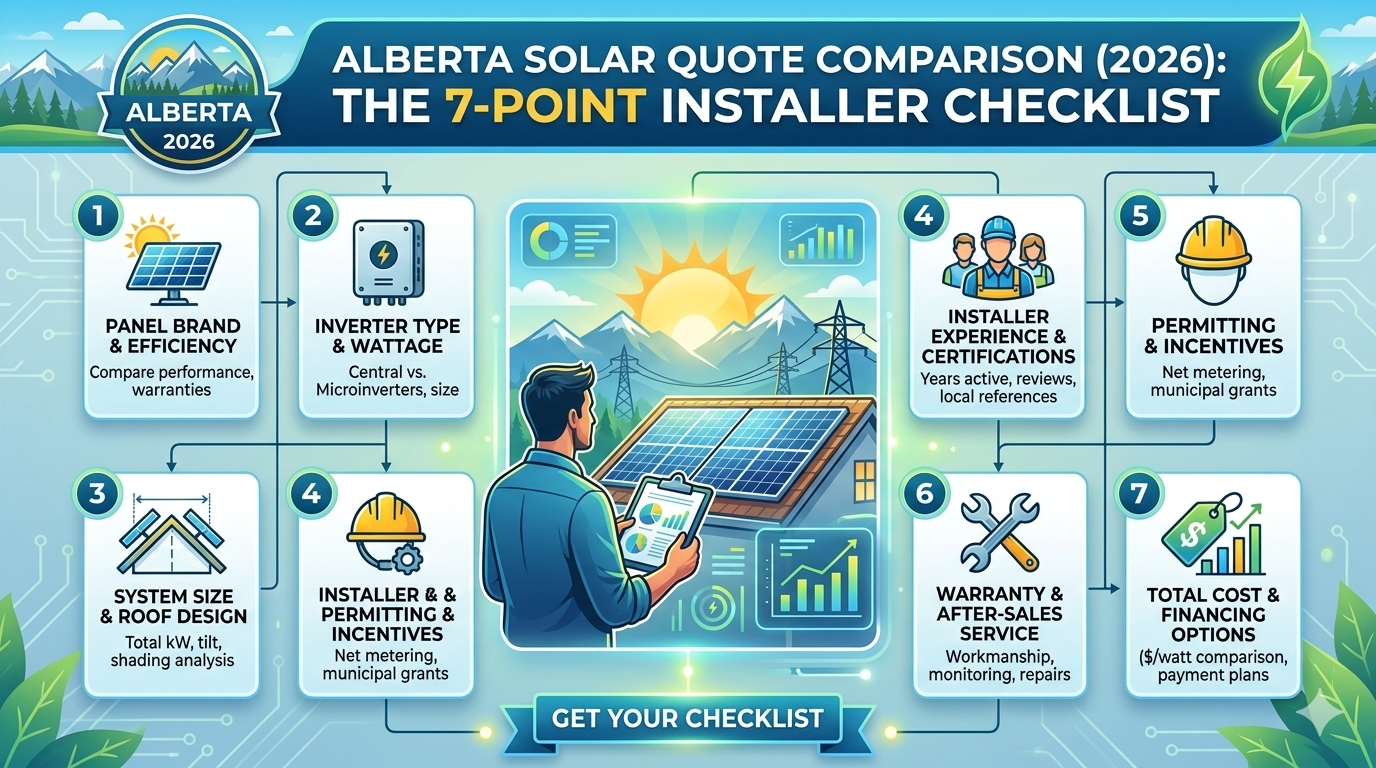
- Getting only one quote. Solar pricing in Calgary varies significantly between installers. Get at least 2–3 quotes from CEIP-registered companies.
- Choosing the cheapest panels. Tier 1 panels from reputable manufacturers (Tier 1 classification is maintained by BloombergNEF) come with meaningful warranty backing. Off-brand panels might save $500 upfront and cost you a warranty claim down the road.
- Oversizing or undersizing the system. A system significantly larger than your annual consumption generates surplus you can't fully use. A system too small leaves money on the table. Your installer should size the system to your actual electricity bills — ideally 12 months of consumption data.
- Missing the CEIP application window. CEIP application rounds in Calgary are time-limited and fill up fast. If you're planning to use CEIP financing, get your quote and documentation ready before the window opens — not after.
Your Pre-Installation Checklist
Before you proceed with any installer, work through this list:
- Pull 12 months of electricity bills to establish your actual consumption
- Check your roof age and condition — replace if needed within 5 years
- Identify which roof faces (south, east, west) have usable space
- Walk your roof perimeter and note potential shading sources (trees, neighbours)
- Check whether your electrical panel is 100A or 200A service
- Verify the CEIP application window status at calgary.ca/ceip
- Get quotes from 2–3 CEIP-registered Calgary solar installers
- Ask each installer for a site-specific shading analysis and production estimate
- Confirm each quote includes permits, utility interconnection, and warranty terms
Bottom Line
Calgary's solar fundamentals are strong: exceptional sunshine, rising electricity costs, zero PST, CEIP financing, and net metering combine to make this one of the most financially compelling solar markets in Canada. The typical 8 kW system pays itself back in under 12 years and generates free electricity for another two decades.
The key is going in prepared — with the right roof, the right system size, the right installer, and the right financing. Use this guide as your starting point, and you'll be in a position to make a genuinely informed decision.
Get Your Free Calgary Solar Quote
Ready to find out what solar will cost for your Calgary home? Canada Solar Pro connects you with pre-vetted local installers and gives you a clear cost and savings projection — free, no obligation.
Last updated: June 2026. Incentive programs, permit requirements, and electricity rates are subject to change. Always verify current details directly with the City of Calgary, ENMAX, and prospective installers.