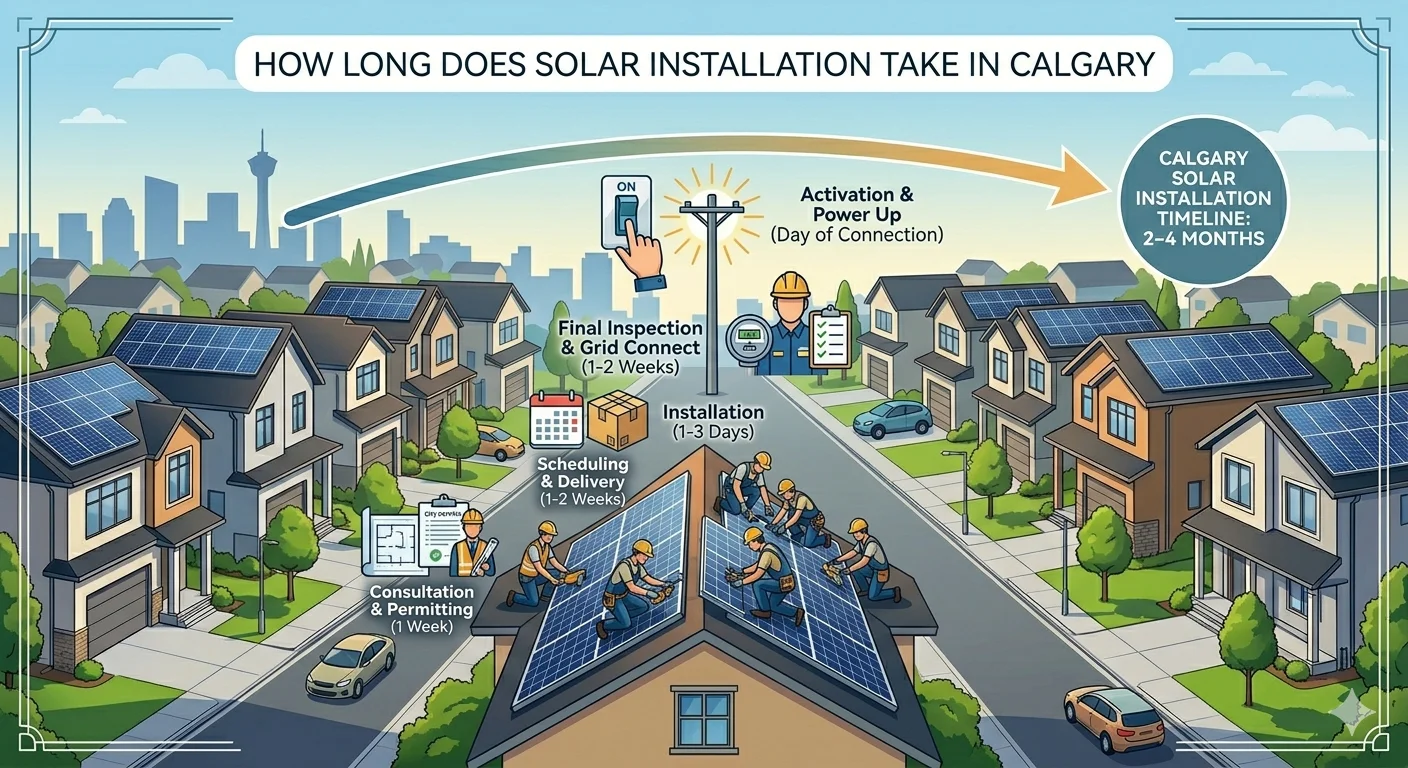
If you are a homeowner in this city thinking about solar energy, your first question is likely: how long does solar installation take in Calgary? The quick answer is that the rooftop work itself takes about 1 to 3 days. But the full project from your first call to the moment your panels start making power runs closer to 6 to 12 weeks.
That gap catches most people off guard. The reason is simple. A solar panel installation involves much more than putting panels on a roof. Your installer must visit your property, design a custom system, apply for permits through the City of Calgary, pass an inspection by the Alberta Safety Codes Authority, and get grid hookup approval from ENMAX. Each step adds time to the total Calgary solar installation timeline.
This guide walks you through every phase of the solar installation process Alberta homeowners go through. We cover real timelines for each step, explain what causes holdups, and share tips to get your system running faster. According to Natural Resources Canada, this city gets over 2,400 hours of sun each year, making it one of the best spots in the country for solar. Whether you are still gathering quotes or ready to sign, this is the most detailed resource on solar panel installation time you will find in 2026. Learn how our solar process works step by step.
Quick Answer: Solar Installation Timeline at a Glance
Before we dive in, here is a quick look at the typical Calgary solar installation timeline for a home project in 2026.
Project Phase | Typical Duration | Who Handles It |
Consultation + Site Assessment | 3 to 7 days | Solar installer |
System Design + Engineering | 1 to 2 weeks | Solar engineer |
Permits + Approvals | 2 to 4 weeks | Installer + City of Calgary |
Physical Installation | 1 to 3 days | Crew on your roof |
Safety Codes Inspection | 1 to 2 weeks post-install | Alberta Safety Codes Authority |
ENMAX Grid Hookup + PTO | 4 to 8 weeks post-install | ENMAX / FortisAlberta |
TOTAL: Quote to Power-On | 6 to 12 weeks | Full-service installer |
The rooftop work is the shortest part. Most of the time goes into permits, approvals, and the ENMAX solar interconnection process. A good solar installer handles all of these steps for you so you never chase papers yourself.
Phase 1: First Consultation and Site Assessment (Week 1)
Every solar project starts with a site visit. A licensed consultant checks your home to see if it works well for solar. The visit takes a few hours, but booking it may take 3 to 7 days based on the installer's schedule.
What Happens During the Site Assessment?
The assessor checks your roof for its shape, angle, which way it faces, and any shading from trees or nearby structures. South-facing roofs give the best results, but east and west-facing setups also work well in Alberta. The assessor also looks at your electrical panel. Homes still running a 100 amp service often need a 200 amp panel upgrade before solar can hook in safely.
Your installer reviews 12 months of ENMAX bills to size your system right. Most Alberta homes use about 7,200 to 10,000 kWh of power per year. A well-sized 6 to 10 kW system can offset most of that thanks to over 2,400 hours of yearly sunshine, more than Miami and more than any other major city in Canada. Have questions about the early steps? Check our frequently asked questions page for quick answers.
What Can Slow This Phase Down?
Scheduling is the top delay here. Peak season runs from March through September, when solar companies get the most calls. Book your first visit in January or February to beat the rush. Roof repairs or structural issues found during the visit can also add time.
Phase 2: System Design and Engineering (Weeks 2 to 3)
After the site visit, a solar engineer designs a custom system for your home. Every roof is different, and the design must factor in local weather, structural loads, and rules from the Alberta Building Code and the Canadian Electrical Code.
How Engineers Design Your System
Good solar companies use HD aerial images, LiDAR mapping, and shading tools to build your panel layout. The engineer picks the right number of panels, places them for peak sun, and selects the best inverter type. They also run snow load math to ensure the racking handles Alberta winter weight. Solar Alberta, the province's main solar group, notes that proper engineering is the single biggest factor in long-term system output.
Why Local Roofs Need Extra Design Care
Hail is a real concern here. Good panels should be rated to handle 25mm hailstones at 80 km per hour, meeting the IEC 61215 standard. Chinook winds are another factor. These warm, fast gusts need proper wind load design in the racking system. A skilled local installer bakes these details into every project from day one.
Phase 3: Permits and Approvals (Weeks 3 to 6)
This is where the solar installation timeline slows down the most. Government agencies control the pace here, not your installer. Knowing what to expect helps you plan better.
What Permits Do You Need?
A solar panel permit Calgary project needs at least one must-have permit and maybe two more. An electrical permit is a must for all solar work in Alberta. The Alberta Safety Codes Authority reviews it. A building permit from the City of Calgary may also apply if the panels add major weight to your roof. A development permit only comes into play for homes in heritage zones or areas with special rules.
How Long Does the Permit Process Take?
How long does it take to get a solar permit in Calgary? Electrical permits usually clear in 1 to 2 weeks. Building permits take 2 to 4 weeks based on the City's workload. Clean, code-ready filings move faster, which is why picking a skilled installer makes a real difference. During peak summer months, expect slightly longer wait times.
ENMAX Grid Hookup Application
Your installer sends a hookup request to ENMAX Power under Alberta's Micro-Generation Regulation. This law lets homeowners make their own power and earn credits for extra energy sent back to the grid. How long does ENMAX net metering approval take? Most homeowners wait 4 to 8 weeks after the install for final sign-off. You can learn more about ENMAX micro-generation rules on their website.
ENMAX does block power export in some secondary network zones for safety reasons. Your installer should check this during the design phase. For homes beyond city limits, the request goes to FortisAlberta instead, and timelines may vary.
Phase 4: Installation Day, What Happens on Your Roof (1 to 3 Days)
This is the part most homeowners look forward to. Once permits clear and gear arrives, the crew starts work. For a standard home system, expect them on your roof for 1 to 3 days.
Day-by-Day Breakdown
On day one, the crew sets up safety gear and bolts the racking system to your roof rafters. This racking holds your panels in place for decades. Most local installers use heavy-duty mounting systems rated for Alberta wind and snow.
By late day one or early day two, panels go onto the racking. The crew routes wiring through conduit from the panels to the inverter and electrical panel. Good installers hide wiring through attic drops so you see less conduit on the outside of your home.
On the last day, the crew connects the inverter, wires the system into a new solar breaker, and sets up monitoring so you can track output from your phone. They test each panel for proper voltage and confirm the system talks to the monitoring platform. Your system is now physically done but stays off until it clears inspection. See our full installation process here.
How to Prepare for Installation Day
How to prepare for solar installation is a question we hear often. Clear your driveway and any areas near the roof so the crew works safely. Move outdoor items away from the work zone. Keep pets inside. Make sure the space around your electrical panel is easy to reach. Have someone 18 or older home during the work for any quick decisions the crew may need.
Does Power Go Out During the Install?
Yes, for a brief stretch. During the final wiring tie-in, power goes off for about 1 to 2 hours. This is normal. Your system stays off after this step until it passes inspection and gets ENMAX approval.
Phase 5: Inspection and Grid Approval (Weeks 2 to 8 Post-Install)
After the crew finishes, two more steps must happen before your panels make power and earn credits. This waiting period is the hardest part for most homeowners because outside agencies control the pace.
Alberta Safety Codes Inspection
A licensed inspector from the Alberta Safety Codes office visits your home to confirm everything meets code. The solar panel inspection usually gets booked 1 to 2 weeks after the install. The inspector checks racking, wiring, conduit, grounding, inverter hookups, and the solar breaker. If it passes, you get a compliance certificate.
What if the inspection fails? Minor fixes like a loose wire or missing label get corrected by your installer and rechecked within days. These issues are rare with skilled installers but can add a few days.
ENMAX Net Metering Hookup and Permission to Operate
After passing inspection, the last step is getting a green light from ENMAX. They install a two-way meter at your home at no charge. This meter tracks both the power you pull from the grid and the extra power your system sends back. How long does ENMAX net metering approval take? Most homeowners wait 4 to 8 weeks. In busy periods, this can stretch longer. Until you get PTO, your system cannot legally push power to the grid.
Once your system is live, joining the Alberta Solar Club can help you save even more by switching between high and low electricity rates based on your solar output each season.
What Can Speed Up or Delay Your Solar Project?
Not every project follows the same path. Several factors unique to this region can speed up or slow down your solar installation process.
Common Causes of Delays
An electrical panel upgrade tops the list. Older homes with 100 amp service cannot safely support solar. Upgrading to 200 amps adds 1 to 2 weeks and costs about 1,500 to 3,000 dollars. Roof repairs push the timeline further if your roof needs fixing before panels go on.
HOA approval in newer communities like Mahogany, Seton, Evanston, and Cranston can also hold things up. Some HOAs need a design review before any exterior changes. File your HOA request right after signing your solar contract so it runs at the same time as the permit process.
Solar installation delays also hit during peak season from March through September. Booking during off-peak months like October through February often means shorter waits. Hail season from June through August can pause outdoor work for a few days too.
How to Speed Things Up
Get quotes in January or February. Have 12 months of ENMAX bills ready before your first call. Fix known roof issues before asking for solar quotes. Most of all, pick a full-service installer who handles permits, inspections, and ENMAX hookup in-house. Fewer handoffs means fewer chances for gaps in the timeline. Get your free solar assessment today and we will give you a real timeline for your home.
Can You Install Solar Panels During Winter?
Can you install solar panels in Calgary winter? Yes. Cold weather does not stop solar work, and cold clear days are great for panel output because panels run better at lower temps. Snow and ice on the roof can delay the crew until conditions are safe. Shorter daylight hours shrink the work window, so a 1-day summer job might take 2 days in winter.
Many homeowners go ahead with winter installs because they skip the peak-season logjam. Your system is ready to capture full output when the long summer days arrive.
Real-World Example: A Typical Project Timeline
What to expect during solar installation is easier to grasp with a real scenario. Here is a typical 8 kW home project in the southwest part of the city with a south-facing roof and 200 amp panel already in place.
Week 1: The homeowner calls Canada Solar Pro and books a site visit. The assessor comes within 5 days and gives the green light.
Weeks 2 to 3: The engineering team designs the system using aerial images and LiDAR data. The homeowner reviews and approves.
Weeks 3 to 5: Permit applications go to the City for a building permit and to Alberta Safety Codes for an electrical permit. Both clear in about 3 weeks.
Week 6: The crew arrives Monday morning. Racking goes up on day one. Panels, wiring, and inverter hookup wrap up by Tuesday afternoon. Done in 2 days.
Week 7: The inspector visits and signs off. No issues found.
Weeks 8 to 12: ENMAX processes the micro-generation application, installs the two-way meter, and grants PTO.
Week 12: The system goes live. The homeowner starts making power and earning credits on their ENMAX bill. Total project time: about 12 weeks. The panels sat on the roof, fully ready, for roughly 5 weeks before ENMAX gave the final okay. This is normal.
How Much Does Solar Cost? (2026 Pricing)
Knowing costs along with timelines helps you plan the full picture. The solar panel installation cost homeowners pay in 2026 averages 2.70 to 3.20 dollars per watt. A small 3 to 5 kW system runs 12,000 to 18,000 dollars before rebates. A mid-size 6 to 8 kW system costs 18,000 to 28,000 dollars. A larger 9 to 12 kW system costs 28,000 to 40,000 dollars. Alberta charges no PST on these installs, which saves you money compared to most other provinces. For a deep dive into costs, read our full Alberta solar pricing guide for 2026.
Rebates and Financing in 2026
The CEIP (Clean Energy Improvement Program) is the biggest funding option for local homeowners. It lets you finance your solar install through property taxes over 10 to 20 years with no big upfront cost. The Alberta RCSP rebate may also cut your net cost based on program rules. Note: the Canada Greener Homes Grant closed to new applicants at the end of 2025. Most homeowners see a payback period of 8 to 14 years on a system built to last 25 to 30 years. See our complete breakdown of Alberta solar rebates, CEIP financing, and grants in 2026.
What Is the Best Time to Install Solar?
Solar installation scheduling matters. The best time to install solar panels is during late winter or early spring, from January through March. Starting early means permits clear before the spring rush and your system runs at full output by the long sunny days of May through August. If you miss that window, fall from September through November is the next best bet.
How Long Do Solar Panels Last in This Climate?
Modern panels carry a 25-year output warranty and keep making power for 25 to 30 years or more. After 25 years, panels still work but at about 80 to 85 percent of their starting output. Cold weather actually helps panels last longer because heat, not cold, speeds up wear. The 2024 hailstorm caused very little damage to panels across affected areas, proving that modern hail-rated panels hold up well under Alberta skies.