Most Manitobans assume solar panels in Manitoba struggle in our climate too cold, too much snow, not enough sun. The reality is the opposite. Manitoba averages over 2,300 hours of sunshine per year, and cold temperatures actually make solar panels more efficient. Whether you're in Winnipeg, Brandon, Portage la Prairie, or rural Manitoba, this guide explains exactly how solar panels work in Manitoba, what the installation process looks like, what rebates are still available in 2026, and how to make the smartest financial decision for your home.
How Solar Panels Actually Work
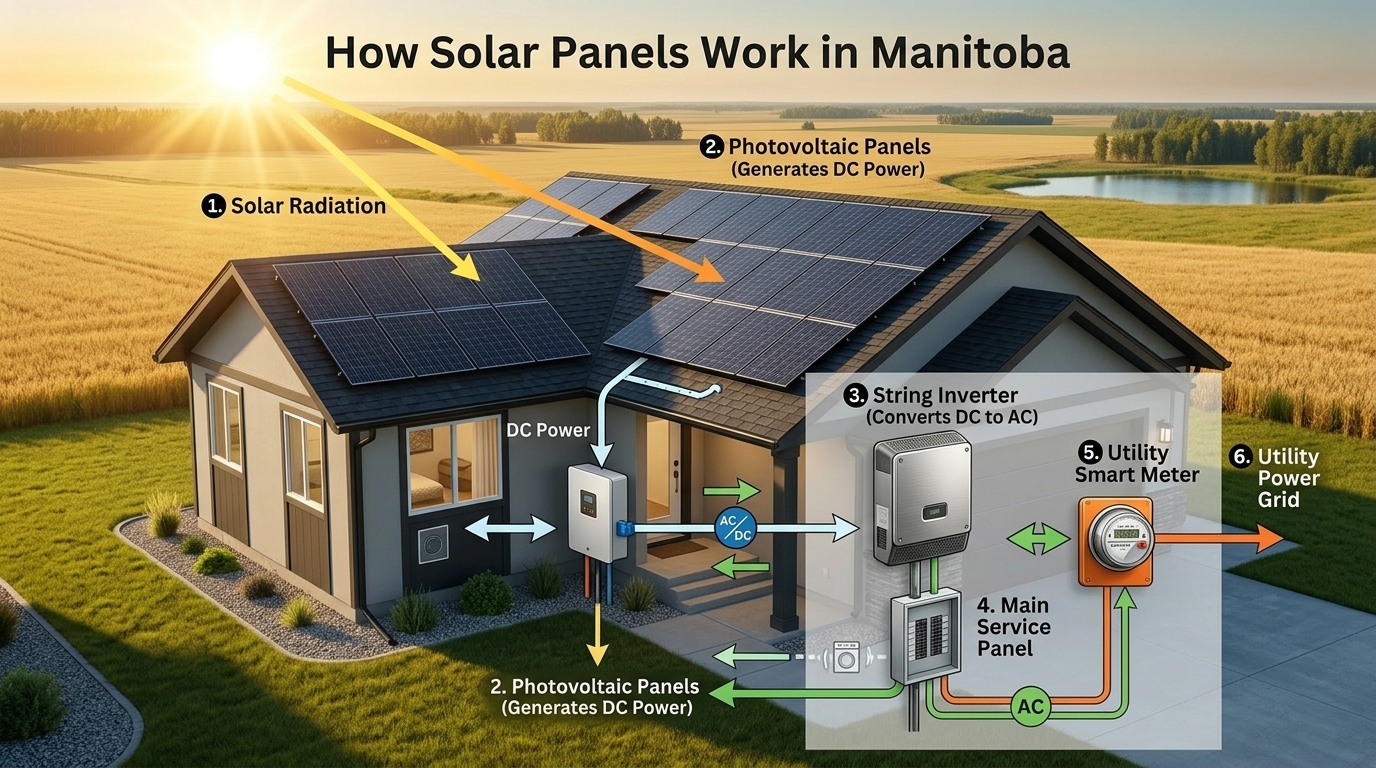
At its core, a solar panel converts sunlight into electricity using a process called the photovoltaic effect. Here is how the full system works, step by step:
Sunlight hits the solar panel. Each panel is made up of silicon photovoltaic (PV) cells. When photons from the sun strike these cells, they knock electrons loose from their atoms.
Direct current (DC) electricity is created. The movement of freed electrons generates an electric current specifically DC power.
An inverter converts DC to AC. Your home runs on alternating current (AC). A solar inverter, installed alongside your panels, converts DC electricity into usable AC power.
Your home uses the electricity first. Power flows directly to your lights, appliances, and devices before touching the grid.
Excess power goes back to Manitoba Hydro's grid. Any electricity your home does not use in that moment flows back through your bi-directional meter and you receive a credit for it.
There are two main panel types used in residential solar panels Manitoba installations:
Monocrystalline panels Higher efficiency, better performance in low-light and cold conditions, and longer lifespan. The most common choice for Manitoba's climate.
Polycrystalline panels Slightly lower efficiency but more affordable. Still a solid choice for homeowners with ample south-facing roof space.
For most Manitoba homes in 2026, monocrystalline panels paired with a grid-tied string inverter or microinverter setup is the standard recommendation.
Does Solar Actually Work in Manitoba's Cold Climate?
This is the question every Manitoba homeowner asks first and the answer is a clear yes. Here is why:
Cold temperatures improve panel efficiency. Solar panels are semiconductor devices, and like most electronics, they actually perform better in cold, clear conditions than in extreme heat. A crisp, sunny February day in Winnipeg can outperform a hot, hazy August afternoon on a per-panel basis.
Manitoba gets more sun than most people realize. With over 2,300 sunshine hours per year and approximately 320 sunny days annually, Manitoba ranks as the #4 province in Canada for solar energy potential ahead of most European solar markets. According to Natural Resources Canada, the average solar panel Manitoba system produces approximately 1,272 kWh of electricity per kW of panels installed per year.
Here is what annual production looks like across the province:
Location | Annual Production (per 1 kW of panels) |
Winnipeg | ~1,281 kWh/yr |
Brandon | ~1,300 kWh/yr |
Portage la Prairie | ~1,290 kWh/yr |
St. Claude | ~1,309 kWh/yr |
Snow is less of a problem than you think. Panels installed at a proper 40–50° angle allow snow to slide off naturally. Snow on the ground also reflects sunlight upward onto your panels a phenomenon called the albedo effect which adds a meaningful production boost on clear winter days.
Net billing handles the seasonal gap. Your summer surplus builds up as credits with Manitoba Hydro. Those credits draw down your winter bills, effectively using the grid as a seasonal battery. More on this below.
The honest limitation: December and January produce roughly 20–35% of your peak summer output. A well-sized system designed by an experienced local installer accounts for this seasonal swing from the start.
The 5-Step Process: Installing Solar Panels in Manitoba
Installing solar panels in Manitoba follows a clear, defined process. Here is exactly what to expect from first contact to activation:
Step 1: Site Assessment
A qualified installer visits your property to evaluate your roof orientation, pitch, shading from trees or neighbouring structures, and structural load capacity. South-facing roofs at a 40–50° pitch deliver the best annual output. If your roof does not face south or lacks the ideal slope, a ground-mount system may produce meaningfully better results.
Step 2: System Sizing
Your installer calculates the right system size based on your annual Manitoba Hydro electricity usage. The formula is simple:
System size (kW) = Annual energy use (kWh) ÷ 1,272
For example: if your home uses 10,000 kWh per year, you need approximately a 7.86 kW system. You can find your annual usage by adding up 12 consecutive months from your Manitoba Hydro bills do not multiply one month by 12, as seasonal swings make that inaccurate.
Step 3: Permits and Manitoba Hydro Approval
All solar installers Manitoba are required to obtain:
An electrical permit from your municipality (City of Winnipeg or relevant authority)
A professional site plan and electrical single-line diagram
Equipment spec sheets confirming CSA standards compliance
An interconnection application submitted to and approved by Manitoba Hydro
Manitoba Hydro must approve your system before it goes live. Operating without approval can result in disconnection. This is why hiring a licensed electrical contractor not a solar-only company is critical.
Step 4: Installation
Your panels are mounted on your roof using racking equipment, or on the ground using fixed-rack frames angled due south at 40–50°. A licensed electrician connects the system, installs the inverter, and wires everything to your home's electrical panel. All work must comply with the Manitoba Electrical Code.
Step 5: Net Billing Activation
Once Manitoba Hydro installs your bi-directional meter and approves your interconnection, your system is live. You begin earning net billing credits for every kilowatt-hour you send back to the grid.
How Manitoba Hydro Net Billing Works (And Why It Matters)
Manitoba solar panels are made financially viable primarily through Manitoba Hydro's net billing program. Without it, electricity your panels produce beyond your immediate needs would go to waste.
Here is exactly how it works:
Your home uses solar power first. Any electricity your panels generate flows directly to your home's appliances and devices.
Surplus flows to the grid. When your panels produce more than your home needs most common on long summer days excess electricity flows back through your bi-directional meter to Manitoba Hydro.
Manitoba Hydro credits your account. You receive a credit at the retail rate of 9.970¢/kWh (the confirmed 2026 Manitoba Hydro residential energy rate, effective January 1, 2026, after a 4% rate increase approved by the Public Utilities Board).
Credits roll forward monthly. Summer surplus accumulates and automatically offsets your winter bills month to month.
Year-end excess energy settlement. Any remaining credits at the end of your annual cycle are paid out at the lower excess energy price of $0.04390/kWh significantly less than the retail rate. This is why right-sizing your system to match your annual consumption rather than overbuilding is essential.
Important cost to budget for: The interconnection study costs $1,000, and Manitoba Hydro installs a bi-directional meter as part of activation. Your installer should include these in your total project budget.
Grid-tied vs. off-grid: Nearly all residential solar panel Manitoba installations are grid-tied. Full off-grid systems require large battery banks and are significantly more expensive only practical for rural properties with no reliable grid access.
A note on Manitoba Hydro rate increases: The Public Utilities Board approved a 4% rate increase effective January 1, 2026, with further increases of 3.5% in 2027 and 3% in 2028 also approved. This means solar savings and payback periods will improve over time as electricity costs rise making 2026 a smart entry point before rates climb further.
Cost, Rebates & Payback: What Residential Solar Panels Cost in Manitoba 2026
Residential solar panels Manitoba installations vary based on system size, panel brand, roof complexity, and installer. Here are verified 2026 figures:
System Size | Best For | Installed Cost (before rebates) | Annual Production |
4–6 kW | Small home / low usage | $12,000 – $18,000 | 4,500 – 6,500 kWh/yr |
7–10 kW | Average Manitoba home | $20,000 – $28,000 | 7,000 – 10,500 kWh/yr |
11–15 kW | Large home / EV charging | $30,000 – $40,000 | 11,000 – 15,500 kWh/yr |
The average installation cost in Manitoba is approximately $3.11 per watt ($2.72–$3.42/watt range depending on equipment and complexity).
Active Rebates and Incentives in 2026
Efficiency Manitoba Solar Rebate ACTIVE This is the primary incentive available to Manitoba homeowners in 2026. Efficiency Manitoba offers $0.50 per DC watt installed, up to a maximum of $5,000 per home for systems up to 10 kW. Key conditions:
Your contractor must be registered with Efficiency Manitoba
Apply within 90 days of system commissioning
The rebate cannot exceed 50% of total equipment cost
Pre-approval is not required before installation
Canada Greener Homes Grant CLOSED The federal Canada Greener Homes Grant (which offered up to $5,000) is permanently closed to new applicants as of February 2024. The associated interest-free loan also closed on October 1, 2025. Do not let any installer quote you this program as an available incentive it is gone.
Canada Greener Homes Affordability Program (CGHAP) For Eligible Homeowners This is the federal replacement program, launched September 2025. It uses a direct-install model for low-to-moderate income households qualifying homeowners may pay nothing out of pocket for eligible retrofits. Manitoba was the first province to sign a CGHAP agreement ($29.8 million). However, Manitoba's CGHAP implementation currently covers insulation, air sealing, and heat pumps only solar panels are not included in Manitoba's CGHAP agreement as of April 2026. Confirm current status with your installer.
Manitoba Home Energy Efficiency Loan ACTIVE Manitoba Hydro offers a repayable financing loan up to $20,000 for qualifying homeowners to cover installation costs. Repayments are added conveniently to your monthly Manitoba Hydro bill.
Green Energy Equipment Tax Credit ACTIVE The Government of Manitoba offers a provincial tax credit for eligible solar thermal and PV equipment purchases. Confirm the current credit rate with a tax professional.
Payback Period: What to Realistically Expect
At Manitoba Hydro's current retail rate of 9.970¢/kWh, a properly sized system on an average Manitoba home typically achieves a payback period of 15–22 years among the longer payback timelines in Canada, due to Manitoba's low electricity rates. However:
Panels carry a 25-year product warranty and have a realistic useful life of 30+ years meaning 8–15 years of effectively free electricity after payback
With confirmed rate increases of 4% in 2026, 3.5% in 2027, and 3% in 2028, your savings improve every year
Adding an EV charger and charging primarily from your own solar production significantly improves the economics
The $5,000 Efficiency Manitoba rebate reduces your upfront cost and shortens payback meaningfully
Rooftop vs. Ground-Mount Solar in Manitoba: Which Is Right for You?
Not all properties are equal. The right mounting system depends on your site, roof, and goals.
Rooftop Solar Best for Urban and Suburban Manitoba
Rooftop systems are the most common choice for homeowners in Winnipeg and other urban centres.
Ideal orientation: Due south, at 40–50° pitch
Roof condition: Must support added weight asphalt shingles and metal roofing are ideal. Flat roofs may need ballast systems.
Snow design: A quality installer accounts for Manitoba's snow load standards. Steeper pitch encourages natural snow slide-off.
Limitation: You are constrained by your roof's direction, slope, and available area.
Ground-Mount Solar Best for Rural and Agricultural Manitoba
Ground-mounted systems are more common on rural and agricultural properties and they consistently outperform rooftop systems in Manitoba because:
Panels can be precisely angled due south at exactly 40–50° pitch
No roof constraints on system size, direction, or slope
More accessible for snow removal and maintenance
Higher upfront cost (piling, mounting, trenching) but better lifetime energy output
Bundling with an EV Charger
A growing number of Manitoba homeowners are pairing solar panel Manitoba installations with a Level 2 EV charger. Charging your vehicle primarily from your own solar production dramatically improves the economics of both investments. Bundling both projects also simplifies permitting and reduces total electrical labour costs, since both require a licensed electrician and Manitoba Hydro coordination.
How to Choose Solar Installers in Manitoba: What to Ask Before You Sign
Not all solar installers Manitoba are equal. Out-of-province companies often do not understand Manitoba Hydro's interconnection requirements, Manitoba's snow load design standards, or local permitting processes. Here is exactly what to look for:
Non-negotiable requirements:
Licensed electrical contractor status required under the Manitoba Electrical Code. All electrical work on a solar system must be performed by a licensed contractor, full stop.
Registered with Efficiency Manitoba required to access the $5,000 solar rebate for your home
Proven experience handling Manitoba Hydro interconnection from start to finish
Clear, itemized warranty terms covering both labour and equipment (panels + inverter)
CSA-certified panels and inverters
Quote includes taxes, permit costs, bi-directional meter, interconnection study ($1,000), and any electrical service upgrades
Five questions to ask every installer before you sign:
Are you a licensed electrical contractor in Manitoba?
Are you registered with Efficiency Manitoba as an approved solar supplier?
Who handles the Manitoba Hydro interconnection application and approval?
What electricity rates are you assuming in your payback calculations and have you updated them for the 2026 rate increase?
What warranties do you provide on installation labour, panels, and inverter?
At Canada Solar Pro, our team is licensed, Efficiency Manitoba-registered, and exclusively focused on the Manitoba market. We handle your permits, interconnection paperwork, rebate application, and Manitoba Hydro activation you do not deal with multiple contractors or confusing bureaucracy.
Frequently Asked Questions
Do solar panels work in winter in Manitoba?
Yes. Cold temperatures improve panel efficiency, and Manitoba's clear winter skies produce solid output on sunny days. December and January typically generate 20–35% of peak summer output. Net billing credits built up in summer automatically offset your winter Manitoba Hydro bills, evening out the seasonal gap.
How much does it cost to install solar panels in Manitoba?
The average is approximately $3.11 per watt installed roughly $20,000–$28,000 for a 7–10 kW system before the Efficiency Manitoba rebate of up to $5,000. Total out-of-pocket after rebate on a 10 kW system: approximately $15,000–$23,000 depending on equipment and site complexity.
Does Manitoba Hydro buy back solar power?
Manitoba Hydro uses a net billing system, not 1:1 net metering. You receive a credit at the retail rate (9.970¢/kWh in 2026) for electricity you consume from the grid that your panels offset. Surplus electricity you export beyond your monthly usage is credited at the lower excess energy price of $0.04390/kWh. This is why sizing your system to match not exceed your annual consumption is critical in Manitoba.
What solar rebates are available in Manitoba in 2026?
The primary active rebate is the Efficiency Manitoba Solar Rebate: $0.50/watt, up to $5,000 per home. The federal Canada Greener Homes Grant and Loan are both permanently closed to new applicants. The Manitoba Home Energy Efficiency Loan (up to $20,000) and the provincial Green Energy Equipment Tax Credit are also available to qualifying homeowners.
How long do solar panels last in Manitoba's climate?
Quality solar panels carry a 25-year product warranty and realistically last 30+ years. Manitoba's cold climate is gentler on panel electronics than hot climates heat, not cold, is what accelerates panel degradation over time.
How big a solar system do I need for my Manitoba home?
Divide your total annual electricity usage in kWh (from your Manitoba Hydro bills add up 12 consecutive months) by 1,272. A home using 10,000 kWh per year needs approximately a 7.86 kW system. Your installer should size the system precisely based on your actual usage history and roof or site constraints.
Is solar worth it in Manitoba given the low hydro rates?
The payback period in Manitoba (15–22 years) is longer than in higher-rate provinces, but with approved rate increases of 4% in 2026, 3.5% in 2027, and 3% in 2028, the financial case improves each year. Panels last 30+ years, so you still enjoy 8–15 years of effectively free electricity post-payback. Add an EV to the equation and the math shifts significantly in your favour.
Ready to Go Solar in Manitoba?
You now know exactly how solar panels work in Manitoba, what installation looks like step by step, and what the real 2026 numbers are without the outdated data or out-of-province guesswork that fills most guides.
The next step is a free, no-pressure solar assessment for your specific home real numbers, real roof, real Manitoba conditions.
Get Your Free Solar Assessment