If you've been wondering how expensive solar panels really are in Calgary or Edmonton, you're not alone. It's one of the most searched questions by Alberta homeowners right now — and honestly, one of the most confusing ones too.
Search solar panels Calgary cost and you'll get a dozen different numbers. Some websites say $12,000. Others say $40,000. Some talk about rebates that no longer exist. None of them actually walk you through the full picture in a way that makes sense for your home.
That's what this guide is for.
We're going to break down the real cost of solar panels in Calgary and Edmonton in 2026 — not a vague range, but an actual step-by-step breakdown so you understand every dollar involved, every rebate you can still claim, and exactly what affects your final price.
By the end of this guide, you'll know:
What solar panels actually cost right now in Calgary and Edmonton
What you're really paying for (it's more than just panels)
Which rebates and financing programs are still active in 2026
How to calculate your personal savings and payback period
What warning signs to watch for in a quote
How to get the best price without overpaying
Why Calgary and Edmonton Are Two of the Best Cities in Canada for Solar
Before we talk about cost, it helps to understand why solar makes so much sense in these two cities specifically — because it directly affects your return on investment.
Calgary averages 333 sunny days per year. Edmonton averages 325 sunny days. That makes them the #1 and #2 sunniest cities in all of Canada — ahead of Vancouver (289 days), Toronto, and every other major city.
More sunshine means more electricity produced per panel. More electricity produced means bigger savings on your bill. Bigger savings means a faster payback on your investment.
On top of that, Alberta's electricity rates — currently ranging from 16¢ to 22¢ per kWh — are high and trending upward. Every kilowatt-hour your solar system generates is money you no longer pay to ENMAX, ATCO, or your retailer.
The combination of high sunshine, rising rates, and strong municipal financing programs makes 2026 one of the strongest years on record to go solar in Alberta. Now let's look at the actual numbers.
What Do Solar Panels Actually Cost in Calgary and Edmonton?
The Honest Price Range
Here is what residential solar installations actually cost in Calgary and Edmonton in 2026 — fully installed, all-in, before rebates:
Calgary:
Per watt: $2.70 – $3.20/watt installed
Small system (3–4 kW): $12,000 – $18,000
Mid-size system (5–7 kW): $18,000 – $28,000 (most common for Calgary homes)
Large system (8–12 kW): $28,000 – $40,000
Edmonton:
Per watt: $2.80 – $3.40/watt installed
Small system (3–4 kW): $11,000 – $17,000
Mid-size system (5–7 kW): $17,000 – $26,000 (most common for Edmonton homes)
Large system (8–12 kW): $26,000 – $38,000
The most common residential system for a typical Alberta family home is 6–8 kW, costing roughly $18,000 – $28,000 before rebates. After available incentives, many homeowners end up paying $15,000 – $22,000 net.
These prices include equipment, labour, permits, and connection to net metering. We'll explain each cost component in Step 1 below.
Why the Range Is So Wide
You might be wondering: why is there a $10,000+ gap in those ranges? The answer comes down to five main factors. We cover all of them in Step 2.
Step-by-Step Cost Breakdown
Step 1: Understand Everything That Goes Into a Solar Quote
This is the single most important thing to understand before you talk to any installer. Most homeowners think they're buying "solar panels." In reality, they're buying a complete system — and panels are just one part of it.
Here is a full breakdown of what a proper all-in solar installation includes:
The Equipment (Hardware)
Solar Panels (PV Modules) These are the photovoltaic panels that capture sunlight and generate electricity. Standard residential panels in 2026 are approximately 1.7m × 1.0m and produce 400–470 watts each. A typical 6–8 kW system uses 14–20 panels.
Panel cost typically makes up 40–50% of the total quote.
Inverter The inverter converts DC electricity (what panels generate) into AC electricity (what your home uses). There are two main types:
String inverters — one central unit, lower cost, works well for unshaded roofs
Microinverters — one per panel, higher cost, better performance if your roof has partial shading
Racking and Mounting Hardware This is the system that physically attaches your panels to your roof. Cost varies depending on your roof type — a simple pitched gable roof installs faster and cheaper than a complex hip roof with multiple levels, dormers, and vents.
Monitoring System Most modern systems include a monitoring app or web dashboard where you can see real-time energy production, consumption, and savings. This is standard with most quality installations.
Battery Storage (Optional) A battery like a Tesla Powerwall stores excess power generated during the day for use at night or during grid outages. In Calgary, a Powerwall costs $14,000–$18,000 installed on top of your solar system. This is entirely optional — most homeowners start without a battery.
The Services (Labour and Administration)
Installation Labour In Alberta, solar panel installers must be certified electricians. Labour cost varies by company and the complexity of your roof. This typically represents 25–35% of your total quote.
Permits and Inspections Required in both Calgary and Edmonton. Your installer should handle all permit applications. This cost should already be included in any reputable all-in quote.
Net Metering Application Your installer submits the interconnection paperwork to your utility (ENMAX in Calgary, ATCO or others in Edmonton) so your system can legally send power back to the grid and earn credits.
GST Alberta charges only 5% GST on solar equipment and labour — no provincial sales tax. This is a genuine advantage over Ontario, BC, and other provinces that charge 12–15% combined tax. On a $22,000 system, Alberta's 5% GST saves you roughly $1,500–$3,000 compared to other provinces.
The Hidden Extras (What Cheap Quotes Leave Out)
Electrical Panel Upgrade If your home's electrical panel is more than 25 years old or rated under 200 amps, it will likely need upgrading before a solar system can be safely connected. This costs $1,500–$3,000 and catches many homeowners off-guard if their quote doesn't flag it upfront.
Roof Repairs A reputable installer will inspect your roof before installation. If repairs are needed, they should tell you before work begins — not after panels are already mounted.
Red flag: If a quote is significantly below $2.50/watt, it almost certainly excludes permits, net metering fees, the electrical panel assessment, or GST. Always ask for a fully itemized, all-in quote in writing.
Step 2: Learn the 5 Factors That Determine Your Specific Price
Two homes on the same street can receive quotes that differ by $5,000 or more. Here's exactly why:
Factor 1 — System Size
This is the biggest driver of cost. System size is measured in kilowatts (kW) and is determined by how much electricity your home uses.
A typical Alberta household uses approximately 7,200 kWh per year. To cover 80–100% of that usage, most homes need a 6–8 kW system (roughly 14–20 panels).
How to estimate your system size:
Find your annual electricity consumption on your ENMAX or ATCO bill (in kWh)
Divide that number by 1,200 (Calgary's approximate annual solar production per kW)
The result is the approximate system size in kW that would cover your full usage
Example: A home using 8,400 kWh/year ÷ 1,200 = 7 kW system
Canada Solar Pro tip: Never let an installer size your system larger than your actual consumption. Alberta's net metering credits are worth only ~9¢/kWh when you export to the grid — far less than the 16–22¢/kWh you save when you consume your own solar power. Oversizing wastes money.
Factor 2 — Roof Complexity
A simple south-facing gable roof with a clean surface installs quickly. A multi-level roof with dormers, skylights, chimneys, vents, and plumbing stacks takes more time, more hardware, and more labour. Hip roofs cost more to install than gable roofs.
Also important: roof orientation. South-facing panels produce the most energy. Southeast and southwest orientations still generate 90–95% of peak output. East-west split arrays work well for wider homes. North-facing installations produce roughly 40% less — most installers will advise against these.
Factor 3 — Equipment Brand and Quality
Not all solar panels are created equal. Panel efficiency ratings range from about 19% for standard Tier 1 panels up to 22–23% for premium TOPCon panels.
For most Calgary and Edmonton homes with adequate roof space, standard Tier 1 panels offer the best value. Premium high-efficiency panels cost more per watt but make sense when roof space is limited — for example, if you can only fit 12 panels but need more power output.
Ask your installer which panel brand and model they're quoting. Look for a minimum 25-year power production warranty.
Factor 4 — Electrical Panel Age
As mentioned above, an older or undersized electrical panel can add $1,500–$3,000 to your project. A site assessment will flag this before installation begins. This is actually a good thing — you want to know upfront, not after signing.
Factor 5 — Installer Selection
For the exact same home, the same system size, and the same equipment, installer quotes in Calgary and Edmonton regularly vary by $3,000 – $8,000. This variation exists because:
Labour rates differ between companies
Some companies mark up equipment more than others
Overhead costs vary significantly between large and small operations
Some installers include services that others quote separately
This is the single biggest reason why comparing multiple quotes is so important — and why Canada Solar Pro exists. Our free matching platform connects you with pre-vetted, licensed Alberta installers who compete for your project, so you automatically see that price variation and pick the best value.
Know Every Rebate and Incentive Still Available in 2026
Alberta's rebate landscape has changed significantly since 2024. Several federal programs have closed. But meaningful incentives still exist — and stacking them correctly can save you thousands.
Here is the current, accurate picture for 2026:
Clean Energy Improvement Program (CEIP) — Most Valuable Financing Option
CEIP is a municipal program that lets you finance your solar installation through your property tax bill, at below-market interest rates, up to $50,000.
Why this is exceptional:
The financing is attached to your property, not you personally
No personal credit check pressure
If you sell your home, the remaining balance transfers to the new owner — along with the solar savings
Participating municipalities include Calgary, Edmonton, St. Albert, Leduc, Okotoks, Canmore, Grande Prairie, Strathcona County, Sturgeon County, and more
Calgary CEIP: Currently closed to new applications. Sign up for the City of Calgary's email notification list to be first in line when the next window opens. This is worth doing today — windows fill quickly.
Edmonton CEIP: Check with your local utility for current availability and application status.
Alberta Residential and Commercial Solar Program (RCSP)
A provincial rebate that directly reduces your upfront installation cost. The exact rebate amount varies by system size and current program funding. Your installer can confirm the current amount before you sign. Always ask about this specifically.
No Provincial Sales Tax
Alberta charges only 5% GST on solar — no PST. Compared to provinces with 12–15% combined tax, this saves Calgary and Edmonton homeowners $1,500–$3,000 on a typical installation automatically. This isn't a rebate you have to apply for — it's built in.
Solar Panels Are Exempt From Property Tax Increases
In Alberta, adding solar panels to your home increases its market value — but it does not trigger a higher property tax assessment. You get the full benefit of increased home value without a higher annual tax bill.
Alberta Net Metering (Micro-Generation Regulation)
This is an ongoing annual benefit, not a one-time rebate. When your panels produce more electricity than you use, the surplus feeds back to the grid and your meter runs backward. Credits accumulate during high-production summer months and offset your bill during lower-production winter months.
Current credit value: approximately 9¢/kWh through most retailers.
Alberta's deregulated market also gives you access to the Solar Club — a rate program where you choose different buy/sell rates by season. In summer when you're exporting surplus power, you lock in higher sell-back rates. In winter when you're importing more, you switch to lower buy rates. This is unique to Alberta and can meaningfully improve your annual savings.
What Has Closed — Don't Be Misled
Many websites still reference these programs. They are no longer available:
Canada Greener Homes Grant — Closed March 2024
Canada Greener Homes Loan — Closed October 2025
New federal program: The Canada Greener Homes Affordability Program (CGHAP) launched in 2025–26 with $800 million in funding. It targets low-to-median-income households for energy retrofits including solar. If this describes your household, check eligibility at the federal government website.
Calculate Your Personal Savings and Payback Period
Now that you know the cost and the rebates, let's look at what you actually get back.
A Real Calgary Example
Home profile: Average Calgary family, $200/month electricity bill, 6 kW system
Item | Amount |
System cost (all-in, before rebates) | $22,000 |
Estimated net cost after RCSP rebate | $18,000 – $20,000 |
Annual electricity savings (ENMAX net metering) | $1,800 – $2,200 |
Payback period | 8 – 11 years |
Years of free electricity after payback | 15 – 20 years |
Estimated total savings over 25 years | $35,000 – $55,000 |
Homeowners who use Canada Solar Pro's matching platform report an average annual saving of $1,200+ — and that number grows every year as electricity rates rise.
A Real Edmonton Example
Home profile: Edmonton homeowner, $180/month electricity bill, 7 kW system
Item | Amount |
System cost (all-in, before rebates) | $21,000 |
Estimated net cost after rebates | $17,000 – $19,000 |
Annual savings (net metering + bill reduction) | $1,600 – $2,000 |
Payback period | 9 – 12 years |
Estimated total savings over 25 years | $30,000 – $50,000 |
Three Benefits Most Homeowners Don't Factor In
1. Carbon Credits Through Alberta's Emission Offset System, solar homeowners can generate and sell carbon credits for the clean electricity they produce. For a 10 kW system in Calgary, this can add hundreds of extra dollars annually — completely passive income on top of your bill savings.
2. Home Resale Value Research consistently shows homes with solar sell 3–4% faster and at higher prices than comparable homes without. In Calgary's and Edmonton's competitive real estate markets, that's a measurable financial return beyond your energy savings.
3. Protection Against Rate Increases Alberta electricity rates have risen steadily for over a decade. Your solar system locks in the cost of electricity production at essentially zero — regardless of what ENMAX or ATCO charge in 2030 or 2035. Every rate increase after your installation makes your payback period effectively shorter.
Read Your Quote Like an Expert
Getting a quote is easy. Understanding what it actually includes — and what it quietly leaves out — is where most homeowners lose money.
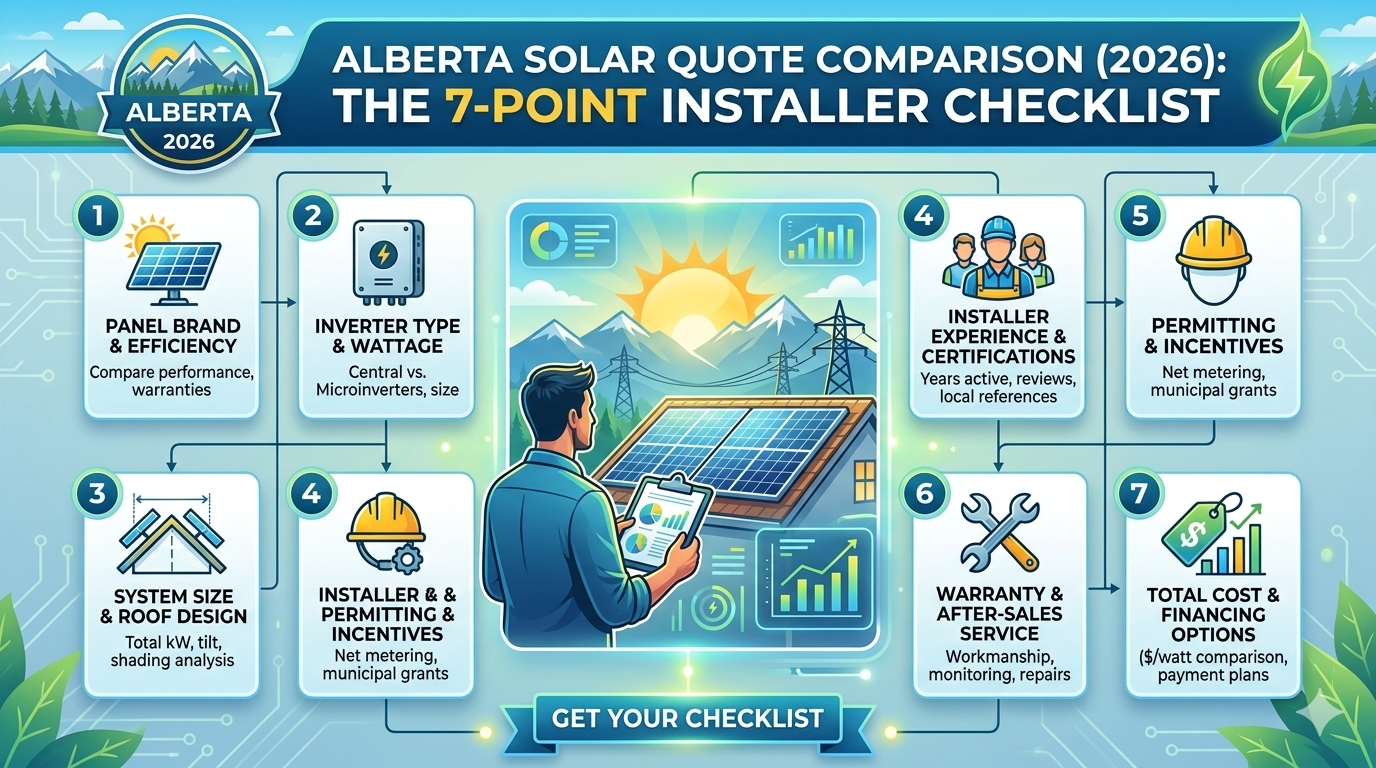
Here is a checklist of questions to ask every installer before you sign anything:
About the quote itself:
Is this an all-in price? Does it include permits, inspections, net metering fees, and GST?
Does it include an electrical panel assessment? What happens if my panel needs upgrading?
What brand and model are the panels? What is the efficiency rating and degradation rate?
What inverter brand and type (string or microinverter)?
What are the panel warranty terms? (Minimum: 25-year power production warranty)
Who performs the installation — your own crew or subcontractors?
About long-term performance:
What is the estimated annual kWh production for my specific roof orientation and location?
How does your monitoring system work?
What is your process if my system produces less than projected?
About the business:
Are you a licensed electrical contractor in Alberta?
Are you listed in the Solar Alberta directory?
Can you provide references from Calgary or Edmonton installations in the past 12 months?
Any reputable, established installer will answer every one of these questions clearly. If they can't — or won't — keep looking
Compare Multiple Quotes — This Step Saves You $3,000 to $8,000
This is the most practical step in the entire guide, and the one most homeowners skip.
For the same home, same system size, and same equipment quality, quotes from different installers in Calgary and Edmonton regularly vary by $3,000 to $8,000 or more. The variation exists because of different labour rates, equipment margins, overhead costs, and how each company structures their pricing.
Going with the first quote you receive almost always costs you money.
This is exactly what Canada Solar Pro was built to solve.
Here's how our free service works:
You fill in a 60-second form with basic details about your home and electricity usage
We match you with 2–3 pre-vetted, licensed Calgary or Edmonton installers within 24 hours
Those installers submit competitive, all-in quotes for your specific home
You compare them side by side — in plain language, not industry jargon
You choose the one that fits best — with zero obligation and zero pressure
Every installer in our network has been screened for licensing, insurance, customer reviews, installation quality, and pricing transparency. You skip weeks of research and go directly to comparing real numbers from trusted professionals.
Over 10,000 Alberta homeowners have used Canada Solar Pro. Our platform costs you nothing. Installers pay us a referral fee only if you decide to proceed — meaning our incentive is to match you well, not to push you toward any particular installer.
Choose Your Financing Path
You don't need to pay cash for solar. Here are the main financing options available to Calgary and Edmonton homeowners in 2026:
Option 1 — CEIP (Property Tax Financing)
Best for homeowners who want low-interest financing with no personal credit risk. Financing is attached to your property, not you. If you sell, the new owner can take over the payments — and the solar savings. Available in most major Alberta municipalities.
Option 2 — Third-Party Financing (e.g., Financeit)
Zero down. Monthly payments typically run $150–$190 for a standard residential system. A properly sized solar system will reduce your monthly electricity bill by a similar or greater amount — meaning you can be cash-flow positive from day one. Terms up to 20 years, no prepayment penalty.
Option 3 — Cash Purchase
If you have the capital, a cash purchase often comes with a 10% installer discount on larger quotes. On a $22,000 system, that's $2,200 in immediate savings. Best total lifetime ROI of any option.
Option 4 — Mortgage Roll-In
At your next mortgage renewal, add your solar cost to your mortgage at your mortgage rate (typically 4–5%). This is the lowest total interest option for homeowners already planning a refinance.
Canada Solar Pro note: Our matched installers will walk you through all financing options relevant to your municipality — including current CEIP availability — before you make any decision.
What Solar Panels Cost in Calgary & Edmonton (2026)
Calgary | Edmonton | |
Cost per watt (installed) | $2.70 – $3.20/W | $2.80 – $3.40/W |
Small system (3–4 kW) | $12,000 – $18,000 | $11,000 – $17,000 |
Mid-size system (5–7 kW) | $18,000 – $28,000 | $17,000 – $26,000 |
Large system (8–12 kW) | $28,000 – $40,000 | $26,000 – $38,000 |
After rebates (typical) | $15,000 – $22,000 | $14,000 – $21,000 |
Payback period | 8 – 12 years | 8 – 12 years |
Annual savings (avg.) | $1,200 – $2,200 | $1,100 – $2,000 |
GST only (no PST) | 5% | 5% |
Ready to Find Out What Solar Would Cost Your Specific Home?
General numbers give you a starting point. But your actual cost depends on your roof, your electricity usage, your municipality's rebate availability, and which installers are competing for your project right now.
The fastest way to get a real number — without sales pressure and without spending hours researching installers — is through Canada Solar Pro.
Here's how it works:
Fill out our 60-second form with basic details about your home
Receive 2–3 competitive, all-in quotes from pre-vetted Calgary or Edmonton installers within 24 hours
Compare your options side by side — no jargon, no pressure, no obligation
Over 10,000 Alberta homeowners have used Canada Solar Pro to find trusted installers and get competitive pricing. Our service is completely free to homeowners.