Alberta homeowners pay some of the highest electricity rates in Canada and those rates climb 3 to 5 percent every single year. If you have ever looked at your monthly bill and thought there must be a smarter way, you are right. A grid tie solar system is the most popular, most cost-effective, and most practical solar solution for homes in Calgary and Edmonton. And right now, with CEIP financing covering 100 percent of upfront costs and net billing credits reducing bills by up to 90 percent, there has never been a better time to understand exactly how this technology works — and how to install it the right way.
This guide walks you through every step of a grid tied solar system installation in Alberta. Whether you are a curious beginner or someone who already has quotes in hand, you will find clear, honest, Alberta-specific information here not the generic American guides that ignore our Micro-Generation Regulation, our utility interconnection process, and our local permit requirements..
What Is a Grid Tie Solar System
A grid tied solar system also called a grid-connected or on-grid solar system — is a solar setup that stays permanently connected to your utility's electricity grid. It does not require expensive battery storage. Instead, it uses the provincial grid as your virtual battery.
Here is how it works in simple terms:
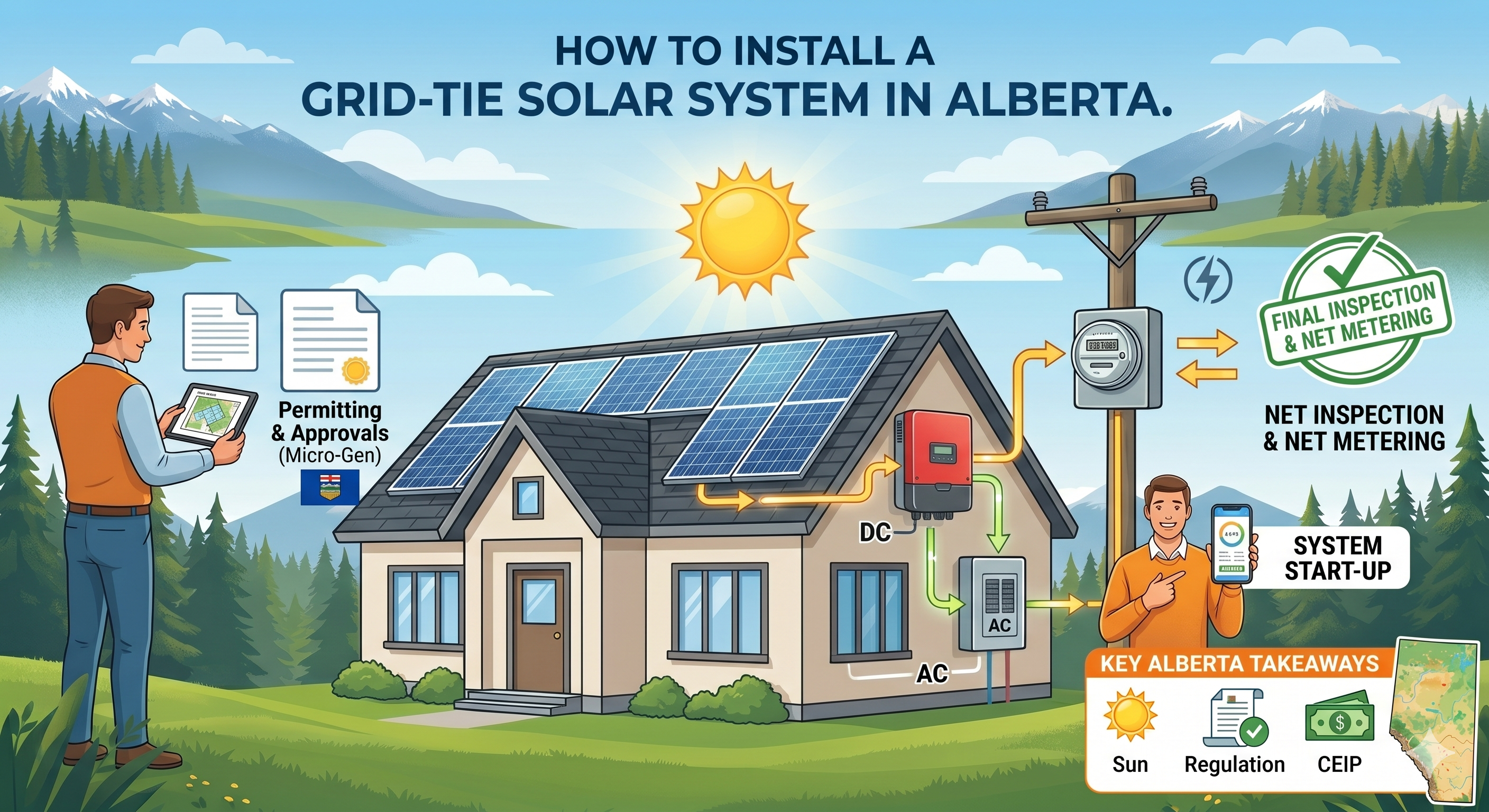
• Your solar panels capture sunlight and generate DC (direct current) electricity during the day
• A grid tie inverter instantly converts that DC power into AC (alternating current) electricity — the kind every appliance in your home actually uses
• Your home consumes that solar power first, in real time
• When your panels produce more electricity than your home needs, the surplus flows back to the Alberta grid through a bidirectional meter
• Your utility records those exports and adds bill credits to your account — this is Alberta's net billing program
• At night or on cloudy days, you automatically draw power from the grid as usual no interruption, no flicker, no battery required
Alberta is one of the best provinces in Canada for grid tie solar. The province receives over 300 sunny days per year, and Calgary alone averages 1,292 kWh of solar production per installed kW annually. Add Alberta's Micro-Generation Regulation, which mandates retail-rate net billing credits and free bidirectional meter installation, and the financial case for going solar becomes extremely strong.
Typical results for Alberta homeowners who install a grid tied solar system:
• 70 to 90 percent reduction in monthly electricity bills
• 8 to 12 year payback period depending on system size and household consumption
• 15 to 20 years of near-free electricity after payback
• 25+ year panel lifespan with manufacturer performance warranties
Grid Tie Solar System Components: Know What You Are Installing
Before you touch a single roof tile, you need to understand the components that make up a complete grid tie solar system. Each part plays a specific role — and choosing the right equipment for your Alberta home directly affects your long-term savings.
1. Solar Panels (PV Modules)
Solar panels are the heart of your system. They capture sunlight and convert it into DC electricity through a process called the photovoltaic effect. Modern residential panels produce between 350 and 500 watts each. Most Calgary and Edmonton homes need between 10 and 20 panels, depending on roof space and monthly electricity consumption.
For solar panel installation in Alberta, south-facing roofs at a 30 to 40 degree tilt deliver maximum annual production. West-facing roofs are the next best option. East-facing panels still produce well in the morning peak hours. North-facing roofs are the only orientation that significantly underperforms.
2. Grid Tie Inverter
The inverter is the brain of your grid tied solar system. It converts DC power from your panels into grid-compatible AC electricity and synchronizes that output with Alberta's utility grid frequency and voltage. There are three main inverter types available in Canada:
• String inverter: One central unit handles all your panels together. It is the most affordable option and works best for roofs with no shading issues. Most residential solar panel installations in Calgary and Edmonton use string inverters
• Microinverters: One small inverter attaches behind each individual panel. They handle shading better, allow panel-level monitoring, and improve overall system resilience — but they cost more upfront
• String inverter with power optimizers: A hybrid solution that gives you panel-level performance optimization while keeping a single central inverter. Good middle ground for partially shaded roofs
3. Solar Racking and Mounting System
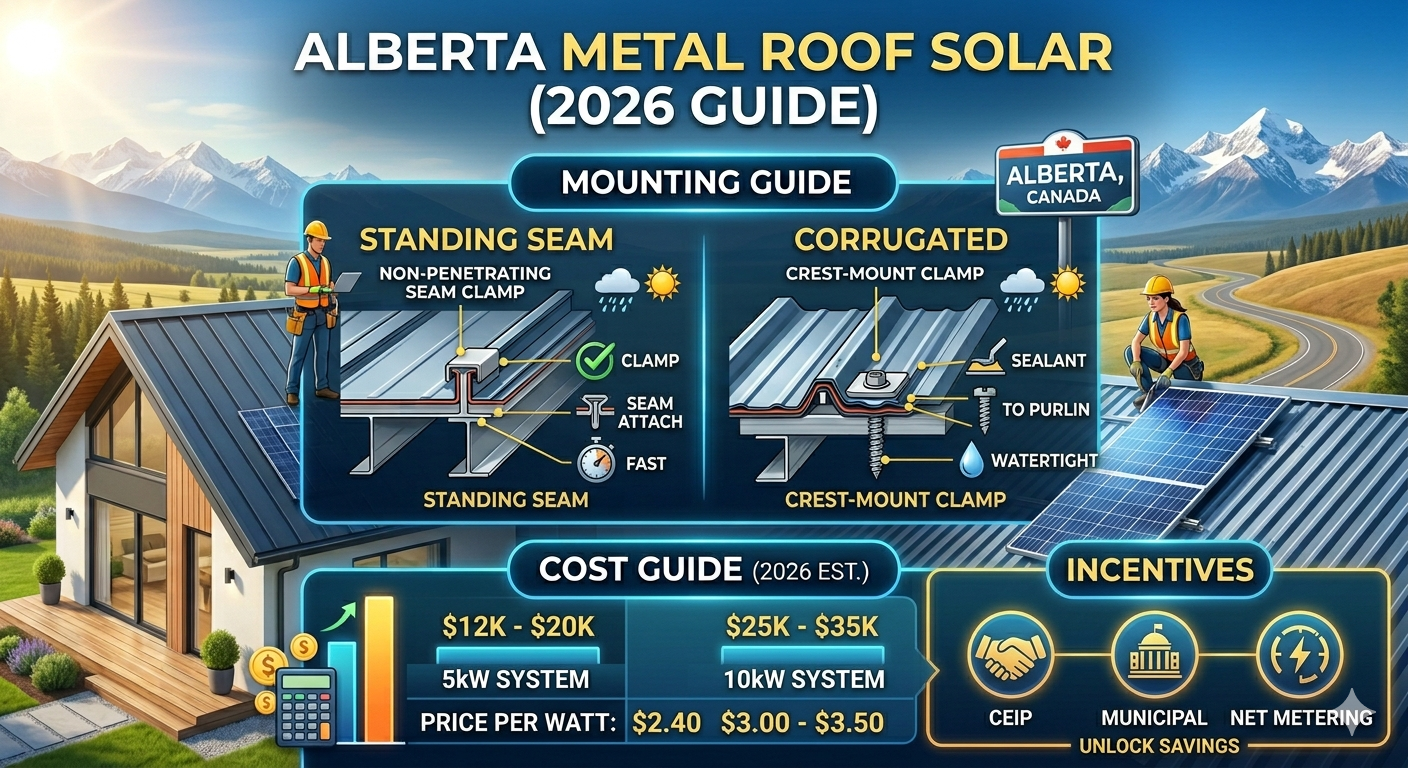
The racking system anchors your panels to your roof structure. In Alberta's climate — heavy snow loads in winter, strong Chinook winds, and freeze-thaw cycles — your racking must meet both the Canadian Electrical Code and Alberta Building Code standards. Engineer-stamped racking from certified manufacturers is not optional. It is a permit requirement.
4. Bidirectional Utility Meter
Your current electricity meter only measures power flowing into your home. A grid tied solar system requires a bidirectional meter that measures both what you import from the grid and what you export to it. Under Alberta's Micro-Generation Regulation, your utility installs this meter at no charge to you as part of the interconnection approval process.
5. DC and AC Disconnect Switches
Safety disconnect switches allow your solar system to shut down independently from your home's main electrical panel. The Canadian Electrical Code and Alberta Building Code both require properly labelled disconnects on the DC side (between panels and inverter) and the AC side (between inverter and main panel). These switches also allow first responders to safely de-energize your system in an emergency.
6. System Monitoring Dashboard
Most modern grid tie inverters include a Wi-Fi connected monitoring system. Once your system goes live, you track real-time solar production, household consumption, and grid export data directly from your phone or computer. This dashboard also alerts you if a panel underperforms — catching issues before they quietly cost you money.
Alberta Rules You Must Understand Before Installation Begins
This is where most generic installation guides completely fail Canadian homeowners. Alberta has specific regulations, utility requirements, and permit processes that every grid tie solar installation must follow. Skipping any of these steps means your system will not pass inspection — or worse, your utility will refuse to connect it to the grid.
Alberta Micro-Generation Regulation
The Alberta Micro-Generation Regulation is the legal framework that gives homeowners the right to generate their own electricity and export surplus power to the grid. Under this regulation, residential solar systems under 150 kW qualify as small-scale micro-generators. The regulation mandates that:
• Utilities must credit your exported electricity at the full retail energy rate
• Utilities cannot charge you for installing the bidirectional meter
• Utilities cannot charge interconnection fees for residential systems
• Monthly surplus credits roll forward — summer production offsets winter bills
Alberta Utilities Commission (AUC) Guidelines
The AUC sets the technical and safety standards for how your solar system connects to Alberta's electricity grid. These guidelines require:
• A certified electrical contractor must perform or directly supervise all electrical work
• A detailed site plan must be prepared and submitted with your interconnection application
• Your system must meet the Canadian Electrical Code and all applicable Alberta standards
Municipal Building and Electrical Permits
Both the City of Calgary and the City of Edmonton require building permits and electrical permits for residential solar panel installation. Your installer handles the application and submission, but you as the homeowner are the permit holder. Inspections occur after installation and before your system goes live. Never skip permits — an unpermitted system voids manufacturer warranties and creates serious liability issues if you ever sell your home.
CEIP Financing — The Alberta Advantage
The Clean Energy Improvement Program (CEIP) is a property-tax-based financing program active in Calgary, Edmonton, and 15+ other Alberta municipalities. It covers up to 100 percent of your solar installation cost with no credit check required. You repay the financing through your property taxes over up to 25 years at competitive interest rates. The debt stays with the property if you sell — it does not follow you personally.
CEIP is the single biggest financial advantage Alberta homeowners have over homeowners in any other province. Check eligibility before you do anything else.
How to Install a Grid Tie Solar System: Step-by-Step
Now that you understand the components and the regulatory framework, here is the complete grid tie solar system installation process from start to finish. Follow these steps in order — each one builds on the last.
Step 1: Assess Your Energy Consumption
Pull out the last 12 months of electricity bills and calculate your average monthly kilowatt-hour (kWh) consumption. Do not just look at the dollar amount — find the actual kWh figure listed on each bill. Your solar system size depends entirely on how much electricity your household actually uses.
A typical Alberta home consumes between 600 and 1,000 kWh per month. If you drive an electric vehicle, run electric heating, or operate a hot tub, your consumption will be higher. Be honest about your usage — undersizing your system means you leave savings on the table. Oversizing creates too much export that takes years to recover through net billing credits.
Step 2: Evaluate Your Roof (Honestly)
Your roof is the foundation of your entire grid tie solar system. Before any equipment gets ordered, you need to assess four things:
1. Orientation: South-facing is ideal. Southwest or west-facing roofs in Alberta still produce 85 to 95 percent of maximum output. North-facing roofs are not suitable for residential solar in Alberta
2. Tilt angle: A pitch between 30 and 40 degrees matches Alberta's latitude and maximizes annual solar energy production. Flat roofs require tilt mounting frames, which adds cost but works well
3. Shading: Walk your roof zone at different times of day. Chimneys, dormers, satellite dishes, and neighbouring trees all create shade that reduces output. If shade is unavoidable, microinverters or power optimizers minimize the impact
4. Structural condition: Your roof must support the additional weight of solar panels and racking — typically 2 to 4 pounds per square foot. If your roof is more than 15 years old, get a professional assessment before proceeding. Installing solar on a roof that needs replacing in five years is expensive planning
Step 3: Size Your Solar System
Use this straightforward formula to size your grid tie solar installation:
System size (kW) = Monthly kWh consumption ÷ (monthly sun hours × 0.80)
For Calgary, use 4.5 peak sun hours per day as your monthly average across the year. The 0.80 accounts for real-world efficiency losses from temperature, wiring, and inverter conversion. For example, a home consuming 900 kWh per month needs approximately: 900 ÷ (4.5 × 30 × 0.80) = roughly 8.3 kW system.
Most Alberta residential grid tie solar systems fall between 6 kW and 12 kW. At $2.60 to $3.27 per watt installed, a 8 kW system costs approximately $21,000 to $26,000 before incentives. With CEIP financing, that upfront cost drops to zero.
Step 4: Choose Your Installer and Get Multiple Quotes
In Alberta, all grid tie solar system electrical work must be performed by a licensed electrical contractor. This is not a recommendation — it is a legal requirement under the Alberta Utilities Commission guidelines and the Canadian Electrical Code. Attempting to connect a grid tied system to the utility grid yourself, without a licensed electrician, risks failed inspections, voided equipment warranties, and potential legal liability.
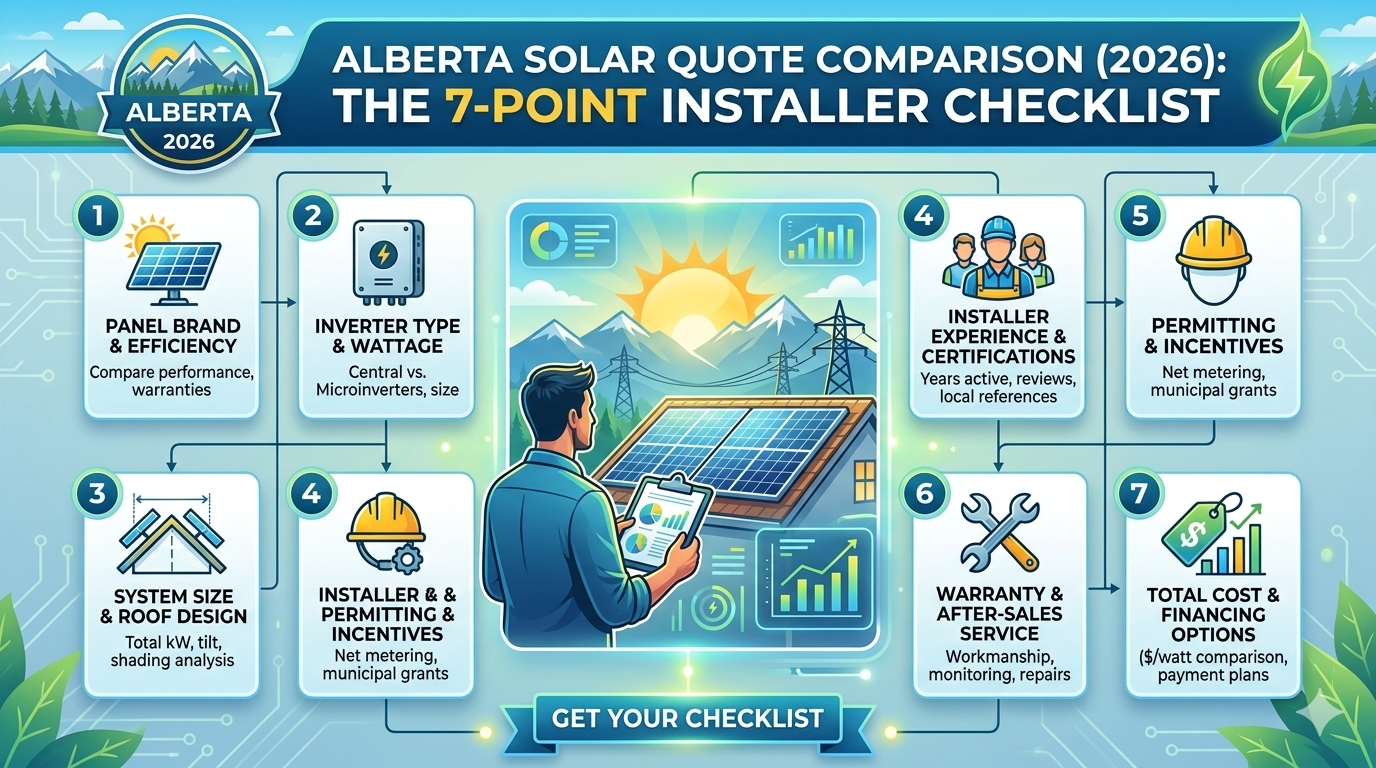
Get at least three quotes from different certified solar installers in Calgary or Edmonton. Compare not just the price, but also the equipment brands, warranty terms, CEIP experience, and whether they handle all permits and utility applications themselves. A good installer handles the entire process — system design, engineering, permits, CEIP application, installation, inspection, and utility interconnection.
When comparing quotes, ask every installer these questions:
• Do you handle the CEIP application and utility interconnection paperwork?
• What specific solar panels and inverter brands do you install, and what are the warranty terms?
• Is your electrical work performed by licensed Alberta electricians?
• How long is your workmanship warranty beyond the equipment warranties?
• Can you provide references from recent installations in Calgary or Edmonton?
Getting multiple quotes used to mean spending weeks making phone calls and scheduling separate site visits. Today, platforms like Canada Solar Pro connect Alberta homeowners with pre-screened, CEIP-certified local installers who compete for your project — delivering 3 to 5 competitive quotes within 24 hours, for free.
Step 5: Apply for CEIP Financing (If Eligible)
Before any installation begins, check whether your property qualifies for CEIP financing. If you live in Calgary, Edmonton, Airdrie, Leduc, Canmore, Strathcona County, or one of the other 15+ participating Alberta municipalities, you may qualify for 100 percent financing with zero upfront payment.
The CEIP application process works as follows:
5. Your installer prepares the technical documentation and project cost breakdown
6. You submit the CEIP application to your municipality through your installer
7. The municipality approves the financing and registers it against your property title
8. Installation proceeds — you pay nothing upfront
9. The financing repayment appears on your annual property tax bill
CEIP financing is available while funds last. Programs like this do not run indefinitely — check current availability before assuming you qualify.
Step 6: Obtain Permits and Submit the Interconnection Application
Your installer pulls the required solar installation permits from the City of Calgary or Edmonton before any equipment arrives. Permit applications require:
• A detailed site plan showing panel placement, equipment locations, and electrical layout
• Engineering documentation for the racking system (especially for roofs outside standard pitch ranges)
• Confirmation of compliance with the Canadian Electrical Code and Alberta Building Code
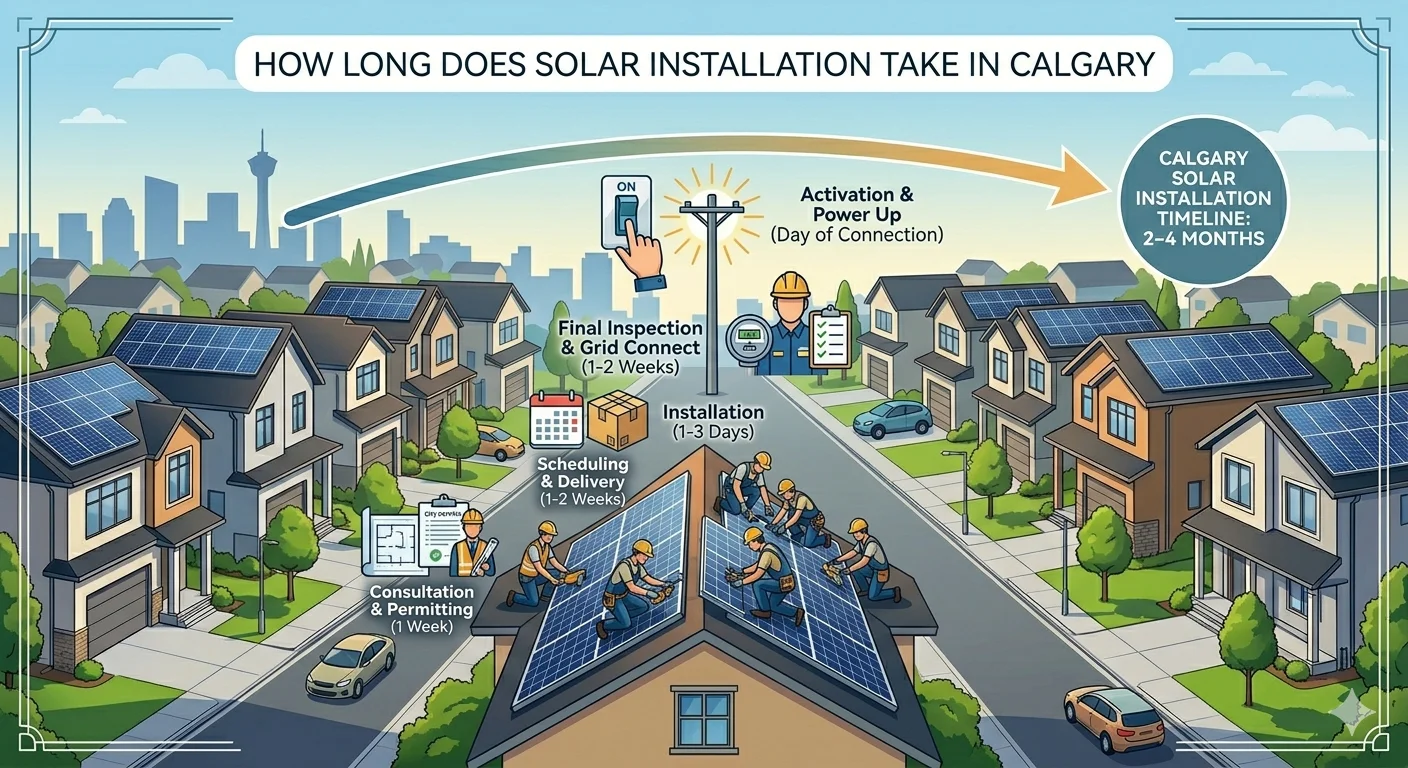
Simultaneously, your installer submits the utility interconnection application to your distribution company — either ENMAX in Calgary, EPCOR in Edmonton, or ATCO in rural areas. This application officially registers your intent to connect your grid tie solar system to Alberta's electricity grid. Processing typically takes two to eight weeks depending on your utility's current workload.
Step 7: Install the Racking and Mount the Solar Panels
Once permits are approved and equipment is on site, physical solar panel installation begins. A qualified installation crew works through the following sequence:
10. Locate and mark roof rafters precisely — racking bolts must hit structural members, not just sheathing
11. Install flashing around every roof penetration to create a weathertight seal that will last decades
12. Attach aluminum racking rails along the marked rafter lines at the engineered spacing
13. Clamp solar panels to the rails in the designed configuration
14. Run weatherproof conduit from the roof array down to the inverter location — typically the garage wall, side of house, or utility room
15. Connect MC4 solar connectors between panels to create the string configuration designed by your system engineer
16. Mount the grid tie inverter on the wall in a ventilated location, protected from direct weather
Every panel connection, every conduit run, and every roof penetration gets inspected by your installer before the electrical portion begins. A proper solar racking installation in Alberta must withstand heavy snow loads and wind uplift — do not accept shortcuts here.
Step 8: Complete the Electrical Connections
This step requires a licensed Alberta electrician on site for all work. The electrical connection sequence runs as follows:
17. Connect the DC wiring from the solar array into the inverter's DC input terminals, following polarity carefully
18. Install the DC disconnect switch between the array and the inverter
19. Wire the inverter AC output to a dedicated breaker in your main electrical panel
20. Install the AC disconnect between the inverter and the main panel
21. Ground and bond all metal components — panels, racking rails, inverter chassis, and conduit — to your home's grounding system per the Canadian Electrical Code
22. Label all disconnects, the inverter, and the new breaker clearly as required by code
The licensed electrician also verifies that your main electrical panel has sufficient capacity to accept the solar connection under the 120 percent rule. This rule states that the combined rating of all breakers cannot exceed 120 percent of your panel's rated capacity. If your panel is full, a subpanel or panel upgrade may be required before solar can be added.
Step 9: Pass the Inspections
After installation is complete, two separate inspections occur before your system can go live:
• Municipal electrical inspection: An electrical safety inspector from the City of Calgary or Edmonton verifies that all electrical work meets the Canadian Electrical Code. Your licensed installer books this inspection and is present for it
• Utility inspection and interconnection: Your distribution company (ENMAX, EPCOR, or ATCO) inspects the interconnection point and installs your bidirectional meter. Once the meter is installed and the interconnection agreement is signed, your system is officially authorized to operate
Do not turn your system on before both inspections pass. Operating a grid tied solar system without utility approval violates your interconnection agreement and can result in disconnection from the grid.
Step 10: Commission Your System and Start Monitoring
With both inspections passed, your installer commissions the system. This involves powering the inverter on for the first time, verifying that it correctly synchronizes with the Alberta grid frequency and voltage, and confirming that your monitoring dashboard shows accurate real-time production data.
Walk through the monitoring system with your installer. Learn how to read your daily production, identify what normal output looks like for your system size and season, and understand how to spot underperformance early. A properly commissioned grid tie solar system requires almost no maintenance — but active monitoring protects your investment over the long term.
From this point forward, every kilowatt-hour your panels produce either powers your home for free or earns you a net billing credit on your electricity bill. Your payback clock starts running the day your system goes live.
How Much Does a Grid Tie Solar System Cost in Alberta?
Understanding the real cost of solar panel installation in Alberta helps you evaluate quotes confidently and avoid both undersized systems and inflated proposals.
System Cost by Size
• 6 kW system: Approximately $15,600 to $19,600 installed
• 8 kW system: Approximately $20,800 to $26,200 installed
• 10 kW system: Approximately $26,000 to $32,700 installed
• 12 kW system: Approximately $31,200 to $39,200 installed
These figures reflect Alberta's average installed cost range of $2.60 to $3.27 per watt. Premium equipment, complex roof configurations, or panel upgrades push costs toward the higher end. With CEIP financing, all of these costs become a property tax line item — you pay nothing upfront.
Financial Incentives Available Right Now
• CEIP financing: 100% project financing, no upfront cost, repaid through property taxes over up to 25 years. Available in Calgary, Edmonton, and 15+ Alberta municipalities
• Net billing credits: Retail-rate credits for all exported electricity under Alberta's Micro-Generation Regulation. Summer surplus credits offset winter bills automatically
• Rate protection: Alberta electricity rates rise 3 to 5 percent annually. Your solar output cost stays fixed from day one — every rate increase makes your system more valuable
Common Mistakes Alberta Homeowners Make (And How to Avoid Them)
• Choosing the cheapest installer without checking credentials: Alberta requires licensed electricians for all grid tie solar electrical work. The cheapest quote often cuts corners on racking quality, uses lower-efficiency panels, or omits proper engineering documentation — which causes permit failures and warranty voids
• Not checking CEIP eligibility first: Many homeowners research solar for months before discovering CEIP makes it zero upfront cost. Check eligibility on day one — it changes your entire financial calculation
• Undersizing to save money today: A system 20 percent smaller than your actual consumption saves very little upfront but leaves significant savings on the table every year for 25 years. Size your grid tie solar system for your real consumption, not your optimistic estimate
• Ignoring the roof condition: Installing solar panels on a roof that needs replacement within five years means paying to remove and reinstall panels when the roof fails. Address your roof first if it is aging
• Skipping the monitoring setup: A solar system that underperforms by 15 percent can go unnoticed for years without active monitoring. Always configure and understand your monitoring dashboard at commissioning
Is DIY Grid Tie Solar Installation Legal in Alberta?
This is a question every motivated homeowner asks — and it deserves a direct, honest answer.
For small off-grid systems like a cabin or shed, DIY solar is straightforward and entirely legal. But for a full residential grid tie solar system connected to Alberta's utility grid, the regulatory requirements make true DIY installation illegal in practice.
Here is what the rules actually require:
• All electrical work must be performed by a licensed Alberta electrician — you cannot legally do your own electrical connections
• Municipal electrical permits require a licensed contractor's credentials
• The utility interconnection application must reference a licensed electrical contractor
• Inspectors verify licensed workmanship during both the municipal and utility inspections
The honest reality is this: the permitting process, utility applications, engineering requirements, and inspection schedule for a residential grid tie solar installation in Alberta are specifically designed around professional installation teams. Attempting to navigate it alone — without an electrician's license — results in failed inspections, personal liability exposure, and voided warranties on expensive equipment.
This is not a reason to avoid solar. It is a reason to choose your installer carefully, get multiple competitive quotes, and make sure the team you hire handles every step from permits through commissioning.
Ready to Go Solar? Here Is Your Next Step
You now understand exactly what a grid tie solar system installation in Alberta involves — the components, the regulations, the steps, the costs, and the financial programs that make it one of the smartest home investments available today.
Most Calgary and Edmonton homeowners who go solar in 2025 pay nothing upfront through CEIP financing, see their electricity bills drop by 70 to 90 percent within months of installation, and watch their system pay for itself completely within 8 to 12 years — leaving 15 to 20 more years of near-free power ahead.
The only question left is: which installer do you choose?
Canada Solar Pro connects Alberta homeowners directly with vetted, CEIP-certified solar installers in Calgary and Edmonton. You answer a few quick questions about your home, and within 24 hours you receive three to five competitive quotes from pre-screened local professionals — completely free, with zero obligation.
You compare the quotes side by side, ask the right questions, and choose the proposal that fits your roof, your consumption, and your budget. Your installer handles everything after that — permits, CEIP application, installation, inspections, and utility interconnection.
Get your free, no-obligation estimate at canadasolarpro.com — it takes 60 seconds and could start saving you over $1,200 every year.