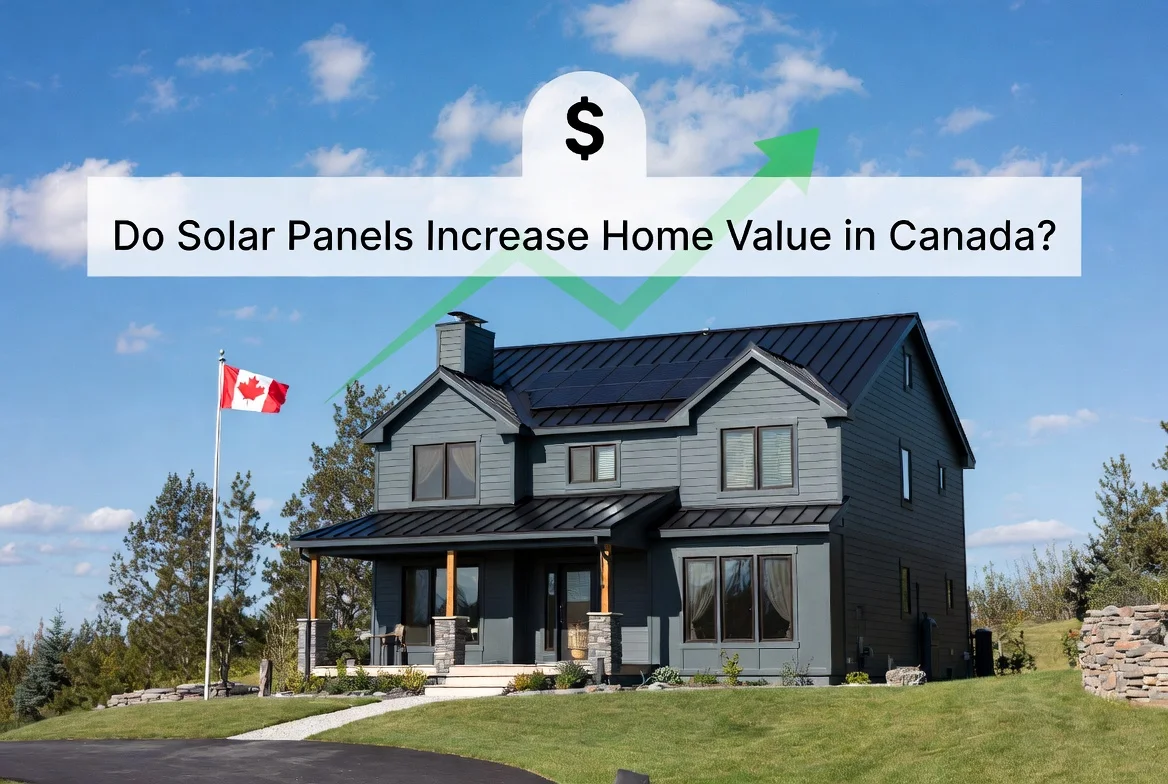
If you're a Canadian homeowner thinking about going solar, one question keeps coming up before everything else: will solar panels actually make my home worth more when I sell?
The short answer is yes but not automatically, and not equally in every province. The real answer depends on where you live, how your system is financed, the age of your panels, and how electricity rates work in your area. This guide breaks it all down with real 2026 numbers so you can make a confident decision.
Do Solar Panels Actually Increase Home Value in Canada?
Yes but with conditions. A buyer isn't purchasing your solar panels. They're purchasing the savings those panels generate for the next 25 years. That's the fundamental principle that drives solar's impact on home value.
The Appraisal Institute of Canada confirms that the value of a solar installation is directly tied to the income or savings it produces. Natural Resources Canada echoes this, noting that energy-efficient homes consistently attract stronger buyer interest especially as electricity rates rise across the country.
The data backs this up. Studies show that solar panels can add approximately 3–4% to a home's resale value, with some research indicating an increase of up to $6,000 per kW of solar installed. On a $600,000 home with a 7 kW system, that's a potential value addition of $18,000–$24,000.
But those numbers only hold under the right conditions which brings us to the provincial picture.
How Much Value Do Solar Panels Add by Province?
This is the most important table you won't find anywhere else. Value added by solar varies significantly across Canada because home prices, electricity rates, and payback periods are all different province by province.
Province | Avg Home Price (2026) | 3–4% Solar Value Add | Electricity Rate | Typical Payback |
Ontario | ~$870,000 | $26,000–$35,000 | ~14¢/kWh | 8–12 years |
British Columbia | ~$960,000 | $29,000–$38,000 | ~12¢/kWh | 9–13 years |
Alberta | ~$510,000 | $15,000–$20,000 | ~16¢/kWh | 7–10 years |
Saskatchewan | ~$340,000 | $10,000–$14,000 | ~15¢/kWh | 8–12 years |
Manitoba | ~$380,000 | $11,000–$15,000 | ~9.97¢/kWh | 15–22 years |
Nova Scotia | ~$400,000 | $12,000–$16,000 | ~17¢/kWh | 9–13 years |
PEI | ~$370,000 | $11,000–$15,000 | ~18¢/kWh | 7–11 years |
Key takeaway: Provinces with high electricity rates Alberta, Ontario, Nova Scotia, PEI see the strongest financial case for solar and the most meaningful home value increases. Low-rate provinces like Manitoba and Quebec still see value gains, but the numbers are more modest.
5 Factors That Determine How Much Value Solar Adds to Your Home
Not every solar installation adds the same value. Here are the five factors that actually move the needle.
1. Ownership Type The Most Important Factor
How your system is financed is the single biggest determinant of whether solar increases or hurts your home's resale value.
Owned outright (paid in full): Maximum value add. The system transfers to the new owner free and clear, just like a furnace or roof. Buyers love this scenario.
Installer financing (e.g., transferable loan): Still adds value if the buyer is willing to assume the contract. Companies that offer structured transfer processes make this easier. The remaining balance typically gets paid out from sale proceeds.
Third-party personal loan: This loan stays in your name. It will almost always be paid off at closing. Buyers don't see it as a burden, but it reduces the net value you capture.
Leased panels or PPAs: These are rare in Canada but important to understand. If a buyer must assume a lease contract they didn't choose, it can actively deter offers or reduce your sale price. A leased system adds little to no value and can complicate the transaction significantly.
2. System Age and Remaining Warranty
A solar system installed last year with a 25-year product warranty remaining is worth significantly more to a buyer than a 15-year-old system with degraded output. Modern panels particularly N-type monocrystalline retain over 90% of their original output after 25 years. Buyers and appraisers both factor this in.
3. Province and Local Electricity Rate
The higher your local electricity rate, the more valuable your solar system is to the next owner. Every cent per kWh saved is money in a buyer's pocket for the next 20+ years. This is why solar adds more value in Alberta and Nova Scotia than in Manitoba or Quebec, where electricity rates are among the lowest in North America.
4. Roof Condition and Panel Orientation
A solar system installed on a south-facing roof with no shading produces maximum output and commands maximum value. A system on an east-facing roof with partial tree shading produces less electricity, generates fewer savings, and is worth proportionally less at resale. Before selling, it's worth confirming your system's actual production history to present accurate savings data to buyers.
5. Home Price Tier
The percentage increase from solar is relatively consistent, but the absolute dollar amount scales with home value. A 3% value add on a $1 million home in Vancouver is $30,000. The same 3% on a $350,000 home in Regina is $10,500. Premium homes in executive markets see the largest absolute gains from solar.
2026 Solar Incentives How They Affect Your Home Value Calculation
Understanding the current incentive landscape matters because it directly affects your net cost and therefore your real ROI when you sell.
Federal programs what's closed:
The Canada Greener Homes Grant is permanently closed to new applicants as of February 2024.
The Canada Greener Homes Loan closed to new applicants on October 1, 2025.
Do not let any installer quote you either of these programs as available they are gone.
What's active in 2026 by province:
BC: BC Hydro rebate up to $5,000 + 7% PST exemption on solar equipment
Alberta: Clean Energy Improvement Program (CEIP) property-assessed financing repaid through property taxes, available in participating municipalities
Manitoba: Efficiency Manitoba rebate $0.50/watt up to $5,000 for systems up to 10 kW
Ontario: Home Renovation Savings Program up to $10,000 for eligible clean energy upgrades (introduced January 2026)
PEI: Solar Electric Rebate Program $1,000/kW up to $10,000, among the most generous in Canada
Nova Scotia: Efficiency NS programs for residential solar
For the full, up-to-date breakdown of every active provincial program, see our 2026 Canadian solar incentives guide.
Why this matters for home value: Incentives reduce your upfront cost. A lower upfront cost means a shorter payback period. A shorter payback period means the system has already paid for itself by the time you sell which makes the value-add story much cleaner for buyers.
What Happens When You Sell a Home With Solar Panels?
Selling a home with solar involves a few moving parts that most real estate agents aren't fully prepared for. Here's what to know.
The Appraisal Problem
Most Canadian appraisers lack a standardized method for valuing solar installations. If your appraiser doesn't account for the energy savings your system generates, your home may be undervalued on paper even if buyers are willing to pay more. To counter this, prepare a document showing your system's annual production history, monthly bill savings, and remaining warranty. Give this to your realtor and ask them to present it proactively.
Transfer vs. Buyout
If your system is financed, you have two paths when selling:
Transfer: The buyer agrees to assume your financing contract. This usually requires a credit check and their written approval. Many installer financing programs are designed with this in mind.
Buyout: You pay off the remaining loan balance from your sale proceeds. This is cleaner for the buyer and removes any hesitation about contract assumptions.
Net Metering Account Transfer
Your interconnection agreement stays with the property. The new owner will need to set up their own net metering account with the local utility whether that's BC Hydro, Fortis, Ontario Hydro, or another provider. Your installer can help prepare the transfer documentation. Contact them as soon as you decide to sell, not after you have an offer.
How to Market Solar to Buyers Effectively
Don't just list "solar panels installed." Buyers don't inherently understand what that means for their wallet. Instead, frame it in dollar terms:
"Solar system generates approximately $1,800/year in electricity savings"
"Average monthly utility bill: $40 vs. $180 for comparable homes"
"System fully owned, 22-year warranty remaining, production data available"
This turns an abstract feature into a concrete financial benefit which is what actually moves buyers.
Do Solar Panels Help Homes Sell Faster in 2026?
Yes, and the 2026 market context makes this more true than ever. With elevated mortgage rates squeezing buyers on monthly carrying costs, anything that reduces a home's operating expenses has become a stronger selling point than it was three or four years ago.
Buyers today are running the full numbers on a home, not just the mortgage payment. A solar-equipped home with demonstrably lower utility costs stands out in a competitive listing environment, particularly in markets with high electricity rates.
Studies consistently show that solar-equipped homes sell faster than comparable non-solar homes. The advantage is strongest in urban markets with environmentally conscious buyer pools Vancouver, Toronto, Calgary, Halifax but is growing in smaller centres as electricity rates climb.
When Solar Panels Don't Increase Home Value
Honesty matters here. Solar doesn't automatically add value in every situation. Here are the cases where it won't or could even hurt.
Leased systems. If a buyer is asked to assume a lease contract they didn't choose, it can be a deal-breaker or result in a lower offer. In Canada, leases are uncommon but they do exist. Know what you have before listing.
Old or degraded systems. Panels installed 18–20 years ago on an older inverter with no warranty remaining and declining output won't command a premium. They may even raise buyer concerns about replacement costs.
Poor roof orientation or heavy shading. A system that produces 40% of its rated capacity due to shading or north-facing installation is generating minimal savings and won't be valued as a meaningful asset.
Low electricity rate markets. In Quebec and Manitoba, where electricity rates are some of the lowest in North America, the savings story is less compelling to buyers. Solar still has environmental and energy-independence value, but the financial case at resale is weaker.
Buyer's markets with excess inventory. In a market where buyers have plenty of choices, solar may not move the needle on price though it can still help differentiate your listing.
How to Maximize Home Value Before Selling With Solar
If you're planning to sell in the next year or two, these steps will help you get full credit for your solar investment.
Get a pre-sale solar inspection. A licensed installer can confirm your system is performing at rated output and flag any maintenance issues before a buyer's home inspection does it instead.
Gather your documentation. Pull together your original installation contract, equipment spec sheets, warranty certificates, interconnection agreement, and 12–24 months of utility bills showing actual savings. This documentation package is what turns "solar panels" from a vague feature into a quantified financial benefit.
Calculate your actual annual savings. Know the number. If your system saves $1,600 per year in electricity costs, say that clearly in your listing. If you've tracked your production through a monitoring app, include a screenshot of the lifetime output.
Brief your realtor. Most agents haven't sold many solar homes and won't know how to present the value. Educate them on the payback period, remaining warranty, and annual savings so they can communicate it confidently to buyers.
Consider getting a solar-specific appraisal addendum. Some appraisers now offer supplemental valuations that account for energy savings using income-based methodology. This can support a higher list price with documented evidence.
Ready to find out what a solar installation is worth for your specific home and province?
Get a free quote from a qualified Canadian installer