Rising electricity costs across Canada are pushing more homeowners toward renewable energy solutions. In New Brunswick, residential solar adoption has grown steadily as homeowners discover the financial and environmental benefits of generating their own power. With provincial rebates reaching up to $3,000 through SaveEnergyNB, combined with federal financing programs and net metering credits, the economics of going solar have never been more attractive.
But choosing the right installer can make or break your solar investment. The wrong company might overpromise savings, use substandard equipment, or worse—disappear before your 25-year warranty runs out. This guide covers everything New Brunswick homeowners need to know about selecting a solar company, understanding costs, accessing available rebates, and making an informed decision that protects your investment for decades.
We'll compare the best solar companies in New Brunswick, break down typical system costs, explain the SaveEnergyNB rebate program, and walk through the complete installation process. Whether you're in Moncton, Saint John, Fredericton, or anywhere else in the province, this guide will help you find the right solar installer for your home.
Is Solar Worth It in New Brunswick in 2026?
Electricity Costs in New Brunswick
NB Power residential electricity rates have climbed steadily over the past decade, with current rates averaging around 12.4 cents per kWh for the first 1,000 kWh and higher rates for additional consumption. While these rates are moderate compared to Ontario or Nova Scotia, they're projected to increase 3-5% annually as aging infrastructure requires upgrades and the province transitions toward cleaner energy sources.
For the average New Brunswick household consuming 1,200-1,500 kWh monthly, annual electricity bills typically range from $1,800 to $2,400. Solar panels allow homeowners to offset or eliminate these costs by generating their own power, with excess energy sent to the grid earning net metering credits that reduce future bills.
How Much Solar Energy Can Homes Produce?
New Brunswick receives approximately 1,900-2,000 hours of sunshine annually, with peak solar production occurring from May through August. While this solar resource is lower than Alberta's 2,300+ hours, it's still sufficient for excellent solar system performance and attractive payback periods.
A typical 10 kW residential solar system in New Brunswick produces approximately 11,000-13,000 kWh annually—enough to offset the energy consumption of most homes. Actual production varies by roof orientation, tilt angle, shading, and system efficiency, but even modest systems deliver substantial electricity bill savings.
Winter Performance of Solar Panels
One of the most common misconceptions about solar panels in Canada is that they don't work during winter. In reality, solar panels perform exceptionally well in cold weather. Solar cells operate more efficiently at lower temperatures, and snow reflection can actually boost energy production on sunny winter days.
While shorter daylight hours and occasional snow accumulation reduce winter output compared to summer, annual production accounts for seasonal variations. Modern solar panel systems are engineered for Canadian climates, with racking systems designed to handle significant snow loads and tilt angles that encourage natural snow shedding.
New Brunswick's cold, sunny winter days still generate meaningful electricity. A well-designed system continues offsetting grid consumption year-round, with summer overproduction banking credits through net metering that offset winter shortfalls.
Average Solar Savings for Homeowners
Most New Brunswick homeowners with appropriately sized solar systems save $1,200-$1,800 annually on electricity bills. These savings depend on system size, energy consumption patterns, roof characteristics, and net metering credit rates.
Savings compound over time as electricity rates rise but solar production remains fixed. A homeowner saving $1,500 annually today will save progressively more each year as NB Power rates increase, accelerating payback and boosting lifetime returns.
With the $3,000 SaveEnergyNB rebate reducing upfront costs and net metering crediting excess production, solar energy in New Brunswick delivers immediate and long-term financial benefits.
Typical Solar Payback Period in NB
The average payback period for residential solar systems in New Brunswick ranges from 10-14 years, depending on system cost, available incentives, energy consumption, and financing terms. With the $3,000 provincial rebate, payback periods shorten significantly.
After payback, homeowners enjoy 15+ years of virtually free electricity, as solar panels typically maintain 80%+ efficiency for 25-30 years. Over a system's lifetime, cumulative savings often exceed $30,000-$50,000, making solar one of the best home solar investments available to Canadian homeowners.
Financing options like 0% interest loans or Energy as a Service programs from select installers can create immediate positive cash flow, where monthly financing payments are lower than electricity bill savings from day one.
Best Solar Companies in New Brunswick
Selecting the right solar installer is the most important decision in your solar journey. A quality company brings engineering expertise, premium equipment, skilled installation crews, responsive customer service, and long-term warranty support. A poor choice can lead to underperforming systems, installation defects, warranty gaps, and financial headaches.
The New Brunswick solar market includes national companies with established track records, regional installers with deep local knowledge, and emerging companies offering competitive pricing. Below are some of the top solar companies serving New Brunswick homeowners in 2026.
Canada Solar Pro
Canada Solar Pro is a national solar comparison platform connecting homeowners with independent, local solar professionals across Canada. Rather than performing installations directly, Canada Solar Pro matches homeowners with vetted installers in their area, allowing customers to compare multiple quotes and choose the best fit for their needs.
Services Offered
Canada Solar Pro provides free, no-obligation quote matching services. Homeowners complete a simple online form describing their property, energy consumption, and goals. Within 24 hours, they're connected with 2-3 local installers who compete for the project by submitting their best proposals.
The platform covers all major Canadian provinces, including New Brunswick, and specializes in helping homeowners navigate available provincial incentives, financing options, and net metering programs.
Why Homeowners Choose Canada Solar Pro
Independent installer network: Access to multiple local professionals rather than a single company
Transparent comparison: Compare equipment, pricing, warranties, and financing side-by-side
No obligation: Free quotes with no pressure to proceed
Provincial expertise: Installers familiar with SaveEnergyNB rebates and NB Power interconnection requirements
Financing guidance: Assistance understanding loan programs and Energy as a Service options
Best For
Homeowners who want to compare multiple installers before committing, prefer working with local companies, and need guidance navigating New Brunswick's solar incentive landscape.
Learn more about Canada Solar Pro's services
Top Solar Companies in New Brunswick
Company | Years in Business | Service Area | Warranty | Financing Options | Battery Installation | Customer Reviews |
Canada Solar Pro | Platform since 2024 | All NB (installer matching) | Varies by matched installer | Varies by matched installer | Yes (installer dependent) | Platform reviews positive |
Polaron Solar | 13+ years (since 2013) | All NB + 5 other provinces | 25-30 yr panels, 10-25 yr inverters | 0% financing, Sunline EaaS | Yes | 13,200+ installations |
Firefly Solar | 8+ years | National including NB | 25+ yr comprehensive | Multiple options available | Yes | 1,330+ Google reviews (most in Canada) |
Sun Kissed Energy | 8+ years | Atlantic Canada + Ontario | 25-year warranty | Various financing available | Yes | 500+ installations |
Epic Energy Solutions | 10+ years | New Brunswick focused | Manufacturer standard | Financing available | Yes | Positive local testimonials |
TruSun Energy | 6+ years | NB & Alberta | Premium equipment warranties | Standard financing options | Available | Good customer feedback |
Greenfoot Energy | 8+ years | Moncton & NB | Standard coverage | Financing available | Available | Regional reputation |
Solar X Canada | 5+ years | National (all provinces) | 30-year comprehensive | Multiple financing paths | Yes | Strong service reviews |
Note: Warranty specifics vary by equipment manufacturer and installation agreement. Always verify exact terms during consultation.
How to Choose the Right Solar Company
Certifications & Licensing
In Canada, solar installers should hold appropriate provincial electrical licenses and certifications. In New Brunswick, installers must comply with the Canadian Electrical Code (CEC) and possess valid electrical contractor licenses issued by Technical Safety NB.
Look for companies whose installers are certified by the Canadian Solar Industries Association (CanSIA) or hold equivalent professional credentials. Proper licensing ensures installations meet safety standards, building codes, and insurance requirements.
Verify that installers carry comprehensive liability insurance and workers compensation coverage. This protects homeowners from liability if accidents occur during installation.
Questions to Ask Before Signing
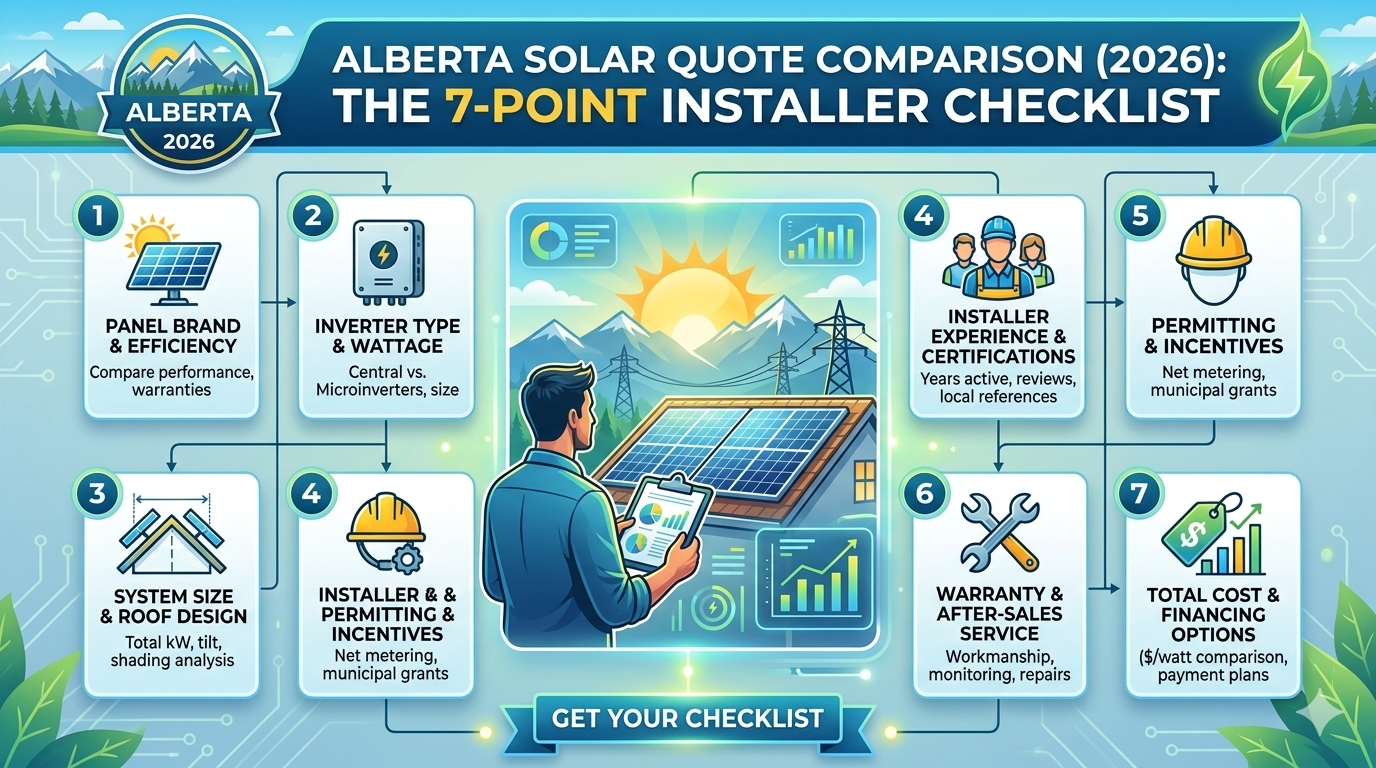
Before committing to any solar contractor, ask these essential questions:
Company stability and experience:
How many years has your company been in business?
How many installations have you completed in New Brunswick?
Can you provide local references from recent customers?
What happens to my warranty if your company goes out of business?
System design and equipment:
What panel brand and model do you recommend and why?
What inverter technology will be used (microinverters, string inverters, or power optimizers)?
How was my system size determined based on my energy consumption?
What's the expected annual energy production?
Installation and timeline:
Do you use in-house installers or subcontractors?
What's the typical installation timeline from signing to activation?
Who handles permit applications and utility interconnection?
What's included in your installation warranty?
Financial and post-installation:
What's the total installed cost including all fees?
Which incentives am I eligible for and who applies for them?
What monitoring system is included?
What's your typical response time for service calls?
Understanding Solar Warranties
Solar system warranties typically include three components:
Equipment warranties:
Panel performance warranty: Most manufacturers guarantee panels will produce at least 80-90% of rated capacity after 25 years
Panel product warranty: Covers defects in materials and workmanship, typically 10-25 years
Inverter warranty: Usually 10-25 years depending on technology (microinverters often carry longer warranties)
Racking and mounting: Typically 10-25 years
Workmanship warranty:
Covers installation labor, roof penetrations, electrical connections, and other installation-specific issues. Good installers offer 5-10 year workmanship warranties.
Production guarantee:
Some companies guarantee minimum energy production. If your system underperforms projections, they compensate for the difference or provide remediation.
Always get warranty terms in writing before signing. Understand what's covered, exclusions, claim procedures, and who remains responsible if the installation company closes.
In-House Installers vs Subcontractors
Companies using in-house installers typically provide more consistent quality, better accountability, and faster service response. In-house crews are trained to company standards, supervised directly, and incentivized to maintain quality.
Subcontractors can deliver quality work, but introduce additional variables. Quality varies by subcontractor, communication chains lengthen, and warranty responsibility may become complicated.
Ask whether the company uses in-house teams or subcontractors. If they subcontract, ask how they vet and supervise subcontractor work.
Red Flags to Avoid
Watch for these warning signs when evaluating solar installers:
Pressure tactics:
Legitimate companies give you time to review proposals. High-pressure sales tactics ("offer expires today") often indicate poor business practices.
Unrealistic promises:
If savings projections seem too good to be true, they probably are. Be skeptical of claims like "eliminate your electricity bill completely" without seeing detailed production modeling.
Lowest price focus:
The cheapest quote often uses inferior equipment, cuts corners on installation, or hides costs in financing terms. Quality installations cost more but deliver better long-term value.
No local references:
Established companies should easily provide local customer references. Refusal or inability to do so is concerning.
Unclear warranty terms:
Vague or verbal warranty promises are worthless. Demand written warranties with specific coverage terms.
No physical office:
Companies without local presence may disappear after installation, leaving you without warranty support.
Solar Panel Costs in New Brunswick (2026)
Average Residential Solar System Cost
Typical solar panel cost in New Brunswick ranges from $2.50 to $3.50 per watt installed, depending on equipment quality, system size, roof complexity, and installer. Total installed costs for common system sizes:
5 kW system: $12,500 - $17,500 before incentives
7 kW system: $17,500 - $24,500 before incentives
10 kW system: $25,000 - $35,000 before incentives
12 kW system: $30,000 - $42,000 before incentives
After applying the $3,000 SaveEnergyNB rebate, net costs drop significantly:
5 kW system: $9,500 - $14,500 after rebate
7 kW system: $14,500 - $21,500 after rebate
10 kW system: $22,000 - $32,000 after rebate
12 kW system: $27,000 - $39,000 after rebate
These costs include panels, inverters, racking, electrical components, labor, permits, and utility interconnection fees. Battery storage adds $10,000-$20,000 depending on capacity.
Cost Per Watt in Canada
Solar installation cost per watt has declined steadily over the past decade due to manufacturing efficiencies, increased competition, and improved installation techniques. Current Canadian averages range from $2.40 to $3.80 per watt, with New Brunswick falling in the middle of this range.
Cost per watt typically decreases as system size increases due to fixed costs (permits, interconnection, design) being spread across more panels. A 5 kW system might cost $3.20/watt while a 12 kW system costs $2.80/watt.
5kW vs 10kW System Pricing
A 5 kW system is appropriate for smaller homes with modest energy consumption (800-1,000 kWh monthly), while 10 kW systems suit larger homes or those with electric heating and higher consumption (1,500+ kWh monthly).
5 kW System:
Typical cost: $12,500 - $17,500 installed
After $3,000 rebate: $9,500 - $14,500
Annual production: ~5,500-6,500 kWh
Annual savings: ~$700-$1,000
Payback period: 12-15 years
10 kW System:
Typical cost: $25,000 - $35,000 installed
After $3,000 rebate: $22,000 - $32,000
Annual production: ~11,000-13,000 kWh
Annual savings: ~$1,400-$1,800
Payback period: 13-16 years
Larger systems provide more savings but require proportionally larger upfront investment. Proper sizing based on consumption history ensures optimal economics.
Battery Storage Costs
Home battery systems add significant costs but provide backup power during outages and enhance energy independence. Popular battery systems and approximate costs:
Tesla Powerwall 2 (13.5 kWh): $12,000-$16,000 installed
Enphase IQ Battery (10.1 kWh): $10,000-$13,000 installed
LG Chem RESU (9.8 kWh): $9,000-$12,000 installed
Generac PWRcell (9-18 kWh modular): $10,000-$18,000 installed
Battery costs include the battery unit, inverter/controller (if not already installed), electrical integration, and installation labor. Multiple batteries can be installed for greater capacity.
While batteries significantly increase upfront costs, they provide energy security during grid outages—increasingly valuable as extreme weather events become more common.
Factors Affecting Installation Costs
Several factors influence final solar panel installation costs:
Roof type and condition:
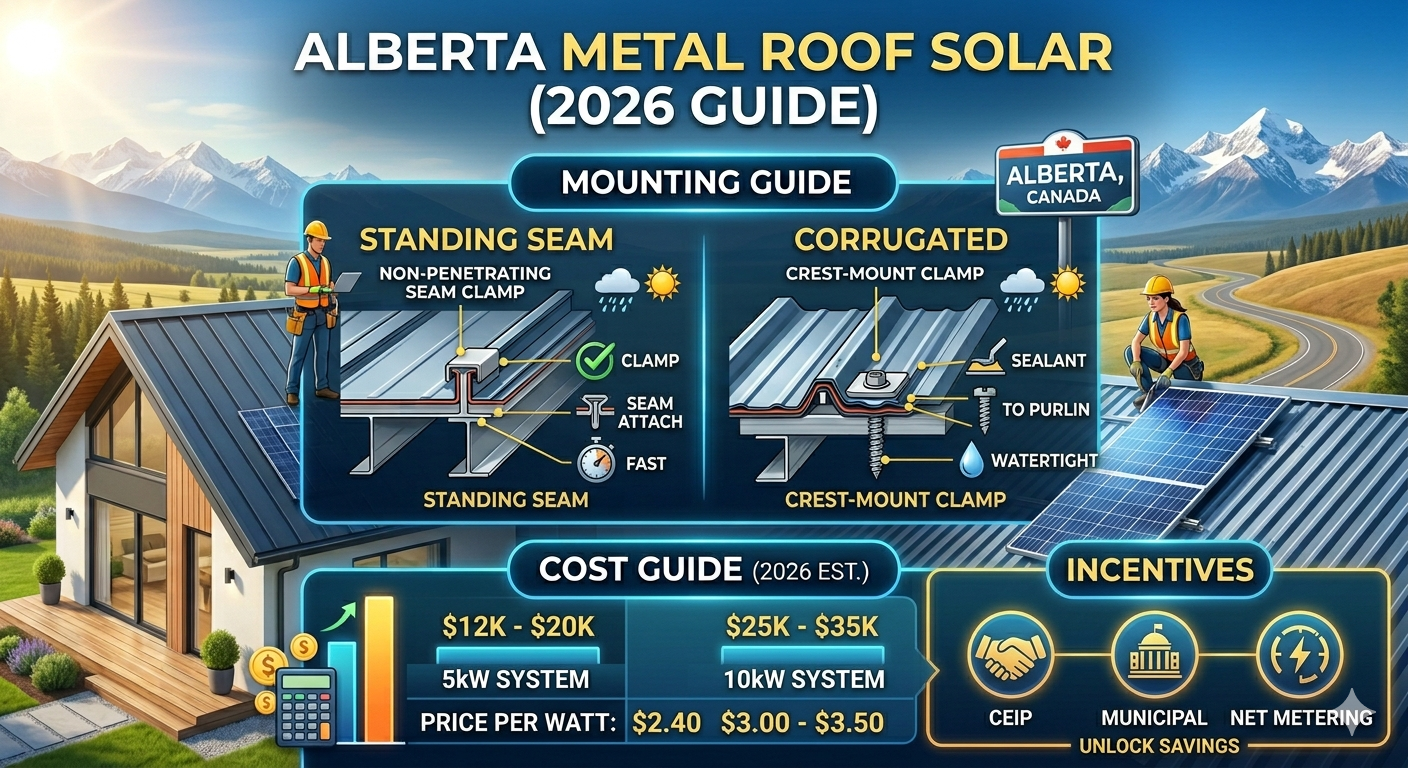
Asphalt shingle roofs are easiest and cheapest to work with. Metal roofs require specialized attachments. Tile, slate, or cedar roofs add complexity and cost. Roof pitch affects installation difficulty—steeper roofs cost more.
Snow load engineering:
New Brunswick's significant snow loads require robust racking systems engineered to handle winter weight. This adds cost compared to installations in milder climates.
Equipment quality:
Tier-1 panels from manufacturers like LG, Panasonic, Canadian Solar, or REC cost more but deliver better performance and warranties. Premium microinverters (Enphase, SolarEdge) cost more than standard string inverters but offer advantages like panel-level monitoring and shade tolerance.
System size:
Larger systems enjoy economies of scale with lower per-watt costs. Small systems (under 5 kW) cost proportionally more per watt.
Electrical panel upgrades:
Homes with older 100-amp or undersized electrical panels may require upgrades before solar installation, adding $1,500-$3,500 to project costs.
Permit fees:
Municipal permit fees vary but typically range $200-$800 depending on system size and jurisdiction.
Utility interconnection:
NB Power charges interconnection fees for net metering enrollment. These are typically modest but should be factored into total costs.
Solar Rebates and Incentives in New Brunswick
SaveEnergyNB Solar Program
The SaveEnergyNB solar rebate program offers New Brunswick homeowners up to $3,000 toward residential solar panel installations. This provincial incentive significantly reduces upfront costs and improves payback periods.
Eligibility requirements:
Property must be located in New Brunswick
System must be installed by a qualified electrical contractor
Minimum system size typically 1 kW, maximum around 25-30 kW for residential
Pre-approval required before installation begins
System must comply with Canadian Electrical Code
Rebate amount:
The standard rebate is $3,000 for qualifying residential solar installations. Some installers offer matching incentives, effectively doubling the savings.
Application process:
Contact a qualified solar installer
Installer submits pre-approval application to SaveEnergyNB on your behalf
Receive pre-approval confirmation
Complete installation
Submit final documentation including electrical inspection certificate
Receive rebate payment (typically 6-8 weeks after approval)
Always verify current program status and requirements directly with SaveEnergyNB, as program funding can be limited and may change annually.
Learn more about solar incentives across Canada
Federal Solar Incentives in Canada
While the Canada Greener Homes Grant ($5,000) and Interest-Free Loan (up to $40,000) closed in 2024-2025, other federal programs may become available. Check Natural Resources Canada (NRCan) regularly for new initiatives.
The federal government continues supporting renewable energy through tax incentives, research funding, and infrastructure programs, even as direct homeowner grants have ended.
Canada Greener Homes Loan (Closed)
The Canada Greener Homes Interest-Free Loan program provided up to $40,000 at 0% interest repayable over 10 years for energy efficiency retrofits including solar panels. This program closed to new applications in October 2025, with the final application deadline in January 2026.
Homeowners who received pre-approval before closure may still access funds if they complete projects by their deadline.
While this specific program ended, similar federal financing initiatives may launch in future budgets. Monitor NRCan announcements for new programs.
Net Metering in New Brunswick
Net metering in New Brunswick allows homeowners to send excess solar electricity to the grid in exchange for credits that offset future consumption. NB Power's net metering program operates as follows:
How it works:
During sunny periods when your panels produce more electricity than you consume, excess power flows to the grid
Your utility meter tracks both consumption and exports
Exports generate credits at your retail electricity rate
Credits accumulate on your account month-to-month
Banked credits offset consumption during low-production periods (nights, winter)
Program details:
Available to residential and commercial customers
Maximum system size limits apply (typically 100 kW for residential)
No monthly fees for participating in net metering
Credits roll over indefinitely
One-time interconnection fee required
System must meet Canadian Electrical Code and utility safety requirements
Financial benefits:
Net metering significantly improves solar economics by ensuring you receive full retail rate credit for every kilowatt-hour produced. Without net metering, excess production would be wasted or sold to utilities at wholesale rates (much lower than retail).
Understand how net metering works in other provinces like Alberta
Tax Credits & Financing Programs
While New Brunswick doesn't offer provincial solar tax credits, homeowners may access various financing programs:
Municipal property tax financing:
Some New Brunswick municipalities may offer property-assessed clean energy (PACE) financing programs. These allow homeowners to finance solar installations through property taxes, with repayment periods up to 20 years. Financing stays with the property if you sell.
Private financing:
Banks and credit unions offer green energy loans and home equity lines of credit (HELOC) that can fund solar installations at competitive interest rates.
Installer financing:
Many solar companies offer proprietary financing programs, including 0% interest options and Energy as a Service arrangements where monthly payments are designed to be lower than electricity bill savings.
Solar Financing Options in Canada
Cash Purchase
Paying cash upfront delivers the best lifetime return on investment by avoiding interest costs. Homeowners who can afford the $9,500-$32,000 net cost (after $3,000 SaveEnergyNB rebate) for typical residential systems maximize savings over the system's 25-30 year lifespan.
Cash purchases provide immediate ownership, full energy savings from day one, and eligibility for any available tax benefits. The main drawback is the significant initial capital requirement.
Solar Loans
Traditional solar loans from banks, credit unions, or specialized renewable energy lenders spread costs over 5-15 years at interest rates typically ranging 4-8% depending on creditworthiness and loan term.
Advantages:
Immediate system ownership
Predictable monthly payments
Full energy savings after loan repayment
No large upfront cash requirement
Considerations:
Interest adds to total system cost
Monthly payments may exceed solar savings initially
Credit requirements and approval process
Personal liability for loan regardless of system performance
0% Government Loans
While federal 0% interest loan programs have closed, some provincial or municipal financing may offer below-market or zero-interest terms for energy efficiency improvements including solar.
Property-assessed financing through municipal tax bills sometimes carries very low interest rates (3-5%) and long terms (15-20 years), creating effective monthly costs lower than electricity savings.
Lease vs Ownership
Solar leases and power purchase agreements (PPAs) are less common in Canada than the United States but some installers offer them. Under these arrangements:
Solar lease:
You pay fixed monthly fee to lease equipment
Installer owns and maintains the system
You receive electricity bill savings minus lease payment
Lease terms typically 20-25 years
You don't own the system
Power Purchase Agreement (PPA):
You pay for electricity produced at predetermined rate
Installer owns and maintains equipment
PPA rate typically lower than utility rate
Contract terms 20-25 years
You don't own the system
Ownership advantages:
Buying your system (cash or loan) provides better long-term economics, full control over the system, property value increases, and simpler home sales. Leases and PPAs complicate property transfers and reduce lifetime savings.
HELOC Financing
Home Equity Lines of Credit allow homeowners to borrow against home equity at variable interest rates typically 1-2% above prime rate. HELOCs offer flexibility—draw funds as needed and repay on your schedule.
HELOC advantages:
Lower interest rates than personal loans
Flexible repayment
Interest may be tax-deductible (consult tax professional)
Access to capital without selling investments
Considerations:
Home serves as collateral
Variable rates can change
Requires sufficient home equity
Approval and setup time required
Compare solar financing options across Canada
Solar Installation Process in New Brunswick
Initial Consultation
The solar journey begins with initial consultation where installers assess your property, review energy bills, discuss goals, and explain available options. Quality installers conduct thorough consultations either virtually (using satellite imagery and utility bills) or with on-site visits.
During consultation, discuss:
Current energy consumption and patterns
Electricity bills and rate structure
Roof age, condition, orientation, and pitch
Shading from trees or structures
Budget and financing preferences
Battery storage interest
Timeline expectations
Installers should ask detailed questions about your energy use, future plans (EVs, heat pumps, renovations), and financial goals before proposing system specifications.
Roof Inspection & Site Assessment
After initial consultation, installers conduct detailed site assessments including:
Physical roof inspection:
Structural integrity and load capacity
Shingle or roofing material condition
Roof penetration points for racking attachments
Attic ventilation and electrical pathways
Any repairs needed before installation
Solar potential analysis:
Roof orientation (south-facing optimal)
Roof pitch (typically 30-40° ideal for New Brunswick)
Shading analysis throughout the year
Available roof space for panel layout
Electrical service assessment (panel capacity, wire sizes, grounding)
Professional installers use tools like solar pathfinders, shade analysis software, and structural calculators to precisely model expected system performance and engineering requirements.
Engineering & System Design
After site assessment, engineers design the solar system to maximize production while meeting safety codes and structural requirements:
System specifications:
Panel selection (wattage, efficiency, warranty)
Inverter technology (microinverters vs string inverters)
System size (kW) based on consumption and roof space
Racking and mounting design engineered for New Brunswick snow loads
Electrical design (wire sizing, disconnect placement, breaker integration)
Engineers create detailed electrical diagrams and structural plans required for permit applications. These documents ensure installations comply with Canadian Electrical Code, National Building Code, and local ordinances.
Permit Approval Process
Before installation begins, permits must be obtained from local municipal authorities. Your installer typically handles this process:
Required permits:
Building permit (structural roof attachments)
Electrical permit (grid-tied electrical work)
Development permit (if required by municipality)
Permit application includes:
System design drawings
Electrical single-line diagrams
Structural calculations for roof loads
Equipment specifications and certifications
Site plans showing panel locations
Permit approval timelines vary by municipality, ranging from 1-4 weeks typically. During this period, you're often locked into your system design and equipment selection.
Utility Interconnection
Simultaneous with permitting, your installer applies to NB Power for net metering enrollment and interconnection approval. This process includes:
Interconnection application:
System specifications and expected production
Electrical design showing grid connection point
Inverter certifications (UL 1741, CSA standards)
Homeowner information and property details
Utility review:
NB Power engineers review application
Assess grid capacity and safety requirements
Approve connection or request modifications
Issue interconnection agreement
Interconnection approval typically takes 2-6 weeks. Some utilities require upgraded metering equipment (bidirectional smart meters) installed before system activation.
Solar Panel Installation
Once permits are approved, installation begins. Professional crews complete most residential installations in 1-3 days depending on system size and complexity.
Installation steps:
Racking installation: Attach mounting rails to roof using flashed penetrations that maintain water-tightness
Panel placement: Lift panels to roof and secure to racking system
Electrical wiring: Connect panels to inverters, run conduit to electrical panel
Inverter installation: Mount inverters (typically in garage or utility room) and wire to electrical panel
System integration: Connect solar system to home electrical panel via dedicated breaker
Monitoring setup: Install production monitors and connect to internet gateway
Quality installers protect your property during installation, clean up thoroughly, and leave your property exactly as found except for the new solar system.
Inspection & Activation
Before you can start using solar power, installations must pass inspections:
Electrical inspection:
Municipal or provincial electrical inspector reviews installation
Verifies code compliance, grounding, labeling, disconnects
Checks workmanship quality
Issues electrical approval certificate
Utility inspection (if required):
Some utilities conduct additional inspections
Verify meter installation and system interconnection
Approve energization
After passing inspections, NB Power authorizes system activation. Your installer schedules activation, typically involving:
Energizing the system
Testing production and monitoring
Demonstrating monitoring tools
Explaining operation and maintenance
Answering final questions
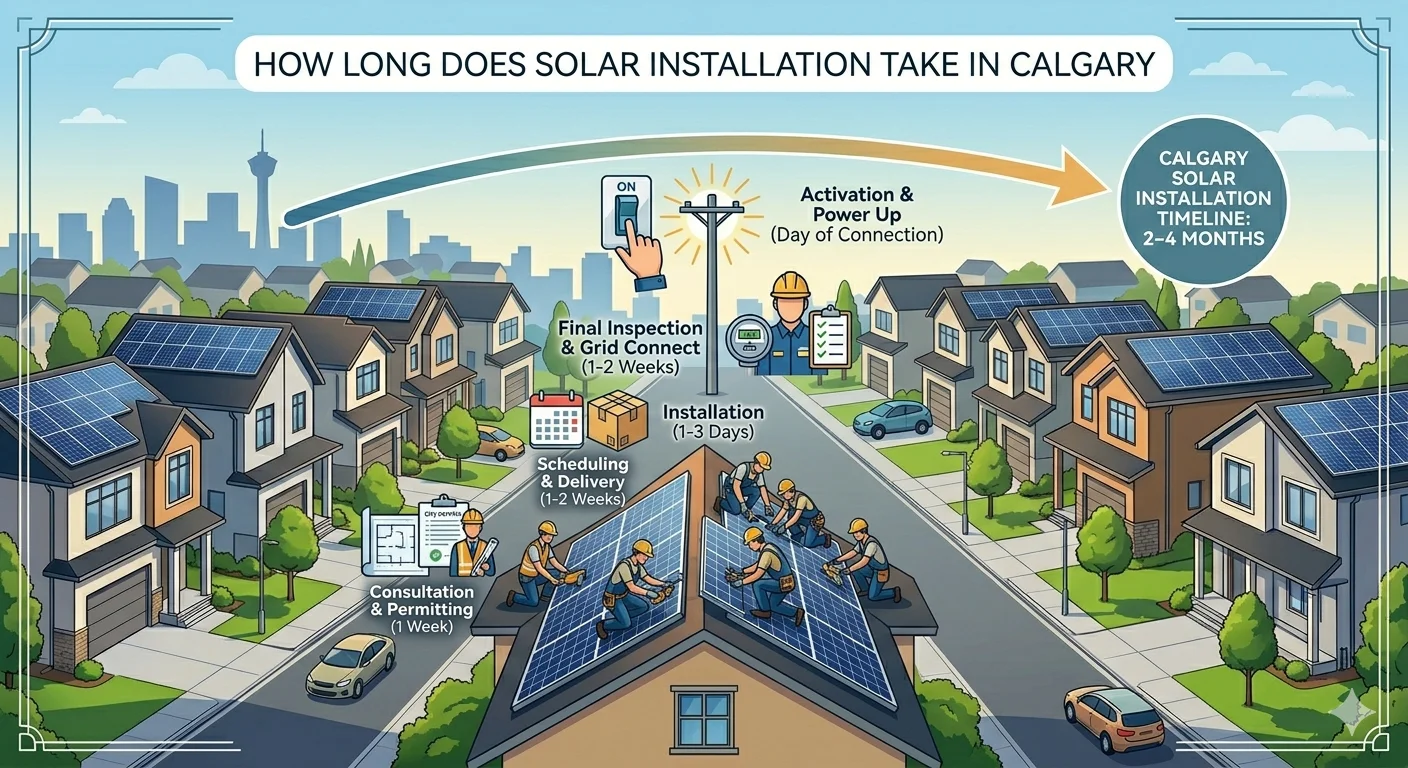
From signing the contract to system activation, expect 2-5 months typically, with permit and utility approval being the longest wait periods.
How Long Does It Take to Install Solar Panels?
The complete solar installation timeline includes several phases:
Design and permitting (4-8 weeks):
Initial consultation: 1-2 days
Site assessment and system design: 1-2 weeks
Permit application and approval: 2-4 weeks
Utility interconnection approval: 2-6 weeks (often overlaps with permits)
Installation (1-3 days):
Racking and mounting: 4-8 hours
Panel installation: 4-8 hours
Electrical wiring and inverter: 4-8 hours
System testing and cleanup: 2-4 hours
Most residential systems install in 1-2 days of active work, though complex roofs or large systems may require 3 days.
Inspection and activation (1-3 weeks):
Schedule electrical inspection: 3-7 days
Pass inspection: Same day (if no issues)
Utility approval and activation: 3-10 days
Total timeline: 2-5 months typical
Delays occasionally extend timelines:
Permit backlogs: Busy municipalities may have 4-6 week permit waits
Utility processing: Grid capacity studies or application backlogs can add weeks
Weather delays: Winter installations may face schedule changes due to snow or extreme cold
Equipment delays: Supply chain issues can push installation dates
Seasonal considerations:
Summer and fall are busiest seasons for solar installations, leading to longer wait times but optimal installation conditions. Winter installations are possible but may face weather delays. Spring offers good balance of availability and weather.
Discuss realistic timelines with your installer during initial consultation. Quality companies provide project schedules with expected milestone dates.
Learn more about typical Canadian solar installation timelines
Best Solar Panels for Canadian Weather
Monocrystalline vs Polycrystalline
Monocrystalline panels feature cells cut from single silicon crystals, offering several advantages:
Higher efficiency (18-22%+ typical)
Better performance in low light and high temperatures
More compact (fewer panels needed for same output)
Longer lifespans and warranties (25-30 years typical)
More expensive per panel
Polycrystalline panels use cells made from melted and recrystallized silicon:
Lower efficiency (15-17% typical)
Slightly reduced performance in extreme conditions
Larger area needed for same output
More affordable
Still provide 25-year warranties
For New Brunswick installations, monocrystalline panels are generally recommended. Higher efficiency means better production from limited roof space, and superior low-light performance helps during shorter winter days.
Snow & Cold Weather Performance
Solar panels actually perform better in cold weather. Solar cell efficiency increases as temperature drops—panels produce more electricity at 0°C than at 25°C.
Winter considerations:
Snow accumulation: Tilted panels naturally shed snow, especially with smooth glass surfaces and heat from sun exposure melting snow layers
Snow reflection: Fresh snow reflects sunlight, creating albedo effect that can boost production on clear winter days
Shorter days: Winter daylight hours are significantly less than summer, reducing total daily production
Lower sun angle: Winter sun sits lower in sky, reducing intensity but also making south-facing tilted panels more effective
Snow management:
New Brunswick's average snowfall requires panels to be mounted at appropriate tilt angles (typically 35-45°) that encourage natural snow shedding. Racking systems must handle significant snow loads per building codes.
Most solar systems in New Brunswick continue producing through winter, just at reduced levels compared to long summer days. Annual production calculations account for seasonal variations.
Best Tier-1 Solar Brands
Tier-1 manufacturers have established track records, strong warranties, and proven reliability. Top brands for Canadian climates include:
Canadian Solar:
Canadian company with strong North American presence
Excellent cold weather performance
25-30 year warranties
Competitive pricing
LG Solar (discontinued 2022, existing warranties honored):
Premium efficiency panels (up to 22%)
Excellent warranties and customer service
Strong performance in diverse conditions
REC Solar:
Norwegian company specializing in northern climate performance
Twin peak technology for better low-light production
25-year warranties
Panasonic (Sanyo HIT technology):
Excellent temperature coefficients (better hot and cold performance)
High efficiency ratings
Premium pricing
Trina Solar:
Tier-1 manufacturer with long track record
Good balance of performance and cost
Strong warranties
Jinko Solar:
World's largest panel manufacturer
Proven reliability
Competitive pricing
Q CELLS:
German-engineered, Korean-manufactured
Excellent low-light performance
Strong warranties
Choose panels based on efficiency needs, budget, and warranty terms rather than brand alone. Reputable installers work with multiple manufacturers and recommend appropriate equipment for your specific situation.
Microinverters vs String Inverters
String inverters:
Single unit connects series of panels
Lower upfront cost
Panel performance linked (one shaded panel reduces string output)
Typically 10-12 year warranties (though premium models offer longer)
Easier to replace if failure occurs
Good for unshaded roofs with consistent orientation
Microinverters:
Individual inverter attached to each panel
Higher upfront cost
Panel-level optimization (shade on one panel doesn't affect others)
25-year warranties standard
Panel-level monitoring shows individual performance
Better for complex roofs, shading, or multiple orientations
More reliable (single microinverter failure doesn't shut down entire system)
Power optimizers (hybrid approach):
Panel-level optimization with central inverter
Balance of cost and performance
Good warranties (typically 25 years on optimizers)
Panel-level monitoring capability
For New Brunswick installations, microinverters are increasingly popular due to 25-year warranties matching panel lifespans, superior performance in partial shade, and panel-level monitoring that helps identify issues quickly.
Solar Batteries for Backup Power
Battery storage transforms solar from a grid-tied system to a reliable backup power source during outages. While not economically necessary for most installations (net metering handles energy timing), batteries provide:
Energy security:
Power during grid outages
Critical load coverage (refrigeration, heating, medical equipment)
Independence from utility reliability issues
Popular battery systems:
Tesla Powerwall 2: 13.5 kWh capacity, integrated inverter, proven track record
Enphase IQ Battery: Modular 3.3 kWh units, scales up to 40 kWh+, integrates with Enphase microinverters
LG Chem RESU: 9.8 kWh capacity, compact design, good cold weather performance
Generac PWRcell: Modular 3 kWh units up to 18 kWh, integrates with Generac home generators
Battery considerations:
Add $10,000-$20,000 to system cost
Extend payback periods
Limited discharge cycles (typically 10-15 years before replacement)
Require maintenance and eventual replacement
Best value for homes with unreliable grid or critical power needs
For most New Brunswick homes with reliable NB Power service, batteries are luxury upgrades rather than economic necessities. They make sense for rural properties with frequent outages or homeowners requiring guaranteed backup power.
Solar Battery Storage in New Brunswick
Are Solar Batteries Worth It?
Battery economics depend on your specific situation:
When batteries make sense:
Frequent or prolonged grid outages in your area
Medical equipment requiring uninterrupted power
Critical business operations in home office
Off-grid or rural locations with poor grid reliability
Desire for complete energy independence
Areas with time-of-use (TOU) electricity rates (less relevant in NB)
When batteries may not be worth it:
Reliable grid with rare outages
Standard net metering available (banks excess production)
Budget constraints
Focused on fastest payback period
Most New Brunswick homeowners prioritize solar panels first, adding batteries later if needs change or costs decline further.
Backup Power During Outages
Standard grid-tied solar without batteries doesn't provide backup power. When the grid fails, your solar system shuts down for safety (prevents back-feeding electricity to grid while utility workers make repairs).
Battery-backed systems include:
Critical load panels:
Separate panel powers essential circuits during outages
Refrigerator, furnace, lights, internet, medical equipment
Battery capacity chosen based on critical load requirements
Extends battery runtime by not powering unnecessary loads
Whole-home backup:
Battery backs up entire electrical panel
Requires larger battery capacity
More expensive but provides complete coverage
Battery depletes faster during outages
Proper battery sizing considers:
Essential load calculations (watts)
Desired backup duration (hours or days)
Solar recharging capability during outages
Budget constraints
Best Home Battery Brands
Leading battery manufacturers for Canadian installations:
Tesla Energy:
Powerwall 2: 13.5 kWh, proven reliability, 10-year warranty
Strong software integration and monitoring
Nationwide service network
Enphase Energy:
IQ Battery: Modular design, easy expansion
Integrates seamlessly with Enphase microinverters
10-year warranty, excellent monitoring
LG Chem:
RESU series: Various capacities (6.5-16 kWh)
Compact wall-mounted design
Good cold weather performance
10-year warranty
Generac:
PWRcell: Modular 3 kWh units
Integrates with Generac generators
10-year warranty
Battery Costs & Lifespan
Typical battery costs (installed):
10 kWh system: $10,000-$13,000
13.5 kWh system: $12,000-$16,000
20 kWh system: $18,000-$24,000
Lifespan considerations:
Most batteries rated for 4,000-6,000 discharge cycles
Daily cycling: 10-15 year lifespan expected
Backup-only use: Longer lifespan (15-20+ years potential)
Capacity degrades over time (typically 60-80% capacity after warranty period)
Warranty periods: 10 years standard
Battery replacement costs will decrease as technology improves, but budget for eventual replacement when planning long-term solar economics.
Future of Energy Storage in Canada
Battery technology continues improving rapidly:
Cost declines:
Battery costs have dropped 80%+ over past decade
Further reductions expected as manufacturing scales
Technology improvements:
Higher energy density (more storage in smaller spaces)
Longer cycle lives
Better cold weather performance
Faster charging capabilities
Policy developments:
Provincial incentives for battery storage may emerge
Virtual power plant programs could provide battery revenue streams
Time-of-use rates may make batteries more economically attractive
Vehicle-to-home (V2H):
Electric vehicles with bidirectional charging can act as mobile batteries
Potential to power homes during outages using EV battery capacity
Technology still emerging but promising for future
As battery costs decline and technology matures, energy storage will become increasingly common in Canadian solar installations.
Learn more about solar battery backup during power outages