For most Alberta homeowners with moderate electricity consumption and a south-facing roof, solar is one of the strongest home investments available in 2026. The typical payback period falls between 7 and 10 years for residential systems. Commercial solar installations with federal tax incentives can pay back in as little as 5 years. After the system covers its cost, it keeps producing near-free electricity for another 15 to 20 years.
Alberta's Solar Club high export rate of 35 cents per kWh is among the best in Canada. Combined with over 2,300 annual sunlight hours and the Clean Energy Improvement Program (CEIP) offering up to 100 percent financing, the province creates a uniquely favourable environment for solar adoption.
But solar is not the right choice for every home. This guide breaks down updated 2026 costs, real savings scenarios, financing programs, and the specific conditions where solar panels in Alberta deliver the best returns. It also covers when homeowners should wait.
How Much Sunlight Does Alberta Actually Get for Solar Energy?
A common myth is that Alberta's climate is too harsh for solar. The data tells a different story. Alberta receives over 2,300 hours of sunshine per year, ranking it among the top three provinces in Canada for solar energy production. The prairie provinces (Alberta, Saskatchewan, and Manitoba) consistently outperform Ontario and British Columbia for solar output.
Calgary averages 4.1 peak sun hours per day, which is comparable to parts of the U.S. Sun Belt. Medicine Hat, Brooks, and Lethbridge rank even higher, producing 1,330 to 1,368 kWh per kWp per year. Even Edmonton performs well at approximately 1,258 kWh per kWp annually.
The average solar power system in Alberta produces approximately 1,276 kWh per kW per year. That figure is higher than most of Ontario, all of Atlantic Canada, and all of British Columbia.
Do Solar Panels Work in Alberta's Cold Winters?
Yes. Cold temperatures actually improve solar panel efficiency. Photovoltaic (PV) cells generate more voltage in cooler conditions than in extreme heat. Winter brings fewer daylight hours, but the bright Alberta sun and clear skies compensate. Snow causes only a 2 to 4 percent annual production loss according to recent studies. Snow slides off tilted panels naturally.
Hailstorms are a concern in Alberta, particularly in Calgary and central Alberta. Modern panels are tested to IEC 61215 standards with tempered glass rated to withstand hail up to 25mm at high velocity. Common panel brands installed in Alberta include LONGi, Canadian Solar, JA Solar, and Thornova. All are designed for Canadian winter conditions and are hail-rated.
How Do Solar Panels Save Money in Alberta?
Solar panels generate financial returns through two streams. Understanding both is essential before making a decision.
Direct Self-Consumption Savings
Every kilowatt-hour (kWh) produced and consumed on-site is a kWh not purchased from the grid. At Alberta's current average all-in electricity rate of approximately 16 cents per kWh, this is the most dependable source of savings. Most homes without battery storage achieve a self-consumption ratio of 30 to 50 percent. The rest flows to the grid.
Export Credits Through Alberta's Micro-Generation Program
Surplus energy exported to the grid earns micro-generation credits. Alberta uses a net billing model, not traditional net metering. This is an important distinction. Under net billing, homeowners earn credits at the agreed rate with their electricity retailer, not a fixed government rate.
The most favourable option currently available is the Solar Club program. As of March 2026, Solar Club offers a high export rate of 35 cents per kWh during summer months and a low import rate of 8.40 cents per kWh during winter. This buy-low, sell-high approach maximizes returns. Members typically switch to the high rate in March and return to the low rate in October, aligning with Alberta's solar production patterns.
Outside Solar Club, some retailers offer export rates of 30 to 33 cents per kWh for micro-generators. The Rate of Last Resort (ROLR), which replaced the Regulated Rate Option in January 2025, sits at approximately 12 cents per kWh. Homeowners on variable or standard plans receive lower export credits. The retailer and plan selection directly impacts the payback period. More details on how net billing works in each province are available on the Canada Solar Pro FAQ page.
What Happens After the System Pays for Itself?
After payback, the system continues producing electricity for another 15 to 20 years with minimal maintenance. Solar panel degradation runs at 0.3 to 0.5 percent per year. At year 25, panels still operate at 80 to 87 percent of original capacity. Most manufacturers guarantee at least 80 percent efficiency at the 25-year mark, with many systems exceeding warranty expectations.
Over a 25-year system life, a typical 10 kW system in Alberta produces $70,000 to $90,000 in total electricity value on an initial investment of $20,000 to $28,000. Even accounting for degradation, the long-term return is substantial.
What Does a Solar System Cost in Alberta in 2026?
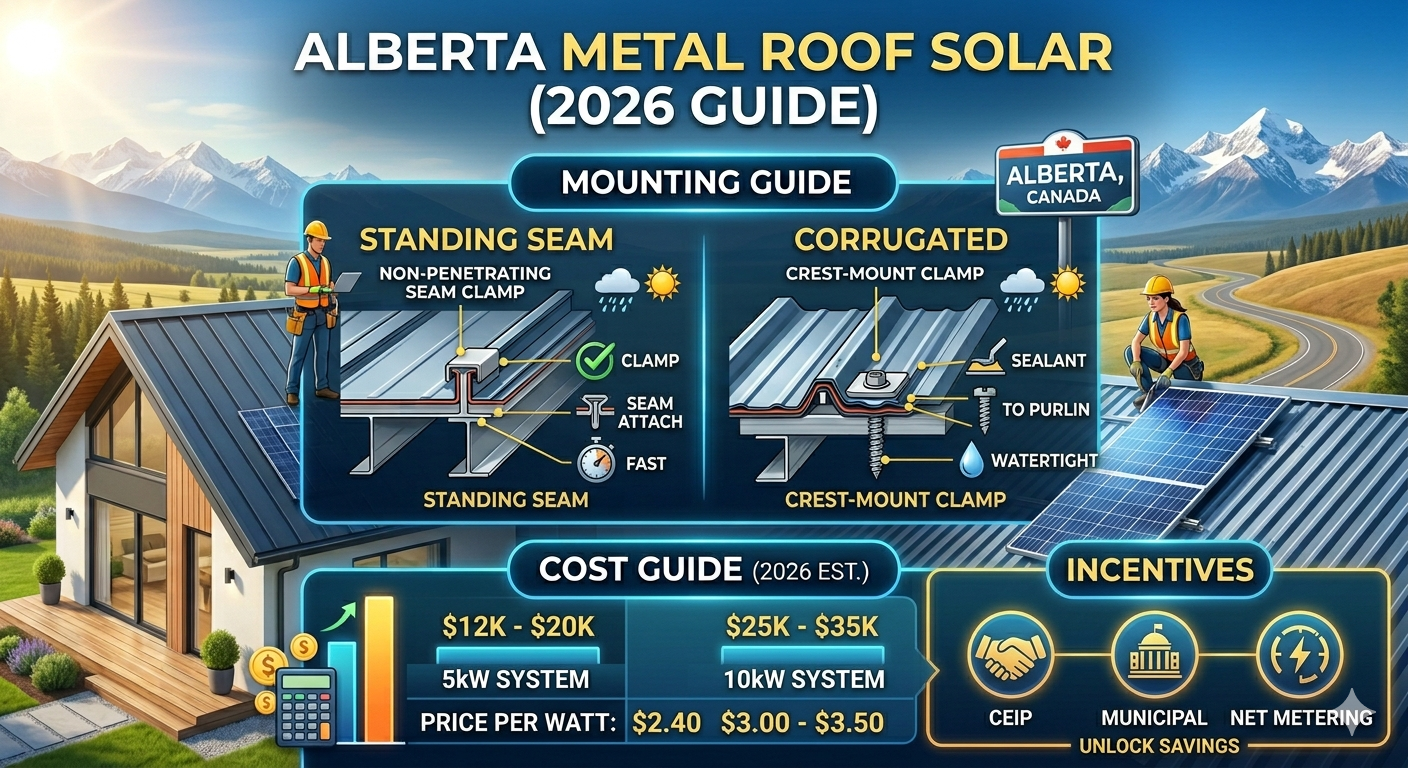
The current benchmark for solar panel installation cost in Alberta ranges from $2.50 to $3.50 per watt installed. Some Edmonton-area installers report tighter ranges of $2.80 to
System Size | Number of Panels | Cost Range | Best For |
5-6 kW | 10-12 panels | $12,500 - $18,000 | Low consumption homes |
8-10 kW | 16-22 panels | $20,000 - $28,000 | Average Alberta home |
12-15 kW | 24-30 panels | $28,000 - $38,000 | High consumption / EV owners |
$3.10 per watt based on 500+ installations. Here is what typical systems cost before financing or incentives.These prices include solar panels, inverter (string or microinverter), racking, electrical work, permits, and utility interconnection. Costs vary based on roof complexity, panel tier (monocrystalline vs bifacial), and whether the electrical panel needs an upgrade. Older homes with panels under 200A may require an upgrade costing $1,500 to $3,000 before solar can be connected.
Costs vary significantly between installers. The most reliable approach is to compare multiple quotes. Canada Solar Pro allows homeowners to request 3 to 5 free quotes from independent Alberta installers within 24 hours. Comparing pricing, equipment, and warranties side by side helps homeowners avoid overpaying.
Government Rebates, Incentives, and Financing in Alberta (2026 Update)
The Alberta solar incentive landscape has changed significantly. Several older programs have closed. Here is the current status as of spring 2026.
Program | Details | Status (2026) |
CEIP (Clean Energy Improvement Program) | Up to 100% financing via property tax, up to $50K residential / $1M commercial, 3-5.75% interest, 20-year terms | ACTIVE - 29+ municipalities |
Solar Club (export rate program) | High export rate 35¢/kWh summer, low import 8.40¢/kWh winter | ACTIVE |
Municipal rebates (Banff, Canmore, etc.) | Banff: $450/kW residential, $750/kW commercial. Others vary. | ACTIVE (varies by municipality) |
Edmonton HERA / Solar Rebate | Residential solar rebate program | FULLY SUBSCRIBED (closed) |
Canada Greener Homes Grant | Up to $5,000 federal grant | CLOSED (Feb 2024) |
Greener Homes Loan | Federal interest-free loan | CLOSED (Oct 2025) |
CGHAP (Canada Greener Homes Affordability Program) | $800M for low-to-median income households, includes solar | LAUNCHING 2025-26 |
The CEIP program is the most impactful option available. It eliminates upfront costs entirely. The financing stays attached to the property, not the homeowner. If the home is sold, the new owner inherits both the payments and the reduced electricity costs. Interest rates vary by municipality. Grande Prairie offers 3 percent. Beaumont and Spruce Grove offer 3.5 percent. Calgary sits at 5.66 to 5.75 percent. Sturgeon County offers 4.7 percent.
Tracking which programs are open, closed, or fully subscribed can be difficult. Canada Solar Pro maintains a real-time incentive tracker covering every active Alberta program.
Solar Payback Period in Alberta With Real 2026 Numbers
Residential Payback Scenario for a Typical Calgary Home
Here is a realistic scenario based on current 2026 rates and average production data for a Calgary homeowner using the Solar Club program.
Parameter | Value |
System Size | 10 kW (approximately 20-22 panels) |
Installed Cost | $25,000 (before CEIP financing) |
Annual Production | 12,760 kWh (based on 1,276 kWh/kW Alberta avg) |
Self-Consumption (40%) | 5,104 kWh at $0.16/kWh = $816/year |
Export (60%) at Solar Club rate | 7,656 kWh at $0.35/kWh = $2,680/year |
Total Annual Savings | $3,496/year |
Simple Payback | 7.2 years |
This scenario assumes Solar Club membership with the high export rate. Homeowners on standard variable or ROLR plans would see lower export revenue and longer payback. The choice of electricity retailer directly impacts returns.
How Different Export Rates Affect Payback
Alberta's deregulated electricity market means export rates can change. Here is how different rates affect the payback on the same 10 kW, $25,000 system.
Export Rate | Annual Export Revenue | Total Annual Savings | Payback Period |
$0.12/kWh (ROLR) | $919 | $1,735 | 14.4 years |
$0.20/kWh | $1,531 | $2,347 | 10.7 years |
$0.25/kWh | $1,914 | $2,730 | 9.2 years |
$0.33/kWh | $2,526 | $3,342 | 7.5 years |
$0.35/kWh (Solar Club) | $2,680 | $3,496 | 7.2 years |
Even at the baseline ROLR rate of 12 cents, the system pays back in under 15 years and still produces $43,000+ in value over 25 years. At Solar Club rates, the economics are dramatically stronger. Choosing the right retailer is as important as choosing the right installer.
Full 25-Year ROI Calculation
A $25,000 system producing $3,496 per year generates approximately $87,400 over 25 years (before accounting for degradation). Adjusted for 0.4 percent annual degradation, the realistic lifetime value is approximately $80,000 to $85,000. Using the standard ROI formula, that represents a total return of 220 to 240 percent, or an annualized return of 7 to 9 percent. This competes with long-term equity market averages, with significantly lower risk and volatility.
Pros and Cons of Solar Panels in Alberta
Every investment has trade-offs. Here is an honest breakdown of the advantages and challenges.
Pros | Cons |
Strong financial return: 7-10 year payback, $70K-$90K lifetime value on a $25K investment | High upfront cost: $12,500-$38,000 before financing, though CEIP can eliminate this barrier |
Alberta's high export rates (up to 35¢/kWh via Solar Club) are among the best in Canada | Export rate volatility: rates can change in Alberta's deregulated market, affecting returns |
2,300+ annual sunlight hours, ranking Alberta in the top 3 provinces for solar production | Delivery charges remain: solar reduces energy charges but homeowners still pay fixed delivery, transmission, and admin fees (roughly 60% of the bill) |
CEIP financing covers up to 100% with no money down, attached to property tax | Long-term commitment: full ROI requires staying in the home for 7-15 years |
Home value increase of 4-5% at resale, faster sale timelines | Roof requirements: older or north-facing roofs may not be suitable without costly modifications |
Cold weather improves panel efficiency, snow impact only 2-4% annual loss | Hail risk in central Alberta may require upgraded hail-rated panels, slightly increasing cost |
Panels last 25-30 years with manufacturer warranties guaranteeing 80% efficiency at year 25 | Federal grants (Greener Homes) are now closed, reducing the incentive stack compared to 2023-2024 |
Hedge against rising electricity prices (3-5% annual increases historically) | Insurance premiums may increase slightly as solar raises the home's replacement cost |
When Does Solar Make Strong Financial Sense in Alberta?
Solar delivers the strongest returns when certain conditions align.
• Monthly consumption above 700 kWh. Higher consumption means more savings from self-produced power. Homes with electric heating, hot tubs, or pool pumps benefit the most.
• South, southwest, or southeast-facing roof with minimal shading and adequate size for 16 to 30 panels. A roof pitch of 15 to 45 degrees is optimal.
• Long-term ownership plan of 10 or more years. This captures full payback plus years of free electricity production.
• Planned electric vehicle purchase. An EV adds 3,000 to 5,000 kWh per year in consumption. Solar offsets that increased demand at a fixed cost, protecting against rising fuel and electricity prices.
• Rising electricity cost concern. Alberta electricity prices have risen 3 to 5 percent annually on average due to carbon pricing, transmission upgrades, and growing demand from data centres and electrification. Solar locks in a fixed production cost.
• CEIP availability in the municipality. Homeowners in CEIP-participating municipalities can go solar with zero money down, making the decision significantly easier.
When Should Homeowners Wait or Skip Solar?
Solar is not the right choice for every property. Here are situations where waiting is the smarter move.
• Roof needs replacement within 5 years. Removing and reinstalling panels adds $2,000 to $4,000. Replace the roof first, then install solar on the new surface.
• Heavy persistent shading. Large trees or tall adjacent buildings blocking the roof for most of the day reduce output significantly. Partial shading can be managed with microinverters, but full shade makes solar impractical.
• Very low consumption below 400 kWh per month. The savings may not justify the investment unless the homeowner plans to add an EV or electrify heating.
• Selling within 3 to 5 years. The homeowner may not recoup the full investment. Solar adds resale value, but the premium rarely equals the full system cost in such a short window.
• North-facing roof only. North-facing panels in Alberta produce 30 to 40 percent less than south-facing. Ground-mounted systems are an alternative but cost more due to trenching and racking.
• Electrical panel under 200 amps. An upgrade ($1,500 to $3,000) may be needed. This adds to the total investment and should be factored into the payback calculation.
Does Solar Increase Home Value in Alberta?
Research across North American real estate markets shows that solar-equipped homes sell faster and for a 4 to 5 percent premium. A home valued at $500,000 could see a $20,000 to $25,000 increase in resale value with a well-documented solar installation.
Alberta buyers in 2026 increasingly weigh operating costs. A system with a documented production history through a monitoring dashboard becomes a verifiable financial asset during sale negotiations. Real estate agents increasingly list solar as a feature. It signals lower ongoing electricity costs and energy independence.
How to Find the Right Solar Installer in Alberta
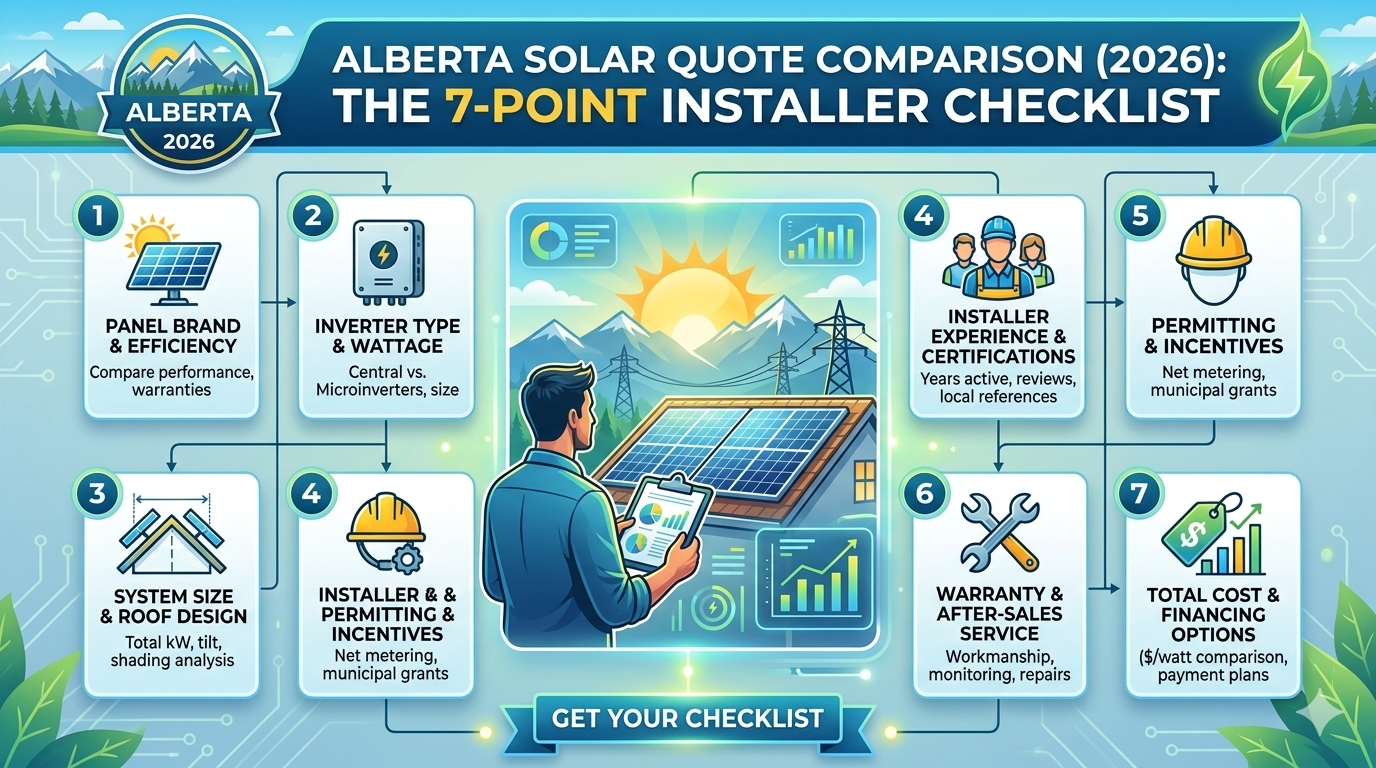
The installer impacts the system's performance for 25 years. The Alberta solar market has hundreds of companies, and pricing, warranties, and workmanship quality vary significantly. Here is what to evaluate.
• Licensed electrical contractor verified with the Alberta government. This is a legal requirement for solar installation in the province.
• NABCEP certification or equivalent industry credentials demonstrating specialized solar training.
• Clear warranty structure with three separate components: workmanship warranty (installer), panel warranty (manufacturer, typically 25-30 years), and inverter warranty (typically 12-25 years).
• Portfolio of completed Alberta installations with verifiable references and production data.
• Experience handling micro-generation applications with Alberta distributors like ENMAX, EPCOR, or FortisAlberta.
• Post-install monitoring setup. Every quality installation includes a real-time monitoring dashboard to track system performance.
Getting a single quote provides no basis for comparison. The industry best practice is to compare at least 3 quotes.
Canada Solar Pro was built to solve this. As a free, unbiased solar installer comparison platform, it matches Alberta homeowners with 3 to 5 independent local installers within 24 hours. Homeowners compare pricing, warranties, equipment, and credentials side by side. There is no obligation and no cost. The platform has helped over 10,000 Canadian homeowners find the right installer since 2019. Learn how the matching process works.
What Homeowners Are Saying About Going Solar Through Canada Solar Pro
The strongest signal comes from homeowners who have already made the switch. Here is what verified homeowners shared on Trustpilot.
★★★★★ Alexandra Y. | Calgary, AB
"Way smoother than I expected. From first call to install was just under 3 weeks. Daniel handled everything and kept me in the loop. Install got pushed a couple days due to weather, but overall solid experience."
★★★★★ Haley & Neal A. | Toronto, ON
"I was skeptical about whether solar would actually lower my bill. Jason broke it down clearly with real numbers. I was around $220/month and now I am closer to $70. Took about 3 weeks total."
★★★★★ Betty S. | Halifax, NS
"Spoke to a couple companies before this and most felt pushy. These guys were straightforward. Chris showed me best and worst-case scenarios, which I appreciated."
★★★★★ Jaskirat S. | Winnipeg, MB
"I had been putting this off for a while because I did not trust the process. Once they explained everything step by step, it made sense. Communication was consistent throughout."
Rated 4.9 on Trustpilot from verified homeowners across Canada. Read all reviews on Trustpilot.
Should Homeowners Add Battery Storage With Solar in Alberta?
Battery storage adds backup power and potential rate arbitrage, but the economics are different from solar alone. A Tesla Powerwall or Enphase IQ battery adds $12,000 to $18,000 to the total system cost. This extends the overall payback period by 5 to 8 years.
Batteries make sense in specific situations. Homes that prioritize backup power during grid outages get real value from storage. If Alberta introduces time-of-use (TOU) rates in the future, battery owners could store cheap off-peak energy and discharge during expensive peak hours.
For most Alberta homeowners in 2026, solar alone delivers the strongest financial return. Battery costs continue declining 10 to 15 percent per year. The math is expected to shift in favour of storage within the next 3 to 5 years.
Financing Options for Solar in Alberta
Not every homeowner wants to pay $20,000 to $30,000 upfront. Several solar financing options are available in Alberta.
• Cash purchase. Highest long-term return. The homeowner owns the system outright and captures all savings immediately. Some installers offer 10 percent cash discounts.
• Solar loan (Financeit or similar). Zero down, from 6.99 percent interest. Monthly payments of $150 to $190 for a standard system. Often less than the electricity bill the system replaces, making homeowners cash-flow positive from month one. Terms up to 20 years with no prepayment penalties.
• CEIP (property-tax financing). Available in 29+ Alberta municipalities. Covers up to 100 percent of costs. Interest rates range from 3 percent (Grande Prairie) to 5.75 percent (Calgary). Terms up to 20-25 years. Financing stays with the property, not the owner.
• Mortgage roll-in. Adding solar to the mortgage at renewal provides the lowest interest rate (typically 4 to 5 percent). This results in the lowest total interest cost over the life of the financing.
Not sure which financing programs are available? Canada Solar Pro includes a free financing eligibility check as part of the quote process. No credit check is required.
Important: Solar Does Not Eliminate the Entire Electricity Bill
One common misconception needs addressing. Solar panels reduce or eliminate energy charges, which represent only about 40 percent of a typical Alberta electricity bill. The remaining 60 percent consists of fixed delivery charges, transmission charges, distribution fees, and administrative fees. These charges apply as long as the home remains connected to the grid, regardless of how much solar energy is produced.
A well-sized system can reduce the total bill by 50 to 80 percent, but it will not bring the bill to zero in most cases. Understanding this upfront prevents unrealistic expectations.
Key Takeaways
• Alberta ranks in the top 3 provinces for solar production with 2,300+ annual sunlight hours and 1,276 kWh/kW average annual output.
• Typical residential payback is 7 to 10 years with Solar Club rates. Even at baseline ROLR rates, payback stays under 15 years.
• The Solar Club high export rate of 35 cents per kWh is among the best in Canada. Retailer selection significantly impacts returns.
• CEIP financing eliminates upfront costs in 29+ Alberta municipalities with 3 to 5.75 percent interest rates.
• After payback, homeowners benefit from 15 to 20 years of near-free electricity. Lifetime value: $70,000 to $90,000.
• Solar adds 4 to 5 percent to home resale value and homes sell faster.
• Solar does not eliminate the full bill. Delivery charges (60% of the bill) remain.
• Always compare multiple quotes. Get free Alberta solar quotes through Canada Solar Pro.
Ready to See What Solar Saves in Alberta?
Homeowners can get matched with independent local installers, compare 3 to 5 quotes side by side, and see estimated savings. Free, no obligation, 60-second estimate.
Get a Free Alberta Solar Quote